

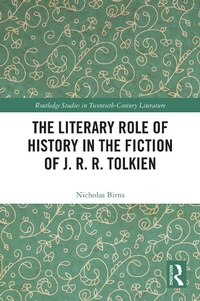
The Literary Role of History in the Fiction of J. R. R. Tolkien
1st Edition
Published on 22. December 2023
228 pages
978-1-003-82218-9 (ISBN)
Description

This volume analyzes the literary role played by history in the works of J. R. R. Tolkien. It argues that the events of The Lord of the Rings are placed against the background of an already- existing history, both in reality and in the fictional worlds of the books.
History is unfolded in various ways, both in explicitly archival annals and in stories told by characters on the road or on the fly, and in which different visions of history emerge. In addition, the history within the work can resemble, or be patterned on, histories in our world. These histories range from the deep past of prehistoric and ancient worlds to the early medieval era of the barbarian invasions and Byzantium, to the modern worlds of urbane civility and a paradoxical longing for nature, and finally to great power rivalries and global prospects. The book argues that Tolkien did not employ these histories indiscriminately or reductively. Rather, he regarded them as aspects of aesthetic and representative figuration that are above all literary.
While most criticism has concentrated on Tolkien's use of historical traditions of Northern Europe, this book argues that Tolkien also valued Southern and Mediterranean pasts and registered the Germanic and the Scandinavian pasts as they related to other histories as much as his vision of them included a primeval mythic aura.
History is unfolded in various ways, both in explicitly archival annals and in stories told by characters on the road or on the fly, and in which different visions of history emerge. In addition, the history within the work can resemble, or be patterned on, histories in our world. These histories range from the deep past of prehistoric and ancient worlds to the early medieval era of the barbarian invasions and Byzantium, to the modern worlds of urbane civility and a paradoxical longing for nature, and finally to great power rivalries and global prospects. The book argues that Tolkien did not employ these histories indiscriminately or reductively. Rather, he regarded them as aspects of aesthetic and representative figuration that are above all literary.
While most criticism has concentrated on Tolkien's use of historical traditions of Northern Europe, this book argues that Tolkien also valued Southern and Mediterranean pasts and registered the Germanic and the Scandinavian pasts as they related to other histories as much as his vision of them included a primeval mythic aura.
Reviews / Votes
"Nicholas Birns explores diverse and wide-ranging visions of history in Tolkien's works, including Roman, Mediterranean, Semitic, and Byzantine influences, thus significantly expanding the conventional focus in Tolkien studies on the early Germanic world, while his discussion of the Goths and Lombards provides a detailed and nuanced account of Tolkien's interest in Germanic histories. Various chapters offer different historical contexts and sometimes surprising insights, such as 18th-century politeness in Theoden and the hobbits; 19th-century Romanticism in the nature-loving Silvan Elves; 20th-century philologists and Tolkien, and the shocking effect of Appendix F in Lord of the Rings. Select a chapter or read the entire book, which examines history in the real world and inside the fiction, from Numenor to the last days of the Dwarves, and suggests ways in which history can be read as an analogue, a limitation, or a creative inspiration for our understanding of Tolkien and his fiction."--Anna Smol, Mount Saint Vincent University
"Birns treats his readers to a fascinating array of historical debates.... Birns's final chapter deserves special mention for braving a discussion of philology via Tolkien, Erich Auerbach, and Edward Said-a trio not discussed often enough by Tolkienists."
--Dennis Wilson Wise, Los Angeles Review of Books
"...tackles boldly some problematic topics concerning Tolkien's historical influences and thus it is overall a fine piece of research which should be considered as part of the Tolkienian scholarship and literary criticism from now on."
--Maria Fernandez Portaencasa, Mythlore
More details
Series
Edition
1. Auflage
Language
English
Place of publication
London
United Kingdom
Publishing group
Taylor & Francis Ebooks
Target group
College/higher education
ISBN-13
978-1-003-82218-9 (9781003822189)
Copyright in bibliographic data and cover images is held by Nielsen Book Services Limited or by the publishers or by their respective licensors: all rights reserved.
Schweitzer Classification
Other editions
Additional editions
Book
06/2025
1st Edition
Routledge
€68.30
Shipment within 10-20 days

Book
12/2023
1st Edition
Routledge
€217.80
Shipment within 10-20 days
Person
Nicholas Birns teaches at New York University and is the author of many books and articles on literary criticism, including coediting The Cambridge Companion to the Australian Novel.
Content
1 History in the Archives and on the Road
2 Forehistories: Prehistory to the Pre- Roman
3 From Ulfilas to Appendix F: How Tolkien Yearned for, and Gave Up, the Goths
4 Interhistories: Tolkien, Byzantium, and the Worlds of Modern Fantasy
5 Hobbits, the Rohirrim and the Modern Histories of Politeness
6 Sylvan Historians: The Silvan Elves in Nature and History
7 Philology and History: Tolkien, Auerbach, Said
8 Afterhistories: Or, Why Moria Was Not Restored?
2 Forehistories: Prehistory to the Pre- Roman
3 From Ulfilas to Appendix F: How Tolkien Yearned for, and Gave Up, the Goths
4 Interhistories: Tolkien, Byzantium, and the Worlds of Modern Fantasy
5 Hobbits, the Rohirrim and the Modern Histories of Politeness
6 Sylvan Historians: The Silvan Elves in Nature and History
7 Philology and History: Tolkien, Auerbach, Said
8 Afterhistories: Or, Why Moria Was Not Restored?
