

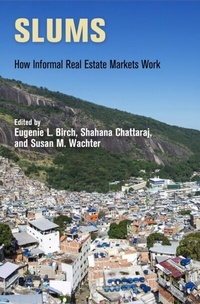
Slums
How Informal Real Estate Markets Work
1st Edition
Published on 8. March 2016
256 pages
978-0-8122-9257-2 (ISBN)
Description

Large numbers of people in urbanizing regions in the developing world live and work in unplanned settlements that grow through incremental processes of squatting and self-building. Slums: How Informal Real Estate Markets Work shows that unauthorized settlements in rapidly growing cities are not divorced from market forces; rather, they must be understood as complex environments where state policies and market actors still do play a role. In this volume, contributors examine how the form and function of informal real estate markets are shaped by legal systems governing property rights, by national and local policy, and by historical and geographic particularities of specific neighborhoods. Their essays provide detailed portraits of individuals and community organizations, revealing in granular detail the working of informal real estate markets, and they review programs that have been implemented in unconventional settlements to provide lessons about the effectiveness and implementation challenges of different approaches.
Chapters explore the relationships between informality, state policies, and market forces from a range of disciplinary perspectives and on different scales, from an analysis of the relationship between regulations and housing in 600 developing world cities to an ethnographic account of the buying and selling of houses in Rio de Janeiro's favelas. While many of the book's contributors focus on the emerging economies of India and Brazil, the conclusions drawn illustrate dynamics relevant to developing countries throughout the Global South. The diversity of perspectives combines to create a rich understanding of an important, complex, and understudied topic.
Contributors: Arthur Acolin, Sai Balakrishnan, Eugenie L. Birch, JosE Brakarz, Shahana Chattaraj, Sebastian Galiani, David Gouverneur, Yvonne Mautner, Paavo Monkkonen, Vinit Mukhija, Janice E. Perlman, Lucas Ronconi, Bish Sanyal, Ernesto Schargrodsky, PatrIcia CezArio Silva, Susan M. Wachter.
Chapters explore the relationships between informality, state policies, and market forces from a range of disciplinary perspectives and on different scales, from an analysis of the relationship between regulations and housing in 600 developing world cities to an ethnographic account of the buying and selling of houses in Rio de Janeiro's favelas. While many of the book's contributors focus on the emerging economies of India and Brazil, the conclusions drawn illustrate dynamics relevant to developing countries throughout the Global South. The diversity of perspectives combines to create a rich understanding of an important, complex, and understudied topic.
Contributors: Arthur Acolin, Sai Balakrishnan, Eugenie L. Birch, JosE Brakarz, Shahana Chattaraj, Sebastian Galiani, David Gouverneur, Yvonne Mautner, Paavo Monkkonen, Vinit Mukhija, Janice E. Perlman, Lucas Ronconi, Bish Sanyal, Ernesto Schargrodsky, PatrIcia CezArio Silva, Susan M. Wachter.
Reviews / Votes
"Likely to be a frequently used and often cited book, Slums: How Informal Real Estate Markets Work provides an extraordinary array of information on a complex and highly idiosyncratic subject that existing studies treat only in a limited way." (Robert Buckley, The New School)More details
Series
Language
English
Place of publication
Pennsylvania
United States
Target group
College/higher education
Illustrations
20 illus.
20 illus.
ISBN-13
978-0-8122-9257-2 (9780812292572)
Copyright in bibliographic data and cover images is held by Nielsen Book Services Limited or by the publishers or by their respective licensors: all rights reserved.
Schweitzer Classification
Other editions
Additional editions
Book
04/2016
University of Pennsylvania Press
€60.50
Shipment within 10-20 days
Persons
Eugenie L. Birch is the Lawrence C. Nussdorf Professor of Urban Research and Education; Chair of the Graduate Group in City and Regional Planning, School of Design; and Co-Director, Penn Institute for Urban Research, at the University of Pennsylvania. Susan M. Wachter is the Albert Sussman Professor of Real Estate and Professor of Finance, The Wharton School; Professor of City and Regional Planning, School of Design; and Codirector, Penn Institute for Urban Research, at the University of Pennsylvania. Shahana Chattaraj is a postdoctoral fellow in Comparative Public Policy at the Blavatnik School of Government, University of Oxford.
Content
Preface
PART I. COMPARATIVE PERSPECTIVES
Chapter 1. Urban Governance and Development of Informality in China and India
-Arthur Acolin, Shahana Chattaraj, and Susan M. Wachter
Chapter 2. Comparative Evidence on Urban Land-Use Regulation Bureaucracy in Developing Countries
-Paavo Monkkonen and Lucas Ronconi
Chapter 3. Urban Land Titling: Lessons from a Natural Experiment
-Sebastian Galiani and Ernesto Schargrodsky
PART II. ANTHROPOLOGICAL PERSPECTIVES
Chapter 4. The Formalization of Informal Real Estate Transactions in Rio's Favelas
-Janice E. Perlman
Chapter 5. Tenure Regularization Programs in Favelas in Brazil
-Patricia Cezario Silva and Yvonne Mautner
Chapter 6. Property Markets Without Property Rights: Dharavi's Informal Real Estate Market
-Shahana Chattaraj
Chapter 7. Periurban Land Markets in the Bangalore Region
-Sai Balakrishnan
PART III. PUBLIC POLICY PERSPECTIVES
Chapter 8. Rehousing Mumbai: Formulizing Slum Land Markets Through Redevelopment
-Vinit Mukhija
Chapter 9. Tenure Regularization: Process and Experiences in Latin America
-JosE Brakarz
Chapter 10. Making a Difference in the Predominantly Informal City
-David Gouverneur
Chapter 11. Informal Land Markets: Perspectives for Policy
-Bish Sanyal
Notes
References
List of Contributors
Index
PART I. COMPARATIVE PERSPECTIVES
Chapter 1. Urban Governance and Development of Informality in China and India
-Arthur Acolin, Shahana Chattaraj, and Susan M. Wachter
Chapter 2. Comparative Evidence on Urban Land-Use Regulation Bureaucracy in Developing Countries
-Paavo Monkkonen and Lucas Ronconi
Chapter 3. Urban Land Titling: Lessons from a Natural Experiment
-Sebastian Galiani and Ernesto Schargrodsky
PART II. ANTHROPOLOGICAL PERSPECTIVES
Chapter 4. The Formalization of Informal Real Estate Transactions in Rio's Favelas
-Janice E. Perlman
Chapter 5. Tenure Regularization Programs in Favelas in Brazil
-Patricia Cezario Silva and Yvonne Mautner
Chapter 6. Property Markets Without Property Rights: Dharavi's Informal Real Estate Market
-Shahana Chattaraj
Chapter 7. Periurban Land Markets in the Bangalore Region
-Sai Balakrishnan
PART III. PUBLIC POLICY PERSPECTIVES
Chapter 8. Rehousing Mumbai: Formulizing Slum Land Markets Through Redevelopment
-Vinit Mukhija
Chapter 9. Tenure Regularization: Process and Experiences in Latin America
-JosE Brakarz
Chapter 10. Making a Difference in the Predominantly Informal City
-David Gouverneur
Chapter 11. Informal Land Markets: Perspectives for Policy
-Bish Sanyal
Notes
References
List of Contributors
Index
