

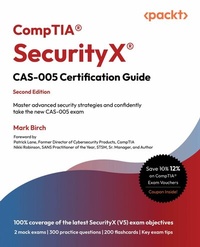
CompTIA (R) SecurityX (R) CAS-005 Certification Guide
Description

Key Features
Strengthen your grasp of key concepts and real-world security practices across updated exam objectives
Gauge your preparedness with over 300 practice questions, flashcards, and mock exams
Visualize complex topics with diagrams of AI-driven threats, Zero Trust, cloud security, cryptography, and incident response
Purchase of the print or Kindle book includes a free PDF eBook
Book DescriptionAs cyber threats evolve at unprecedented speed and enterprises demand resilient, scalable security architectures, the CompTIA SecurityX CAS-005 Certification Guide stands as the definitive preparation resource for today's security leaders. This expert-led study guide enables senior security professionals to master the full breadth and depth of the new CAS-005 exam objectives. Written by veteran instructor Mark Birch, this guide draws from over 30 years of experience in teaching, consulting, and implementing cybersecurity controls to deliver clear, actionable content across the four core domains: governance, risk, and compliance; security architecture; security engineering; and security operations. It addresses the most pressing security challenges, from AI-driven threats and Zero Trust design to hybrid cloud environments, post-quantum cryptography, and automation. While exploring cutting-edge developments, it reinforces essential practices such as threat modeling, secure SDLC, advanced incident response, and risk management. Beyond comprehensive content coverage, this guide ensures you are fully prepared to pass the exam through exam tips, review questions, and detailed mock exams, helping you build the confidence and situational readiness needed to succeed in the CAS-005 exam and real-world cybersecurity leadership.What you will learn
Build skills in compliance, governance, and risk management
Understand key standards such as CSA, ISO27000, GDPR, PCI DSS, CCPA, and COPPA
Hunt advanced persistent threats (APTs) with AI, threat detection, and cyber kill frameworks
Apply Kill Chain, MITRE ATT&CK, and Diamond threat models for proactive defense
Design secure hybrid cloud environments with Zero Trust architecture
Secure IoT, ICS, and SCADA systems across enterprise environments
Modernize SecOps workflows with IAC, GenAI, and automation
Use PQC, AEAD, FIPS, and advanced cryptographic tools
Who this book is forThis CompTIA book is for candidates preparing for the SecurityX certification exam who want to advance their career in cybersecurity. It's especially valuable for security architects, senior security engineers, SOC managers, security analysts, IT cybersecurity specialists/INFOSEC specialists, and cyber risk analysts. A background in a technical IT role or a CompTIA Security+ certification or equivalent experience is recommended.
All prices
More details
Other editions
Additional editions
Persons
Content
Given a Set of Organizational Security Requirements, Implement the Appropriate Governance Components
Given a Set of Organizational Security Requirements, Perform Risk Management Activities
Explain how compliance affects information security strategies
Given a Scenario, Performing Threat Modeling Activities
Summarize the Information Security Challenges Associated with AI Adoption
Given a Scenario, Analyze Requirements to Design Resilient Systems
Given a Scenario, Implement Security in the Early Stages of the Systems Life Cycle and Throughout Subsequent Stages
Given a Scenario, Integrate Appropriate Controls in the Design of a Secure Architecture
Given a Scenario, Apply Security Concepts to the Design of Access, Authentication, and Authorization Systems
Given a Scenario, Securely Implement Cloud Capabilities in an Enterprise Environment
Given a scenario, Integrate Zero-Trust Concepts into System Architecture Design
Given a Scenario, Troubleshoot Common Issues with Identity and Access Management (IAM) Components in an Enterprise Environment
Given a Scenario, Analyze Requirements to Enhance the Security of Endpoint and Servers
Given a Scenario, Troubleshoot Complex Network Infrastructure Security Issues
Given a Scenario, Implement Hardware Security Technologies and Techniques
Given a Set of Requirements, Secure Specialized and Legacy Systems against Threats
Given a Scenario, Use Automation to Secure the Enterprise
Explain the Importance of Advanced Cryptographic Concepts
Given a scenario, Apply the Appropriate Cryptographic Use Case and/or Technique
Given a Scenario, Analyze Data to Enable Monitoring and Response Activities
Given a scenario, Analyze Vulnerabilities and Attacks and Recommended Solutions to Reduce the Attack Surface
Given a Scenario, Apply Threat-Hunting and Threat Intelligence Concepts
Given a Scenario, Analyze Data and Artifacts in Support of Incident Response Activities
Preface
The CompTIA SecurityX CAS-005 certification validates the advanced skills required to design, engineer, and implement secure enterprise-grade solutions across diverse, interconnected environments. This study guide is designed to equip cybersecurity professionals with the knowledge to proactively support resilient operations through automation, real-time monitoring, threat detection, and effective incident response. It addresses the application of security principles in complex infrastructures-whether cloud-based, on-premises, or hybrid-and emphasizes the practical integration of cryptographic methods and emerging technologies, including artificial intelligence. Throughout, the guide reinforces the importance of enterprise-wide governance, regulatory compliance, risk mitigation, and threat modeling as essential components of modern security architecture.
The CompTIA SecurityX exam is an update and rebrand of the CompTIA CASP+ (CAS-004) exam, which was retired in June 2025. The 28 objectives of the CAS-004 exam have been narrowed down to 23, and the domains have been reordered. The new weighting of the exam is shown in the following table:
Domain
Percentage of examination
1.0 Governance, Risk, and Compliance
20%
2.0 Security Architecture
27%
3.0 Security Engineering
31%
4.0 Security Operations
22%
Total
100%
Changes in this updated exam include a greater emphasis on cloud-native security, zero-trust architectures, threats from artificial intelligence, enhanced data protection regulations, and security for operational technology and internet of things (IoT) devices.
To help you best organize your study, this book has been structured to closely follow the CompTIA SecurityX domains, objectives, and concepts. The book is divided into four sections-one for each domain-and each section is split into chapters that align with the objectives as stated in the official exam outline. Each chapter has been designed to closely follow the concepts in each objective, again as stated in the outline.
In addition, there are mock exams that closely match the type of multiple-choice questions you will encounter in the actual exam, review questions to test your knowledge at the end of each chapter, flashcards to help you remember important ideas, and exam tips to support you on the day of the test.
There is also an exam voucher that gives you 12% off the cost of sitting the exam.
Who this book is for
This book is intended for experienced cybersecurity professionals preparing for the CompTIA SecurityX (CAS-005) certification, particularly those working in enterprise environments who are responsible for securing complex, hybrid infrastructures. It is especially valuable for security architects, engineers, senior analysts, and consultants seeking to deepen their knowledge of enterprise-level security operations, governance, risk management, and advanced technical controls. Candidates should already possess foundational cybersecurity knowledge (such as Security+ or equivalent experience) and be familiar with key concepts in network defense, cryptography, compliance, cloud security, and incident response. This guide is also useful for IT professionals transitioning into senior cybersecurity roles and for those involved in designing and implementing enterprise security strategies.
What this book covers
Chapter 1, Given a Set of Organizational Security Requirements, Implement the Appropriate Governance Components, explains the importance of organizational policies, security programs, governance frameworks, change management, and the importance of data governance in enterprise environments.
Chapter 2, Given a Set of Organizational Security Requirements, Perform Risk Management Activities, explores the essential risk management activities required to meet organizational security requirements, including impact analysis, risk assessment, third-party risk management, and strategies for addressing availability, confidentiality, integrity, privacy risks, crisis management, and breach response.
Chapter 3, Explain How Compliance Affects Information Security Strategies, provides a concise understanding of compliance requirements, industry standards, and security frameworks. It helps candidates distinguish between audits, assessments, and certifications, while also addressing privacy laws and cross-border data compliance challenges relevant to modern enterprise environments.
Chapter 4, Given a Scenario, Perform Threat-Modeling Activities, explores the comprehensive processes and methodologies of threat modeling, including understanding actor characteristics, attack patterns, frameworks, and methods, to effectively determine and apply threat models within an organizational environment.
Chapter 5, Summarize the Information Security Challenges Associated with Artificial Intelligence (AI) Adoption, explores the information security challenges associated with adopting artificial intelligence (AI), focusing on legal and privacy implications, threats to AI models, AI-enabled attacks, risks of AI usage, and the security of AI-enabled assistants and digital workers.
Chapter 6, Given a Scenario, Analyze Requirements to Design Resilient Systems, covers the critical process of designing resilient systems, focusing on the strategic placement and configuration of security devices and the essential considerations for ensuring system availability and integrity.
Chapter 7, Given a Scenario, Implement Security in the Early Stages of the Systems Life Cycle and Throughout Subsequent Stages, provides a comprehensive guide on implementing security measures throughout the system life cycle, from the initial stages to the end-of-life phase, ensuring robust protection against evolving threats.
Chapter 8, Given a Scenario, Integrate Appropriate Controls in the Design of a Secure Architecture, explores the integration of appropriate controls in the design of a secure architecture, emphasizing attack surface management, threat detection, data security, DLP, hybrid infrastructures, third-party integrations, and evaluating control effectiveness.
Chapter 9, Given a Scenario, Apply Security Concepts to the Design of Access, Authentication, and Authorization Systems, explores the application of security concepts in designing robust access, authentication, and authorization systems, crucial for protecting organizational resources and ensuring secure user interactions.
Chapter 10, Given a Scenario, Securely Implement Cloud Capabilities in an Enterprise Environment, explores the critical strategies and technologies required to safeguard cloud infrastructures, emphasizing practical approaches to leveraging cloud services while maintaining robust security postures.
Chapter 11, Given a Scenario, Integrate Zero Trust Concepts into System Architecture Design, explains how to apply Zero Trust principles to system architecture, emphasizing continuous authorization, context-based reauthentication, secure network architecture, API integration, asset management, security boundaries, deperimeterization, and defining subject-object relationships.
Chapter 12, Given a Scenario, Troubleshoot Common Issues with Identity and Access Management (IAM) Components in an Enterprise Environment, explains how to set about troubleshooting common issues with identity and access management (IAM) components in an enterprise environment, providing practical insights and solutions for maintaining secure and efficient IAM operations.
Chapter 13, Given a Scenario, Analyze Requirements to Enhance the Security of Endpoints and Servers, delves into strategies and techniques for analyzing and improving the security of endpoints and servers, covering application control, EDR, event logging, privilege management, and more, to ensure robust protection against evolving threats.
Chapter 14, Given a Scenario, Troubleshoot Complex Network Infrastructure Security Issues, covers advanced techniques for identifying and resolving security issues within network infrastructures, covering misconfigurations, IPS/IDS complications, DNS security, and more, equipping professionals with essential troubleshooting skills.
Chapter 15, Given a Scenario, Implement Hardware Security Technologies and Techniques, explains the implementation of hardware...
