

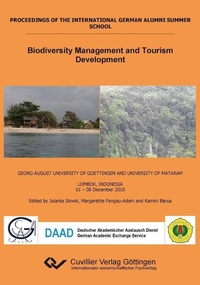
Biodiversity Management and Tourism Development
Cuvillier Verlag eBooks
Published on 9. July 2012
240 pages
978-3-7369-4092-5 (ISBN)
Description

Indonesia is a favourite ecotourism destination in Southeast Asia and tourism in general plays an important role in the Indonesian economy. Being one of the world’s largest archipelagos’, with more than 17,503 islands sprawling across the Indian Ocean, Indonesia is one of the third top global megabiodiversity hotspots with rich natural ecosystems ranging from rainforests to mangrove systems and a high degree of insular endemism. The Indonesian archipelago is divided into two ecological regions – the Sundaland (Asian zoogeographical region) and Wallacea (Australasian zoogeographical region) by the Wallace line. This line runs between the islands Bali and Lombok. Indonesia also boasts of a rich marine biodiversity with 20 % of the world’s coral reefs and is biogeographically a part of the coral triangle. Nearly 45 % of Indonesia is still covered by natural ecosystems and one of the reasons for this is that only 6000 out of the 17,000 islands are permanently inhabited. While Sumatra and Java are the most popular tourist destinations, Indonesia also has one of the world’s longest coastlines with popular beaches and island resorts in Bali, Lombok and Bintan islands. The waters around these islands also provide excellent and economical diving opportunities, with a very high coral diversity as for example in Bunaken Marine National Park in the northern tip of Sulawesi island and the Raja Ampat area in west Papua which according to Conservation International claims to have the highest marine diversity. Indonesia also has a rich cultural diversity with most of these cultural sites listed as world heritage sites. Ecotourism in Indonesia can be used not only as a tool for conservation of biodiversity but also to promote sustainable development especially for the local communities. While promoting ecotourism, it should also be seen that nature and culture are not harmed or destroyed. The International German Alumni Summer School aimed at addressing the issues of ecotourism potential and development in Indonesia and other countries in South-East Asia on an interdisciplinary platform and find solutions for sustainable and practically applicable nature conservation efforts.
More details
Other editions
Additional editions
Margaretha Pangau-Adam | Jolanta Slowik | Kamini Barua
Biodiversity Management and Tourism Development
Book
07/2012
1st Edition
Cuvillier Verlag
€37.05
Shipment within 15-20 days
Persons
Content
- Intro
- ACKNOWLEDGEMENTS
- CONTENTS
- INTRODUCTION
- FOREWORD
- CONTRIBUTORS
- Ecolodges: Possibilities for Conservation and Quality of Life KELLY BRICKER
- Tourism and Biodiversity Research PrioritiesRENATE BÜRGER-ARNDT
- A half-century of Ecotourism in Australia, with Particular Reference toWildlife TourismRONDA J. GREEN
- Current Issues on Biodiversity Management and Tourism Development inthe PhilippinesJOSE SANTOS R. CARANDANG VI
- Marine Biodiversity and Tourism Development in Central-easternSumatera, Indonesia: Complexity of Challenges and Urgency of WiserApproachJOKO SAMIAJI
- Biodiversity Management and Tourism Development in CambodiaCHAY CHETHA
- Biodiversity and Tourism as Conerstones of Sustainable Development ofCosta Rica: 40 years of facing threats and solving gapsJOSÉ RODRIGO ROJAS MORALES
- The Role of Eco-tourism in Hong Kong and Local Nature Conservation.CHUNG LIM, LUK
- Ecolabels and Certifications as Tools for Management and Governance ofSustainable Tourism in the Galapagos Biosphere ReserveANDREA MUÑOZ BARRIGA
- Potential for Sustainable Ecotourism in Northeast IndiaKAMINI BARUA
- Key Factors to Successful Tourism Development(Case of Purbalingga Regency, Central Java Indonesia)ISTIQOMAH
- Livestock Biodiversity and Tourism Development in NepalLOK NATH PAUDEL
- Papuan Bird Diversity and Its Potential for Wildlife Tourism in Papua,IndonesiaMARGARETHA PANGAU-ADAM
- Insect Diversity Conservation and Campus Ecotourism in South Sumatera,Indonesia(Case Study of Insect Species Richness at Sriwijaya University)ARINAFRIL
- Diversity and Abundance of Odonata at Lake Linow and the Potential forEcotourismMEIS J. NANGOY, R.KONERI, R.C. TANGKAU, J.WAROUW, S.J.RONDONUWU,R.D.T.MARAMIS, M.TULUNG
- Wetland Ecosystem as a Destination of Nature Tourism in Sabah MalaysiaANDY R. MOJIOL, MUI-HOW PHUA, MAHALI M., KAMLUN K & MARIPA R.
- Mangrove Conservation of Balikpapan City, IndonesiaROSMARINI HERONASIA, FAHRIANOOR R. HAKIM, ARIE SOETJIADI
- Surfing, It's Impact on Ecotourism and Coastal Ecosystem:The Case of La Union, PhilippinesANTONIO O. OGBINAR AND ISRAEL O. RUDIO
- Do disturbances support or suppress biodiversity?JOLANTA SLOWIK
- Can Initiatives of Local Community in Developing Ecotourism Offer aBetter Livelihood Opportunity and Sustain Biodiversity Conservation ofGunung Leuser National Park?: Lessons from Tangkahan, NorthSumateraPINDI PATANA
- Integrating Ecotourism and Biodiversity Conservation in Kanha TigerReserve, IndiaDHIRENDRA BHARGAVA
- Survey on Ecotourism Potential of Batuputih Nature Tourism Park, NorthSulawesi, IndonesiaTRINA E. TALLEI AND SAROYO SUMARTO
- Participation of ethnic minorities in ecotourism: Case Study of Cat TienBiosphere Reserve, VietnamDINH THANH SANG AND KAZUO OGATA
- Indonesian Tropical Forest, Biodiversity Conservation and EcotourismDevelopmentWAHYUDI
- Need Assessment on Development of Mangrove Ecotourism in SouthSumatraSOLICHIN, T. IMANSYAH AND R. SALEH
