

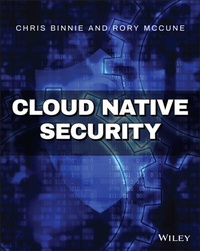
Cloud Native Security
Description

Cloud Native Security delivers a detailed study into minimizing the attack surfaces found on today's Cloud Native infrastructure. Throughout the work hands-on examples walk through mitigating threats and the areas of concern that need to be addressed. The book contains the information that professionals need in order to build a diverse mix of the niche knowledge required to harden Cloud Native estates.
The book begins with more accessible content about understanding Linux containers and container runtime protection before moving on to more advanced subject matter like advanced attacks on Kubernetes. You'll also learn about:
* Installing and configuring multiple types of DevSecOps tooling in CI/CD pipelines
* Building a forensic logging system that can provide exceptional levels of detail, suited to busy containerized estates
* Securing the most popular container orchestrator, Kubernetes
* Hardening cloud platforms and automating security enforcement in the cloud using sophisticated policies
Perfect for DevOps engineers, platform engineers, security professionals and students, Cloud Native Security will earn a place in the libraries of all professionals who wish to improve their understanding of modern security challenges.
More details
Other editions
Additional editions
Persons
RORY MCCUNE has over 20 years of experience in the Information and IT security arenas. His professional focus is on container, cloud, and application security and he is an author of the CIS Benchmarks for Docker and Kubernetes and has authored and delivered container security training at conferences around the world.
Content
Introduction
There is little doubt that we have witnessed a dramatic and notable change in the way that software applications are developed and deployed in recent years.
Take a moment to consider what has happened within the last decade alone. Start with the mind-blowing levels of adoption of containers, courtesy of Docker's clever packaging of Linux container technologies. Think of the pivotal maturation of cloud platforms with their ever-evolving service offerings. Remember the now-pervasive use of container orchestrators to herd multiple catlike containers. And do not forget that software applications have been teased apart and broken down into portable, microservice-sized chunks.
Combined, these significant innovations have empowered developers by offering them a whole new toolbox from which their software can be developed, and a reliable platform that their applications can be deployed upon.
In hand with the other recent milestone innovations in computing, such as the growth of Unix-like operating systems and the birth of the web and the internet as a whole, Cloud Native technologies have already achieved enough to merit a place in the history books. However, as with all newly formed tech, different types of security challenges surface and must be addressed in a timely fashion.
Cloud Native security is a complex, multifaceted topic to understand and even harder to get right. Why is that? The answer lies with the multiple, diverse components that need to be secured. The cloud platform, the underlying host operating system, the container runtime, the container orchestrator, and then the applications themselves each require specialist security attention.
Bear in mind too, that the securing and then monitoring of the critical nuts and bolts of a tech stack needs to happen 24 hours a day, all year round. For those who are working in security and unaccustomed to Cloud Native technologies, their limited breadth of exposure can make the challenge that they are suddenly faced with a real eye-opener.
Among the more advanced attackers, there are many highly adaptive, intelligent, and ultimately extremely patient individuals with a vast amount of development and systems experience who have the ability to pull off exceptional compromises, including those of the highest-profile online services. These individuals, who may also be well-funded, are extremely difficult to keep out of a cloud estate. Only by continually plugging every security hole, with multiple layers of defense, is it possible to hope to do so. They are the attackers, however, that can usually be kept at arm's length. At the highest level, so-called nation-state attackers are advanced enough that many security teams would struggle to even identify if a compromise had been successful.
Insomnia-inducing concerns aside, the good news is that it is possible to increase the effort involved for an attacker to successfully exploit a vulnerability significantly. This can be achieved using a combination of open source tools and shifting security to the left in the software lifecycle in order to empower developers with greater visibility of threats and therefore giving them more responsibility for the code that makes it into production.
Shifting security to the left, as championed by DevSecOps methodologies, is a worthwhile pursuit, especially when coupled with the interjection of security logic gates into CI/CD pipelines that determine whether to pass or fail software builds. Combined with multiple build tests, wherever they might be needed within the software lifecycle, this approach is highly effective and has been growing in popularity exponentially.
Meeting the Challenge
The authors of Cloud Native Security have both worked in the technology and security space for more than 20 years and approach such challenges from different perspectives. For that reason, this book is divided into four distinct sections that together will arm the reader with enough security tooling knowledge, coupled with niche know-how, to improve the security posture of any Cloud Native infrastructure.
The key areas explored in detail within this book are the high-level building blocks already mentioned in the introduction. Part I focuses on container runtime and orchestrator security, Part II on DevSecOps tooling, Part III on the securing and monitoring cloud platforms, and finally Part IV looks at advanced Kubernetes security.
There is ostensibly less Linux hardening information in this book than the other facets because Linux is more mature than the other components in a Cloud Native stack, fast approaching its 30th birthday. However, it would be unfair not to mention that almost every component involved with Cloud Native technologies starts with Linux in one shape or form. It is an often-overlooked cornerstone of security in this space. For that reason, a chapter is dedicated to ensuring that the very best advice, based on industry-consensus, is employed when it comes to using automation to harden Linux.
Today's popular cloud platforms are unquestionably each different, but the security skills required to harden them can be transposed from one to another with a little patience. Amazon Web Services (AWS) is still the dominant cloud provider, so this book focuses on AWS; readers working on other cloud platforms, however, will find enough context to work with them in a similar manner. From a Linux perspective, the hands-on examples use Debian derivatives, but equally other Linux distributions will match closely to the examples shown.
Coverage of container security issues often incorrectly focuses solely only on static container image analysis; however, within this book readers will find that the information relating to container runtime threats are separated away cleanly from orchestrator threats for much greater clarity.
This book explores concepts and technologies that are more accessible to less experienced readers within the first three sections. And, on a journey through to the last section where more advanced attacks on Kubernetes are delved into, the latter chapters are constructed to help encourage the reader to absorb and then research further into the complex concepts.
It is the hope that security professionals will gain a diverse mix of the required niche knowledge to help secure the Cloud Native estates that they are working on. Equally, as today's developers are consistently required to learn more about security, they too can keep abreast of the challenges that their roles will increasingly involve.
With this in mind, it has been an enjoyable experience collecting thoughts to put them down on paper. The reader's journey now begins with a look at the innards of a Linux container. Not all DevOps engineers can confidently explain what a container is from a Linux perspective. That is something that this book hopes to remedy, in the interests of security.
What Does This Book Cover?
Here's a chapter-by-chapter summary of what you will learn in Cloud Native Security:
- Chapter 1: What Is A Container? The first chapter in Part I discusses the components that comprise a Linux container. Using hands-on examples, the chapter offers the perspective of these components from a Linux system's point of view and discusses common types of containers in use today.
- Chapter 2: Rootless Runtimes This chapter looks at the Holy Grail of running containers, doing so without using the
rootuser. An in-depth examination of Docker's experimental rootless mode, followed by an in-depth look at Podman being run without using the superuser, helps demonstrate the key differences between the runtimes. - Chapter 3: Container Runtime Protection This chapter looks at a powerful open source tool that can provide impressive guardrails around containers. The custom policies can be used to monitor and enforce against unwanted anomalies in a container's behavior.
- Chapter 4: Forensic Logging This chapter examines a built-in Linux Auditing System that can provide exceptional levels of detail. Using the auditing system, it is possible to walk, step-by-step, through logged events after an attack to fully understand how a compromise was successful. In addition, misconfigurations and performance issues can be identified with greater ease.
- Chapter 5: Kubernetes Vulnerabilities This chapter looks at a clever tool that uses a number of detailed checks to suggest suitable security and compliance fixes to Kubernetes clusters. Such advice can be useful for auditing both at installation time and in an ongoing fashion.
- Chapter 6: Container Image CVEs By using the best of three Common Vulnerability and Exploit scanning tools, or a combination of them, it is possible to capture a highly detailed picture of the vulnerabilities that require patching within static container images.
- Chapter 7: Baseline Scanning (or, Zap Your Apps) This chapter is the first of Part II, "DevSecOps Tooling," and explores the benefits of performing baseline tests within a CI/CD pipeline to highlight issues with applications.
- Chapter 8: Codifying Security This chapter demonstrates a tool that can utilize popular attack applications using custom policies to test for vulnerabilities within newly built services and applications in CI/CD tests.
- Chapter 9:...
