

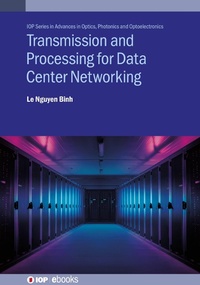
Transmission and Processing for Data Center Networking
Description

Modern society's demand on data transport has led to significant development and research in ultrahigh-speed transport of data, and an increase of data centres around the world. This book offers an insight into data centre transport technology centres and the principal techniques for modern communication transmission of ultra-wideband channels. Beginning with an introduction to digital transmission technologies and data centre networking, the text progresses to discussions on access and DC networking transmission technologies and super-channel transmission by multi-carrier sources, before concluding with a chapter on photonic signal processors. This comprehensive and up-to-date overview is an invaluable source for scientists, engineers, professors and mid-senior level students involved with data transmission and processing.
More details
Other editions
Additional editions

Person
Le Nguyen Binh obtained his PhD in electronic engineering and integrated photonics/optical communications engineering from The University of Western Australia. He has published more than 300 journal and conference papers, as well as 14 books in the fields of optical communications transmission systems and network engineering, photonic processing, integrated optics, and electromagnetics engineering. He also owns several patents.
Content
- Intro
- Preface
- Acknowledgements
- Author biography
- Le Nguyen Binh
- Abbreviations
- Chapter 1 Historical overview and digital transmission technologies in cloud networking
- 1.1 Non-DSP based optical transmission technologies
- 1.2 Signal processor DSP based optical transmission
- 1.3 Increasing transmission capacity over short distances
- 1.4 Digital optical transmission in evolving networking
- 1.4.1 Traffic growth
- 1.4.2 Transmission technologies for intra- and inter-DC cloud networking
- 1.4.3 DCs and cloud computing-a historical overview
- 1.4.4 100 G, 400 G and beyond-transmission technologies for cloud networking
- 1.5 Photonic signal processing
- 1.5.1 Motivations and backgrounds
- 1.5.2 Generic innovative models of photonic signal processors
- 1.6 Modulation techniques for ultra-broadband
- 1.6.1 Modulation formats and optical signal generation
- 1.7 Opto-electronic reception and processing
- 1.7.1 Incoherent optical receivers
- 1.7.2 DSP-coherent optical receivers
- 1.7.3 e-DSP electronic equalization
- 1.8 Organization of the book
- References
- Chapter 2 Data center networking
- 2.1 The evolution of DCN and traditional telecoms networks
- 2.1.1 Types of data center networks
- 2.1.2 Performance of DCNs
- 2.1.3 Communication interconnection speed
- 2.2 Telecoms carriers and challenges from data center networking
- 2.2.1 Evolution to 5G transport DC based networks
- 2.2.2 Optical transport technology
- 2.2.3 Basic rates, capacity and server clusters for intra- and inter-DC connections
- 2.3 Exabits s-1 integrated photonic interconnection technology for flexible data-centric optical networks
- 2.3.1 Introductory remarks
- 2.3.2 Ebps optical network topologies
- 2.3.3 Basic optical switches
- 2.3.4 Current technologies for optical switching and routing
- 2.3.5 Remarks
- 2.4 Concluding remarks
- References
- Chapter 3 Access and data center networking transmission technologies
- 3.1 Introductory remarks
- 3.2 DSP-based coherent optical transmission systems
- 3.3 Quadrature amplitude modulation (QAM)
- 3.3.1 112 G-800 Gbps QPSK coherent transmission systems
- 3.3.2 Modulation format 16QAM
- 3.3.3 Optical modulators
- 3.3.4 Optical transmitter
- 3.3.5 Optical receivers
- 3.3.6 I-Q imbalance estimation
- 3.4 Optical pre-processing reception and transmitter
- 3.4.1 Skew estimation
- 3.4.2 Fractionally spaced equalization of CD and PMD
- 3.4.3 Electronic digital equalization
- 3.5 16QAM systems
- 3.6 Terabits/second superchannel transmission systems
- 3.6.1 Overview
- 3.6.2 Nyquist pulse and spectra
- 3.6.3 Superchannel system requirements
- 3.6.4 System structure: DSP-based coherent receiver
- 3.7 Timing recovery in the Nyquist QAM channel
- 3.8 128 Gbps 16QAM superchannel transmission
- 3.9 450 Gb s-1 32QAM Nyquist transmission systems
- 3.10 DSP-based heterodyne coherent reception systems
- 3.11 Remarks
- 3.12 PAM4 IM/DD systems
- 3.12.1 Generating PAM4 signals
- 3.12.2 DSP-based PAM4 generation for low cost broadband channels
- 3.12.3 PAM4 systems
- 3.13 Beyond 1.0 Tbps capacity using IM/DD systems
- 3.13.1 Beyond 200+ Gbps DMT transmission
- 3.13.2 Experimental set-up
- 3.13.3 Performance
- 3.13.4 Remarks
- 3.14 Higher order modulation in IM/DD systems
- 3.15 Concluding remarks
- 3.16 Appendix 1: Principles of DSP-based coherent transmission
- 3.17 Appendix 2: Balanced detection in coherent receivers
- 3.17.1 Optical front end
- 3.17.2 Optical mixing and polarization diversity
- 3.17.3 Differential amplification
- 3.17.4 Unmatched detector frequency responses
- 3.18 Intra-DC networking and access transmission
- References
- Chapter 4 Superchannel transmission by multi-carrier sources
- 4.1 Introduction
- 4.2 Comb generation of multi-sub-carriers
- 4.2.1 General structure
- 4.2.2 Synchronous optical modulator
- 4.2.3 Implementation of the comb generator
- 4.3 Dual band frequency shifting re-circulating comb generator
- 4.4 The comb generator in a multi-Tbps optical transmission system
- 4.5 Packing modulated comb channels in the frequency domain using Nyquist shaping
- 4.5.1 Analytical representation for pulse shaping
- 4.5.2 Implementation
- 4.6 Pulse shaping using ultra-high sampling rate DAC
- 4.7 Transmission of superchannels formed by modulated MCL
- 4.8 Remarks
- 4.9 Multi Tera-bits s-1 optical access transport technology
- 4.9.1 Introductory remarks
- 4.9.2 100 G access systems
- 4.9.3 Tbps access transmission and routing technology
- 4.9.4 Multi-carrier comb source direct detection systems
- 4.10 Tbps coherent reception systems
- 4.11 Optical interconnect for multiple Tbps access networks
- 4.12 Remarks
- 4.13 Low cost 1.6 Tbps using un-cooled comb sources
- 4.13.1 DSP-assisted Tbps low cost comb source system
- 4.13.2 A simple generation of comb lines via cascade modulators
- 4.13.3 Optical injection and comb generation
- 4.13.4 Concluding remarks
- References
- Chapter 5 Photonic signal processors
- 5.1 Optical transformed channels and transmission: spectral domain processing
- 5.1.1 Optical Fourier transform (OFT) based structure
- 5.1.2 Optical Fourier processor OFT based structure
- 5.2 5G optical transport networking: from photonic devices to processors
- 5.2.1 Introduction
- 5.2.2 5G infrastructure evolution
- 5.2.3 Optical transport networking evolution for 5G delivery
- 5.3 Photonic signal processors
- 5.3.1 Generic deep neural network learning photonic signal processor (DNNLPSP)
- 5.3.2 PSP operating principles
- 5.3.3 ONN operating principles
- References
