

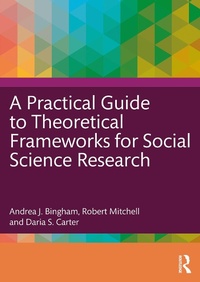
A Practical Guide to Theoretical Frameworks for Social Science Research
1st Edition
Published on 13. February 2024
232 pages
978-1-003-84723-6 (ISBN)
Description

This practical book offers a guide to finding, choosing, and applying theoretical frameworks to social sciences research, and provides researchers with the scaffolding needed to reflect on their philosophical orientations and better situate their work in the existing landscape of empirical and theoretical knowledge.
Using a multifaceted approach, the book provides clear definitions, primary tenets, historical context, highlights of the challenges and contemporary discussion and, perhaps more importantly, concrete and successful examples of studies that have drawn on and incorporated each theoretical framework. The authors define and explain the connections among such concepts as ontology, epistemology, paradigm, theory, theoretical frameworks, conceptual frameworks, and research methodology; describe the process of finding and effectively using theoretical and conceptual frameworks in research; and offer brief overviews of particular theories within the following disciplines: sociology, psychology, education, leadership, public policy, political science, economics, organizational studies, and business. The book also has a dedicated chapter on critical theories, and for each theory, provides a definition, explores how the theory is useful for researchers, discusses the background and foundations, outlines key terms and concepts, presents examples of theoretical applications, and gives an overview of strengths and limitations.
This book offers a useful starting point for any researcher interested in better situating their work in existing conceptual and theoretical knowledge, but it will be especially useful for graduate students and early career researchers who are looking for clear definitions of complex terms and concepts, and for an introduction to useful theories across disciplines.
Using a multifaceted approach, the book provides clear definitions, primary tenets, historical context, highlights of the challenges and contemporary discussion and, perhaps more importantly, concrete and successful examples of studies that have drawn on and incorporated each theoretical framework. The authors define and explain the connections among such concepts as ontology, epistemology, paradigm, theory, theoretical frameworks, conceptual frameworks, and research methodology; describe the process of finding and effectively using theoretical and conceptual frameworks in research; and offer brief overviews of particular theories within the following disciplines: sociology, psychology, education, leadership, public policy, political science, economics, organizational studies, and business. The book also has a dedicated chapter on critical theories, and for each theory, provides a definition, explores how the theory is useful for researchers, discusses the background and foundations, outlines key terms and concepts, presents examples of theoretical applications, and gives an overview of strengths and limitations.
This book offers a useful starting point for any researcher interested in better situating their work in existing conceptual and theoretical knowledge, but it will be especially useful for graduate students and early career researchers who are looking for clear definitions of complex terms and concepts, and for an introduction to useful theories across disciplines.
More details
Edition
1. Auflage
Language
English
Place of publication
London
United Kingdom
Publishing group
Taylor & Francis Ebooks
Target group
College/higher education
Professional and scholarly
Product notice
Reflowable
Illustrations
32 Line drawings, black and white; 32 Illustrations, black and white
ISBN-13
978-1-003-84723-6 (9781003847236)
Copyright in bibliographic data and cover images is held by Nielsen Book Services Limited or by the publishers or by their respective licensors: all rights reserved.
Schweitzer Classification
Other editions
Additional editions
Andrea J. Bingham | Robert Mitchell | Daria S. Carter
A Practical Guide to Theoretical Frameworks for Social Science Research
Book
02/2024
1st Edition
Routledge
€71.30
Shipment within 10-20 days

Andrea J. Bingham | Robert Mitchell | Daria S. Carter
A Practical Guide to Theoretical Frameworks for Social Science Research
Book
02/2024
1st Edition
Routledge
€206.30
Shipment within 10-20 days
Persons
Dr. Andrea J. Bingham is an Associate Professor of Educational Leadership at California State University Channel Islands in Camarillo, CA, USA. She researches applications of qualitative methodologies, education policy, and school change.
Dr. Robert Mitchell is an Assistant Professor of Leadership, Research, and Foundations at the University of Colorado Colorado Springs, Colorado Springs, CO, USA. He continues to research and teach rural secondary education and education policy.
Daria S. Carter is a doctoral candidate at University of Colorado Colorado Springs, Colorado Springs, CO, USA. She researches the effects of automation on the workforce with the goal of understanding employee value. She also works in operations at a Fortune 500 technology company.
Dr. Robert Mitchell is an Assistant Professor of Leadership, Research, and Foundations at the University of Colorado Colorado Springs, Colorado Springs, CO, USA. He continues to research and teach rural secondary education and education policy.
Daria S. Carter is a doctoral candidate at University of Colorado Colorado Springs, Colorado Springs, CO, USA. She researches the effects of automation on the workforce with the goal of understanding employee value. She also works in operations at a Fortune 500 technology company.
Content
1. Introduction 2. Understanding and Applying Theoretical and Conceptual Frameworks 3. Critical Theories 4. Sociology 5. Psychology 6. Education 7. Leadership 8. Public Policy 9. Political Science 10. Economics 11. Organisational Studies 12. Business
