

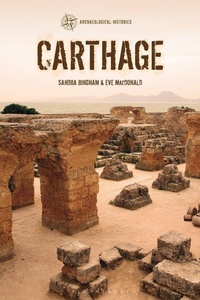
Carthage
1st Edition
Published on 13. June 2024
168 pages
978-1-4725-2890-2 (ISBN)
Description

This book traces the formation of the archaeological site of Carthage and how it re-emerged in the minds of European antiquarians and travellers in the early modern world. For almost 1,600 years the ancient city sat on the north coast of Africa, dominating the central Mediterranean until its fall in 698 CE. One of the oldest cities in the Mediterranean, it was founded in legend by the Tyrian queen Dido and destroyed after epic wars with Rome. It was soon reborn as a Roman city, and late in antiquity evolved into a centre for Christian worship.
In the 17th and 18th centuries, when European explorers first arrived, searching for the site of Carthage, they were amazed that almost nothing of its former glory remained and lamented its loss. The gradual and sometimes controversial exploration of Carthage has, over the last two centuries, brought the story of this renowned ancient city back into the public imagination. From the first discovery of Punic artifacts to the plunder of the site for the enrichment of European museums, the book follows the many personalities whose interests and diligence led to the establishment of scientific archaeological excavations and the re-emergence of Carthage from the ruins.
In the 17th and 18th centuries, when European explorers first arrived, searching for the site of Carthage, they were amazed that almost nothing of its former glory remained and lamented its loss. The gradual and sometimes controversial exploration of Carthage has, over the last two centuries, brought the story of this renowned ancient city back into the public imagination. From the first discovery of Punic artifacts to the plunder of the site for the enrichment of European museums, the book follows the many personalities whose interests and diligence led to the establishment of scientific archaeological excavations and the re-emergence of Carthage from the ruins.
More details
Series
Edition
1. Auflage
Language
English
Place of publication
London
United Kingdom
Publishing group
Bloomsbury Publishing PLC
Target group
College/higher education
Illustrations
38 bw illus
ISBN-13
978-1-4725-2890-2 (9781472528902)
Copyright in bibliographic data and cover images is held by Nielsen Book Services Limited or by the publishers or by their respective licensors: all rights reserved.
Schweitzer Classification
Other editions
Additional editions
Persons
Sandra Bingham is a Senior Lecturer in Classics at the University of Edinburgh, UK. She has been involved in excavations at Carthage and now works in Greece. She has written The Praetorian Guard (2012); other interests include espionage in antiquity and Roman imperial women.
Eve MacDonald is Senior Lecturer in Ancient History at Cardiff University, UK. As an archaeologist she has excavated at and taught extensively on Carthage. She is the author of Hannibal: A Hellenistic Life (2015) and currently works on excavations on the Sasanian Persian frontiers.
Eve MacDonald is Senior Lecturer in Ancient History at Cardiff University, UK. As an archaeologist she has excavated at and taught extensively on Carthage. She is the author of Hannibal: A Hellenistic Life (2015) and currently works on excavations on the Sasanian Persian frontiers.
Content
List of Illustrations
List of Maps
Acknowledgements
Introduction
Chapter 1: From Carthage to Rome: A Brief Overview
Chapter 2: From Carthage to Tunis: A New Focus
Chapter 3: The Europeans
Chapter 4: Rivals in the Field
Chapter 5: The French Collector
Chapter 6: The Excavating Priest
Chapter 7: The Tophet, Carthage and the Early Twentieth Century
Chapter 8: Independence, UNESCO and the Twenty-First Century
Epilogue
Notes
Bibliography
Index
List of Maps
Acknowledgements
Introduction
Chapter 1: From Carthage to Rome: A Brief Overview
Chapter 2: From Carthage to Tunis: A New Focus
Chapter 3: The Europeans
Chapter 4: Rivals in the Field
Chapter 5: The French Collector
Chapter 6: The Excavating Priest
Chapter 7: The Tophet, Carthage and the Early Twentieth Century
Chapter 8: Independence, UNESCO and the Twenty-First Century
Epilogue
Notes
Bibliography
Index
