

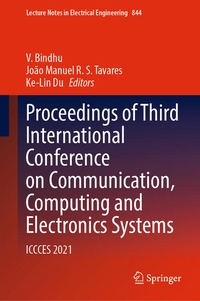
Proceedings of Third International Conference on Communication, Computing and Electronics Systems
Description

More details
Other editions
Additional editions
Persons
Dr. V.Bindhu received the B.E degree in Electronics and Communication Engineering from Bharathair University, Coimbatore in 2002 and M.E. Degree in Applied Electronics from Anna University, Chennai in 2007 and PhD Degree from Anna University, Chennai in 2014. She has 11 years of teaching experience and 6 years of research experience. Currently, she is a professor at PPG Institute of Technology, Coimbatore. Her area of interest includes Signal processing, and VLSI Design.
João Manuel R. S. Tavares graduated in Mechanical Engineering at the Universidade do Porto, Portugal in 1992. He also earned his M.Sc. degree and Ph.D. degree in Electrical and Computer Engineering from the Universidade do Porto in 1995 and 2001, and attained his Habilitation in Mechanical Engineering in 2015. He is a senior researcher at the Instituto de Ciência e Inovação em Engenharia Mecânica e Engenharia Industrial (INEGI) and Full Professor at the Department of Mechanical Engineering (DEMec) of the Faculdade de Engenharia da Universidade do Porto (FEUP).
João Tavares is co-editor of more than 60 books, co-author of more than 50 book chapters, 650 articles in international and national journals and conferences, and 3 international and 3 national patents. He has been a committee member of several international and national journals and conferences, is co-founder and co-editor of the book series "Lecture Notes in Computational Vision and Biomechanics" published by Springer, founder and Editor-in-Chief of the journal "Computer Methods in Biomechanics and Biomedical Engineering: Imaging & Visualization" published by Taylor & Francis, Editor-in-Chief of the journal "Computer Methods in Biomechanics and Biomedical Engineering" published by Taylor & Francis, and co-founder and co-chair of the international conference series: CompIMAGE, ECCOMAS VipIMAGE, ICCEBS and BioDental. Additionally, he has been (co-)supervisor of several MSc and PhD thesis and supervisor of several post-doc projects, and has participated in many scientific projects both as researcher and as scientific coordinator.
Dr. Ke-Lin Du received the PhD in electrical engineering from Huazhong University of Science and Technology, China, in 1998. He founded Xonlink Inc., Ningbo, China in 2014. He was Chief Scientist at Enjoyor Inc., Hangzhou, China from 2012 to 2014. He was on research staff at Department of Electrical and Computer Engineering, Concordia University, Montreal, Canada from 2001 to 2010. Prior to 2001, he was on technical staff with Huawei Technologies, China Academy of Telecommunication Technology, and Chinese University of Hong Kong. He visited Hong Kong University of Science and Technology in 2008. Currently, he is an Affiliated Associate Professor in the Department of Electrical and Computer Engineering at Concordia University from the year of 2011. His research area includes signal processing, wireless communications, and soft computing.
