

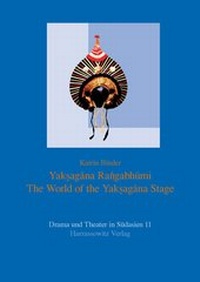
Yaksagana Rangabhumi
The World of the Yaksagana Stage
1st Edition
Published on 1. June 2014
XII, 476 pages
978-3-447-19273-6 (ISBN)
Description

The yaksagana dance-drama of the coastal regions of the south Indian union state of Karnataka is still a thriving theatre tradition. Characterised by its distinct musical style, a lively blend of sung poetry and improvised dialogues, impressive costumes and vigorous dancing, this genre combines many features prevalent in Indian performing arts.
The volume by Katrin Binder presents a general overview of the dance-drama and its representation in academic literature, followed by terminological and methodological considerations. These reflect the author's own training as a yaksagana artist, which also informs the descriptive sections focussing on the songs and dances of the pre-performance rituals. Three exemplary performances are analysed in detail, illustrating trends in performance settings, techniques and costuming. A context-oriented section assesses the current yaksagana scene, documenting troupes, repertoire, sponsors and other factors. This section also addresses the dynamics of change shaping this dance-drama between vow-performances, commercial venture and regional cultural icon. An appendix outlines the possible development of yaksagana in the context of other south Indian performing arts by tracing its literary history. Yaksagana's basic rhythmic patterns and the most important songs discussed in the main study are provided in a performance notation. Accompanying visual material is accessible online.
All prices
More details
Other editions
Additional editions
Book
02/2013
1st Edition
Harrassowitz Verlag
€89.00
No shipping information available
Content
- Intro
- Table of Contents
- Acknowledgements
- Preface
- Note on transliteration and use of words from Indian languages, Indian personal and place names
- 1. Introduction
- 1.1. Summary
- 1.2. Yak?agana of coastal Karnataka
- 2. Research material, terminology and method
- 2.1. Published research on yak?agana
- 2.1.1.Lines of inquiry: picking up threads and themes
- 2.2. Terminology and definitions
- 2.2.1. Genre and classification
- 2.2.2.The name yak?agana: problems in its history and etymology
- 2.2.3. »Tradition« and »traditional
- 2.2.4. Art, artists and performers
- 2.2.5. Field, fieldwork and informants
- 2.3. Methodological considerations
- 2.3.1. Academic reference points
- 2.3.2. Performance knowledge
- 2.3.3. Implicit learning and procedural knowledge
- 2.3.4. Corporeality
- 2.3.5. Learning "yak?agana" myself
- 2.3.6. Learning and performing as research method
- 2.3.7. Committing experience to writing
- 3. Performing yak?agana
- 3.1 Learning process and transformation
- 3.1.1. Transmission of dramatic text
- 3.1.2. Transmission of music
- 3.1.3. Transmission of dance
- 3.1.4. Courses at the Yak?agana Kendra, Udupi
- 3.1.5. Other yak?agana training centres
- 3.1.6. Yak?agana Svabodhini - »yak?agana self-taught«
- 3.1.7. Te?kuti??u prathamika yak?agana pa?haga?u (purvara?ga)
- 3.1.8. Discussion: books »teaching« yak?agana and the institutionalisation of yak?agana training
- 3.2. Cauki: In the green room
- 3.2.1. Abbara
- 3.2.2. Green room puje
- 3.2.3.The yak?agana stage
- 3.2.4. Make-up
- 3.2.5. Costume
- 3.2.6. Character-types
- 3.3. Sabhalak?a?a: Stage preliminaries
- 3.3.1. The »Yak?agana sabhalak?a?a mattu prasauga pi?hike«
- 3.3.2. The sabhalak?a?a - a stage manual?
- 3.3.3. Performance of the sabhalak?a?a today
- 3.3.4. Interpretative challenges
- 3.3.5. »Reconstructions« of the sabhalak?a?a in ba?agu ti??u
- 3.4. Ata: »Play« or The yak?agana performance
- 3.4.1. Dance
- 3.4.2. Music and rhythm
- 3.4.3. Acting
- 3.4.4. Speech
- 3.4.5. Characterisation
- 3.4.6. The portrayal of female characters
- 3.4.7. Performance conventions and staging characteristics
- 3.4.8. Oral transmission, written texts, and performance texts
- 3.4.9. The use of stage space
- 3.4.10. The use of the curtain
- 3.4.11. The curtain entrances
- 3.4.12. Set pieces of dance
- 3.4.13. The closing of a performance
- 3.5. Case studies of three performances
- 3.5.1. Per?uru me?a: Harsavardhana
- 3.5.2. Mandarti me?a: Mahabharata
- 3.5.3. Pur?acandra me?a: Bhi?ma Vijaya
- 4. Yak?agana ra?gabhumi
- 4.1. Introduction
- 4.1.1. The yak?agana season
- 4.1.2. Context
- 4.1.3. The yak?agana scene before 1975
- 4.1.4. Yak?agana as a means of »education
- 4.1.5. Yak?agana as a religiously meritorious act
- 4.1.6. Processes of commercialisation
- 4.2. The Performers
- 4.2.1. Yak?agana Kalara?ga
- 4.2.2. Amateur, children and women yak?agana
- 4.3. Troupe activity
- 4.3.1. Troupes
- 4.3.2. Performance venues
- 4.3.3. Sponsors and audiences
- 4.3.4. Repertoire
- 4.3.5. Troupes, venues, occasions, prasa?gas and sponsors
- 4.3.6. Tulu yak?agana
- 4.3.7. Additional information from the newspaper announcements
- 5. Ma?ga?am: Conclusions and reflections
- 5.1. What roles does yak?agana play?
- 5.1.1. Regional identity, social status and performance
- 5.1.2. Yak?agana as an icon of cultural identity
- 5.2. The »invention of tradition
- 5.2.1. »Refinement«, reconstruction and the rhetorics of invention
- 5.2.2. Authenticity and legitimisation
- 5.3. Conclusions
- 6. Appendix: Prasa?ga literature and the history of yak?agana
- 6.1. Introduction
- 6.2. Sources
- 6.2.1. Epic and puranic prasapgas
- 6.2.2. Contemporary prasa?gas
- 6.3. An attempt at a history of yak?agana
- 6.3.1. Kannada literature and the history of yak?agana
- 6.3.2. Telugu yak?agana(s).
- 6.3.3. Historical context
- 6.3.4. Textual evidence
- 6.3.5. Regional patterns of performance
- 6.3.6. Conclusions
- 6.4. Authors and poets
- 6.5. The poetry of yak?agana prasa?gas
- 6.5.1. Metres
- 6.5.2. Characteristic stylistic features
- 6.5.3. Narrative structure
- 6.5.4. Content
- 7. The ta?as, song texts and verses
- 7.1. Introduction
- 7.2. The seven ta?as
- 7.2.1. kore ta?a (tittittai ma??u)
- 7.2.2. eka ta?a
- 7.2.3. eka ta?a, era?ane kala
- 7.2.4. jhampe ta?a
- 7.2.5. jhampe ta?a, era?ane kala
- 7.2.6. rupaka ta?a
- 7.2.7 rupaka ta?a, era?ane kala
- 7.2.8. a??a ta?a
- 7.2.9. a??a ta?a, era?ane kala
- 7.2.10. trivu?e ta?a
- 7.2.11. trivu?e ta?a, era?ane kala
- 7.2.12. adi ta?a
- 7.3. Songs from the sabhalak?a?a
- 7.3.1. Ga?apati stuti
- 7.3.2. Ko?a?gi
- 7.3.3. Balagopala
- 7.3.4. Pi?hike Strive?a
- 7.3.5. Raja ve?a o??olaga
- 7.3.6. Srikr??ana o??olaga
- 7.3.7. Ramalak?ma?ara o??olaga
- 7.3.8. Pa??avara o??olaga
- 7.3.9. Ba??a ve?ada o??olaga
- 7.3.10. He??u ba??ada o??olaga
- 7.3.11. Kirata o??olaga
- 7.3.12. Praya?a ku?ita
- 7.3.13. Yuddha ku?ita
- 8. Performers on the VCDs
- 8.1. VCD 1
- 8.2. VCD 2
- 9. Stha?a Pura?as in Bhatta's »prasa?ga directory«
- 10. Troupes
- 10.1. Northern style
- 10.2. Southern style
- 11. Glossary
- 12. Bibliography
- 12.1. Literature on yak?agana including internet entries with author
- 12.2. Secondary literature and internet pages with author
- 12.3. Online resources
- 12.3.1. Websites
- 12.3.2. Single entries without author
- 12.4. Audiovisual sources
- 12.5. Resource persons
- 12.5. Resource persons
- Indices
- Authors
- Personal Names and Places
- Subjects
