

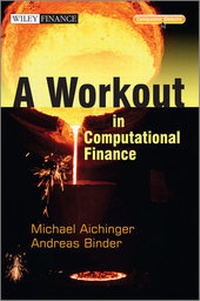
A Workout in Computational Finance
Published on 6. August 2013
336 pages
978-1-119-97348-5 (ISBN)
Description

A comprehensive introduction to various numerical methods usedin computational finance today
Quantitative skills are a prerequisite for anyone working infinance or beginning a career in the field, as well as riskmanagers. A thorough grounding in numerical methods is necessary,as is the ability to assess their quality, advantages, andlimitations. This book offers a thorough introduction to eachmethod, revealing the numerical traps that practitioners frequentlyfall into. Each method is referenced with practical, real-worldexamples in the areas of valuation, risk analysis, and calibrationof specific financial instruments and models. It features a strongemphasis on robust schemes for the numerical treatment of problemswithin computational finance. Methods covered include PDE/PIDEusing finite differences or finite elements, fast and stablesolvers for sparse grid systems, stabilization and regularizationtechniques for inverse problems resulting from the calibration offinancial models to market data, Monte Carlo and Quasi Monte Carlotechniques for simulating high dimensional systems, and local andglobal optimization tools to solve the minimization problem.
Reviews / Votes
"Mathematical Finance needs both: a well-founded theorybased on stochastic calculus as well as numerical valuation schemesthat work. In A Workout in Computational Finance the authorsput emphasis on the numerical aspects and present an impressiverange of numerical methods. All these techniques have beenimplemented by their group and can be used as a starting point forbuilding a professional software system." --Walter Schachermayer, Full Professor forMathematical Finance, University of Vienna "With their strong background in numerical simulation ofindustrial problems, the authors succeed to develop the concepts ofdifferent numerical schemes which are useful for computationalfinance and essential for valuation, risk analysis and the riskmanagement of financial instruments. Especially in times ofdifficult market environments, the mathematical and algorithmicfoundation of software used in banking must be a solid one whichavoids additional traps of poor implementation. A Workout inComputational Finance gives clear recommendations for thepreferred numerical methods for various models and instruments. Thebook will be utmost useful for practitioners but it also will be ofgreat interest for researchers in the field." --Gerhard Larcher, Institute of MathematicalFinance, Kepler Universität "The authors cover a broad range of numerical techniquesfor differential equations in computational finance, such as finiteelements, trees, Monte Carlo, Fourier techniques and parametercalibration. Using sound, yet compact mathematical reasoning, theycapture the substance of models for interest rate and equityderivatives, and provide hands-on guidance to numerics, coveringall sorts of practical challenges. A vast number of numericalresults illustrate potential implementation pitfalls and themitigation techniques presented. With its strong focus on tangibleusability this book is a highly valuable manual for students aswell as professionals." --Robert Maringer, Head Valuation ControlSwitzerland, Credit Suisse "For shaping your body you should go to a gym, while forbuilding up your numerical toolkit you need a workout incomputational finance. This modern treatment of numerical methodsin quantitative finance addresses problems that professionalsworking in the field face on a daily basis. The very clearpresentation of the material also makes it a perfect fit forstudents having a background in the theory of mathematical financewho want to gain insight on how practical problems are tackled inthe industry." --Philipp Mayer, Financial Modeling, ING FinancialMarkets, BrusselsMore details
Other editions
Additional editions

Book
08/2013
Wiley
€95.50
Shipment within 15-20 days
Persons
MICHAEL AICHINGER obtained his Ph.D. in Theoretical Physics from the Johannes Kepler University Linz with a thesis on numerical methods in density functional theory and their application to 2D finite electron systems. A mobility grant led him to the Texas A&M University (2003) and to the Helsinki University of Technology (2004). In 2007 Michael Aichinger joined the Industrial Mathematics Competence Center where he has been working as a senior researcher and consultant in the field of quantitative finance for the last five years. He also works for the Austrian Academy of Sciences at the Radon Institute for Computational and Applied Mathematics where he is involved in several industrial mathematics and computational physics projects. Michael has (co-) authored around 20 journal articles in the fields of computational physics and quantitative finance.
ANDREAS BINDER obtained his Ph.D. in Industrial Mathematics from the Johannes Kepler University Linz with a thesis on continuous casting of steel. A research grant led him to the Oxford Center for Industrial and Applied Mathematics, UK, in 1991, where he got in touch with mathematical finance for the first time. After some years being an assistant professor at the Industrial Mathematics Institute, in 1996, he left university and became managing director of MathConsult GmbH, where he heads also the Computational Finance Group. Andreas has authored two introductory books on mathematical finance and 25 journal articles in the fields of industrial mathematics and of mathematical finance.
Content
- Intro
- A Workout in Computational Finance
- Contents
- Acknowledgements
- About the Authors
- 1 Introduction and Reading Guide
- 2 Binomial Trees
- 2.1 Equities and Basic Options
- 2.2 The One Period Model
- 2.3 The Multiperiod Binomial Model
- 2.4 Black-Scholes and Trees
- 2.5 Strengths and Weaknesses of Binomial Trees
- 2.5.1 Ease of Implementation
- 2.5.2 Oscillations
- 2.5.3 Non-recombining Trees
- 2.5.4 Exotic Options and Trees
- 2.5.5 Greeks and Binomial Trees
- 2.5.6 Grid Adaptivity and Trees
- 2.6 Conclusion
- 3 Finite Differences and the Black-Scholes PDE
- 3.1 A Continuous Time Model for Equity Prices
- 3.2 Black-Scholes Model: From the SDE to the PDE
- 3.3 Finite Differences
- 3.4 Time Discretization
- 3.5 Stability Considerations
- 3.6 Finite Differences and the Heat Equation
- 3.6.1 Numerical Results
- 3.7 Appendix: Error Analysis
- 4 Mean Reversion and Trinomial Trees
- 4.1 Some Fixed Income Terms
- 4.1.1 Interest Rates and Compounding
- 4.1.2 Libor Rates and Vanilla Interest Rate Swaps
- 4.2 Black76 for Caps and Swaptions
- 4.3 One-Factor Short Rate Models
- 4.3.1 Prominent Short Rate Models
- 4.4 The Hull-White Model in More Detail
- 4.5 Trinomial Trees
- 5 Upwinding Techniques for Short Rate Models
- 5.1 Derivation of a PDE for Short Rate Models
- 5.2 Upwind Schemes
- 5.2.1 Model Equation
- 5.3 A Puttable Fixed Rate Bond under the Hull-White One Factor Model
- 5.3.1 Bond Details
- 5.3.2 Model Details
- 5.3.3 Numerical Method
- 5.3.4 An Algorithm in Pseudocode
- 5.3.5 Results
- 6 Boundary, Terminal and Interface Conditions and their Influence
- 6.1 Terminal Conditions for Equity Options
- 6.2 Terminal Conditions for Fixed Income Instruments
- 6.3 Callability and Bermudan Options
- 6.4 Dividends
- 6.5 Snowballs and TARNs
- 6.6 Boundary Conditions
- 6.6.1 Double Barrier Options and Dirichlet Boundary Conditions
- 6.6.2 Artificial Boundary Conditions and the Neumann Case
- 7 Finite Element Methods
- 7.1 Introduction
- 7.1.1 Weighted Residual Methods
- 7.1.2 Basic Steps
- 7.2 Grid Generation
- 7.3 Elements
- 7.3.1 1D Elements
- 7.3.2 2D Elements
- 7.4 The Assembling Process
- 7.4.1 Element Matrices
- 7.4.2 Time Discretization
- 7.4.3 Global Matrices
- 7.4.4 Boundary Conditions
- 7.4.5 Application of the Finite Element Method to Convection-Diffusion-Reaction Problems
- 7.5 A Zero Coupon Bond Under the Two Factor Hull-White Model
- 7.6 Appendix: Higher Order Elements
- 7.6.1 3D Elements
- 7.6.2 Local and Natural Coordinates
- 8 Solving Systems of Linear Equations
- 8.1 Direct Methods
- 8.1.1 Gaussian Elimination
- 8.1.2 Thomas Algorithm
- 8.1.3 LU Decomposition
- 8.1.4 Cholesky Decomposition
- 8.2 Iterative Solvers
- 8.2.1 Matrix Decomposition
- 8.2.2 Krylov Methods
- 8.2.3 Multigrid Solvers
- 8.2.4 Preconditioning
- 9 Monte Carlo Simulation
- 9.1 The Principles of Monte Carlo Integration
- 9.2 Pricing Derivatives with Monte Carlo Methods
- 9.2.1 Discretizing the Stochastic Differential Equation
- 9.2.2 Pricing Formalism
- 9.2.3 Valuation of a Steepener under a Two Factor Hull-White Model
- 9.3 An Introduction to the Libor Market Model
- 9.4 Random Number Generation
- 9.4.1 Properties of a Random Number Generator
- 9.4.2 Uniform Variates
- 9.4.3 Random Vectors
- 9.4.4 Recent Developments in Random Number Generation
- 9.4.5 Transforming Variables
- 9.4.6 Random Number Generation for Commonly Used Distributions
- 10 Advanced Monte Carlo Techniques
- 10.1 Variance Reduction Techniques
- 10.1.1 Antithetic Variates
- 10.1.2 Control Variates
- 10.1.3 Conditioning
- 10.1.4 Additional Techniques for Variance Reduction
- 10.2 Quasi Monte Carlo Method
- 10.2.1 Low-Discrepancy Sequences
- 10.2.2 Randomizing QMC
- 10.3 Brownian Bridge Technique
- 10.3.1 A Steepener under a Libor Market Model
- 11 Valuation of Financial Instruments with Embedded American/Bermudan Options within Monte Carlo Frameworks
- 11.1 Pricing American options using the Longstaff and Schwartz algorithm
- 11.2 A Modified Least Squares Monte Carlo Algorithm for Bermudan Callable Interest Rate Instruments
- 11.2.1 Algorithm: Extended LSMC Method for Bermudan Options
- 11.2.2 Notes on Basis Functions and Regression
- 11.3 Examples
- 11.3.1 A Bermudan Callable Floater under Different Short-rate Models
- 11.3.2 A Bermudan Callable Steepener Swap under a Two Factor Hull-White Model
- 11.3.3 A Bermudan Callable Steepener Cross Currency Swap in a 3D IR/FX Model Framework
- 12 Characteristic Function Methods for Option Pricing
- 12.1 Equity Models
- 12.1.1 Heston Model
- 12.1.2 Jump Diffusion Models
- 12.1.3 Infinite Activity Models
- 12.1.4 Bates Model
- 12.2 Fourier Techniques
- 12.2.1 Fast Fourier Transform Methods
- 12.2.2 Fourier-Cosine Expansion Methods
- 13 Numerical Methods for the Solution of PIDEs
- 13.1 A PIDE for Jump Models
- 13.2 Numerical Solution of the PIDE
- 13.2.1 Discretization of the Spatial Domain
- 13.2.2 Discretization of the Time Domain
- 13.2.3 A European Option under the Kou Jump Diffusion Model
- 13.3 Appendix: Numerical Integration via Newton-Cotes Formulae
- 14 Copulas and the Pitfalls of Correlation
- 14.1 Correlation
- 14.1.1 Pearson's ?
- 14.1.2 Spearman's ?
- 14.1.3 Kendall's ?
- 14.1.4 Other Measures
- 14.2 Copulas
- 14.2.1 Basic Concepts
- 14.2.2 Important Copula Functions
- 14.2.3 Parameter estimation and sampling
- 14.2.4 Default Probabilities for Credit Derivatives
- 15 Parameter Calibration and Inverse Problems
- 15.1 Implied Black-Scholes Volatilities
- 15.2 Calibration Problems for Yield Curves
- 15.3 Reversion Speed and Volatility
- 15.4 Local Volatility
- 15.4.1 Dupire's Inversion Formula
- 15.4.2 Identifying Local Volatility
- 15.4.3 Results
- 15.5 Identifying Parameters in Volatility Models
- 15.5.1 Model Calibration for the FTSE-100
- 16 Optimization Techniques
- 16.1 Model Calibration and Optimization
- 16.1.1 Gradient-Based Algorithms for Nonlinear Least Squares Problems
- 16.2 Heuristically Inspired Algorithms
- 16.2.1 Simulated Annealing
- 16.2.2 Differential Evolution
- 16.3 A Hybrid Algorithm for Heston Model Calibration
- 16.4 Portfolio Optimization
- 17 Risk Management
- 17.1 Value at Risk and Expected Shortfall
- 17.1.1 Parametric VaR
- 17.1.2 Historical VaR
- 17.1.3 Monte Carlo VaR
- 17.1.4 Individual and Contribution VaR
- 17.2 Principal Component Analysis
- 17.2.1 Principal Component Analysis for Non-scalar Risk Factors
- 17.2.2 Principal Components for Fast Valuation
- 17.3 Extreme Value Theory
- 18 Quantitative Finance on Parallel Architectures
- 18.1 A Short Introduction to Parallel Computing
- 18.2 Different Levels of Parallelization
- 18.3 GPU Programming
- 18.3.1 CUDA and OpenCL
- 18.3.2 Memory
- 18.4 Parallelization of Single Instrument Valuations using (Q)MC
- 18.5 Parallelization of Hybrid Calibration Algorithms
- 18.5.1 Implementation Details
- 18.5.2 Results
- 19 Building Large Software Systems for the Financial Industry
- Bibliography
- Index
