

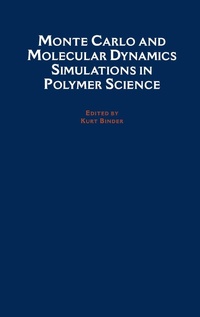
Monte Carlo and Molecular Dynamics Simulations in Polymer Science
1st Edition
Published on 3. August 1995
602 pages
978-0-19-535746-2 (ISBN)
Description

Written by leading experts from around the world, Monte Carlo and Molecular Dynamics Simulations in Polymer Science comprehensively reviews the latest simulation techniques for macromolecular materials. Focusing in particular on numerous new techniques, the book offers authoritative introductions to solutions of neutral polymers and polyelectrolytes; dynamics of polymer melts, rubbers and gels, and glassy materials; thermodynamics of polymer mixing and mesophase formation, and polymers confined at interfaces and grafted to walls. Throughout, contributors offer practical advice on how to overcome the unique challenges posed by the large size and slow relaxation of polymer coils. Students and researchers in polymer chemistry, polymer physics, chemical engineering, and materials and computational science will all benefit from the cogent, step-by-step introductions contained in this important new book.
More details
Other editions
Additional editions
Book
04/1996
Oxford University Press Inc
€288.50
Shipment within 15-20 days
Content
- Intro
- Contents
- 1. Introduction: General Aspects of Computer Simulation Techniques and their Applications in Polymer Physics
- 1.1 Why is the computer simulation of polymeric materials a challenge?
- 1.1.1 Length scales
- 1.1.2 Time scales
- 1.2 Survey of simplified models
- 1.2.1 Off-lattice models
- 1.2.2 Lattice models
- 1.3 Taking the idea of coarse-graining literally
- 1.3.1 Effective potentials for the bond fluctuation model
- 1.3.2 How different coarse-grained models can be compared
- 1.4 Selected issues on computational techniques
- 1.4.1 Sampling the chemical potential in NVT simulations
- 1.4.2 Calculation of pressure in dynamic Monte Carlo methods
- 1.5 Final remarks
- References
- 2. Monte Carlo Methods for the Self-Avoiding Walk
- 2.1 Introduction
- 2.1.1 Why is the SAW a sensible model?
- 2.1.2 Numerical methods for the self-avoiding walk
- 2.2 The self-avoiding walk (SAW)
- 2.2.1 Background and notation
- 2.2.2 The ensembles
- 2.3 Monte Carlo methods: a review
- 2.3.1 Static Monte Carlo methods
- 2.3.2 Dynamic Monte Carlo methods
- 2.4 Static Monte Carlo methods for the SAW
- 2.4.1 Simple sampling and its variants
- 2.4.2 Inversely restricted sampling (Rosenbluth-Rosenbluth algorithm)
- 2.4.3 Dimerization
- 2.5 Quasi-static Monte Carlo methods for the SAW
- 2.5.1 Quasi-static simple sampling
- 2.5.2 Enrichment
- 2.5.3 Incomplete enumeration (Redner-Reynolds algorithm)
- 2.6 Dynamic Monte Carlo methods for the SAW
- 2.6.1 General considerations
- 2.6.2 Classification of moves
- 2.6.3 Examples of moves
- 2.6.4 Fixed-N, variable-x algorithms
- 2.6.5 Fixed-N, fixed-x algorithms
- 2.6.6 Variable-N, variable-x algorithms
- 2.6.7 Variable-N, fixed-x algorithms
- 2.7 Miscellaneous issues
- 2.7.1 Data structures
- 2.7.2 Measuring virial coefficients
- 2.7.3 Statistical analysis
- 2.8 Some applications of the algorithms
- 2.8.1 Linear polymers in dimension d = 3
- 2.8.2 Linear polymers in dimension d = 2
- 2.9 Conclusions
- 2.9.1 Practical recommendations
- 2.9.2 Open problems
- References
- 3. Structure and Dynamics of Neutral and Charged Polymer Solutions: Effects of Long-Range Interactions
- 3.1 Introduction
- 3.2 Dynamics of neutral polymer chains in dilute solution
- 3.2.1 Theoretical background
- 3.2.2 Simulations
- 3.3 Structure of charged polymer solutions
- 3.3.1 Theoretical models
- 3.3.2 Experiment
- 3.3.3 Simulation methods
- 3.3.4 Simulation results
- 3.4 Conclusion
- References
- 4. Entanglement Effects in Polymer Melts and Networks
- 4.1 Introduction
- 4.2 Theoretical concepts
- 4.2.1 Unentangled melt
- 4.2.2 Entangled melt
- 4.3 Model and method
- 4.4 Simulations of uncrosslinked polymers
- 4.4.1 Reptation simulations
- 4.4.2 Melt simulations on a "molecular level
- 4.4.3 Comparison to experiment
- 4.4.4 Semidilute solutions
- 4.5 Polymer networks
- 4.5.1 Network elasticity
- 4.5.2 Networks with fixed crosslinks
- 4.5.3 Fully mobile systems
- 4.6 Conclusions
- References
- 5. Molecular Dynamics of Glassy Polymers
- 5.1 Introduction
- 5.2 Molecular dynamics for polymers
- 5.3 Force fields
- 5.4 Preparation of polymer melt samples
- 5.4.1 Building polymer structures
- 5.4.2 Introducing excluded volume
- 5.4.3 Sample relaxation
- 5.4.4 Sample size effects
- 5.5 Preparation of polymer glasses
- 5.5.1 Glass preparation by computer simulation
- 5.5.2 The glass transformation on different time scales
- 5.6 Stress-strain properties
- 5.6.1 Uniaxial tension simulations
- 5.6.2 Stress-strain behavior and configurational properties
- 5.7 Penetrant diffusion
- 5.8 Local motions in amorphous polymers
- References
- 6. Monte Carlo Simulations of the Glass Transition of Polymers
- 6.1 Introduction
- 6.2 Model and simulation technique
- 6.2.1 The definition of the bond fluctuation model
- 6.2.2 Hamiltonians and cooling procedures
- 6.3 Results for the schematic models
- 6.3.1 Structural properties of the melt
- 6.3.2 Dynamic properties of the melt
- 6.4 Modeling of specific polymers
- 6.4.1 How to map naturalistic models to abstract models
- 6.4.2 Modeling bisphenol-A-polycarbonate
- 6.5 Summary
- References
- 7. Monte Carlo Studies of Polymer Blends and Block Copolymer Thermodynamics
- 7.1 Introduction
- 7.2 Simulation methodology
- 7.2.1 Dynamic algorithms and the role of vacancies
- 7.2.2 The semi-grand-canonical technique for polymer blends
- 7.2.3 Other ensembles
- 7.2.4 Finite size scaling
- 7.2.5 Technical problems of simulations of block copolymer mesophases
- 7.2.6 Interfacial structure, surface enrichment, interdiffusion, spinodal decomposition
- 7.3 Results for polymer blends
- 7.3.1 Test of the Flory-Huggins theory and of the Schweizer-Curro theory
- 7.3.2 Critical phenomena and the Ising-mean field crossover
- 7.3.3 Asymmetric mixtures
- 7.3.4 Chain conformations in blends
- 7.3.5 Interdiffusion and phase separation kinetics
- 7.3.6 Surfaces of polymer blends and wetting transitions
- 7.4 Results for block copolymers
- 7.4.1 Test of the Leibler theory
- 7.4.2 Chain conformations and the breakdown of the random phase approximation (RPA)
- 7.4.3 Asymmetric block copolymers
- ring polymers
- 7.4.4 Block copolymers in reduced geometry: thin films, interfaces, etc.
- 7.5 Discussion
- References
- 8. Simulation Studies of Polymer Melts at Interfaces
- 8.1 Introduction
- 8.2 Systems of atomistic chains
- 8.2.1 General considerations
- 8.2.2 Models and methods
- 8.2.3 Liquid n-tridecane near impenetrable walls by Monte Carlo simulations
- 8.2.4 N-Alkane systems near neutral and attractive surfaces by SD and MD simulations
- 8.2.5 Liquid tridecane in a narrow and a broad slit in equilibrium
- 8.2.6 Systems with free surfaces
- 8.2.7 Explicit atom simulations of n-alkanes at interfaces
- 8.2.8 Comparison of atomistic simulations with Scheutjens-Fleer lattice theory
- 8.3 Systems of bead chains
- 8.3.1 General considerations
- 8.3.2 Models and methods
- 8.3.3 Results
- 8.4 Conclusions
- References
- 9. Computer Simulations of Tethered Chains
- 9.1 Introduction
- 9.2 Models and methods
- 9.2.1 Lattice models
- 9.2.2 Off-lattice models
- 9.2.3 Numerical solution of SCF equations
- 9.3 Polymers tethered to a point
- 9.3.1 Star polymers in a good solvent
- 9.3.2 Star polymers in a Ø and poor solvent
- 9.3.3 Relaxation of star polymers
- 9.4 Polymers tethered to a line
- 9.4.1 Polymers tethered to an inflexible line
- 9.4.2 Polymers tethered to a flexible line
- 9.5 Polymeric brushes
- 9.5.1 Brushes in good solvents
- 9.5.2 Brushes in Ø and poor solvents
- 9.5.3 Attractive grafting surfaces
- 9.5.4 Polydispersity effects
- 9.5.5 Interaction between brushes
- 9.5.6 Brushes on curved surfaces
- 9.5.7 Brushes without a solvent
- 9.5.8 Time-dependent phenomena
- 9.6 Polymers tethered to themselves
- 9.6.1 Flory theory
- 9.6.2 High-temperature flat phase
- 9.6.3 Effect of attractive interactions
- 9.7 Conclusions
- References
- Index
- A
- B
- C
- D
- E
- F
- G
- H
- I
- J
- K
- L
- M
- N
- O
- P
- Q
- R
- S
- T
- U
- V
- W
- Y
- Z
