

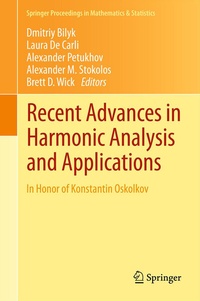
Recent Advances in Harmonic Analysis and Applications
Description

Recent Advances in Harmonic Analysis and Applications features selected contributions from the AMS conference which took place at Georgia Southern University, Statesboro in 2011 in honor of Professor Konstantin Oskolkov's 65th birthday. The contributions are based on two special sessions, namely "Harmonic Analysis and Applications" and "Sparse Data Representations and Applications." Topics covered range from Banach space geometry to classical harmonic analysis and partial differential equations. Survey and expository articles by leading experts in their corresponding fields are included, and the volume also features selected high quality papers exploring new results and trends in Muckenhoupt-Sawyer theory, orthogonal polynomials, trigonometric series, approximation theory, Bellman functions and applications in differential equations.
Graduate students and researchers in analysis will be particularly interested in the articles which emphasize remarkable connections between analysis and analytic number theory. The readers will learn about recent mathematical developments and directions for future work in the unexpected and surprising interaction between abstract problems in additive number theory and experimentally discovered optical phenomena in physics. This book will be useful for number theorists, harmonic analysts, algorithmists in multi-dimensional signal processing and experts in physics and partial differential equations.
Reviews / Votes
From the reviews:
"These are the proceedings of a conference held in honor of Konstantin Oskolkov at the Georgian Southern University March 11-13, 2011. . The main part of the book consists of 23 contributions from the conference. . the book will be a natural choice to be bought by a library having a section on analysis. It gives a nice survey of topics that are currently being investigated." (A. Bultheel, The European Mathematical Society, December, 2012)More details
Other editions
Additional editions
Content
- Intro
- Recent Advances in Harmonic Analysis and Applications
- Preface
- Contents
- Part I Konstantin Oskolkov
- On the Scientific Work of Konstantin Ilyich Oskolkov
- References
- K. I. Oskolkov
- References
- My First Meetings with Konstantin Oskolkov
- References
- Meetings with Kostya Oskolkov
- Konstantin Ilyich Oskolkov, Friend and Colleague
- 1 Mathematical Interests
- 2 Armenia, 2001
- 3 Friendship and Mushrooms
- The Activity of K. I. Oskolkov in Nonlinear Approximationof Functions
- References
- How Young We Were
- References
- Part II Contributed Papers
- A Survey of Multidimensional Generalizations of Cantor's Uniqueness Theorem for Trigonometric Series
- 1 Introduction
- 2 History of the Three Theorems
- 3 The Questions
- References
- The L2 Discrepancy of Two-Dimensional Lattices
- 1 Introduction
- 1.1 Discrepancy
- 2 The L2 Discrepancy of the Fibonacci Set
- 3 General Lattices
- 4 Further Remarks
- References
- On Fourier Multipliers Over Tube Domains
- 1 Introduction
- 3 Polygonal Cones and Fourier Multipliers
- References
- Multiparameter Projection Theorems with Applications to Sums-Products and Finite Point Configurations in the Euclidean Setting
- 1 Introduction
- 1.1 Applications to the Finite Point Configurations
- 2 Proofs of Main Results
- 2.1 Proof of the Projection Results (Theorem 3)
- 2.2 Proof of Applications to Sums and Products (Corollary 1)
- 2.3 Proof of the Spherical Configuration Result (Theorem 4)
- 3 Proof of the Euclidean Configuration Result (3)
- References
- Riesz Potentials, Bessel Potentials, and Fractional Derivatives on Besov-Lipschitz Spaces for the Gaussian Measure
- 1 Introduction
- 2 Main Results and Proofs
- References
- Maximal Operators Associated to Sets of Directions of Hausdorff and Minkowski Dimension Zero
- 1 Introduction
- 2 Maximal Operators Associated to Sets of Directions of Hausdorff Dimension Zero
- 3 Maximal Operators Associated to Sets of Directions of Minkowski Dimension Zero
- References
- Distance Graphs in Vector Spaces Over Finite Fields
- 1 Introduction
- 1.1 Diameter of the Distance Graph and Related Objects
- 1.2 Kaleidoscopic Pseudorandomness
- 2 Classical Exponential Sums and Fourier Decay Estimates
- 3 Proof of Theorem 1
- 4 Proof of Theorem 2
- 4.1 The Proof of the First and Second Part of Theorem 2
- 4.2 The Proof of the Third Part of Theorem 2
- 5 Proof of the ``Kaleidoscopic" Result (Theorem 4)
- 5.1 The Induction Step
- References
- Remarks on Extremals in Minimal Support Inequalities
- 1 Introduction
- 2 Energy Functionals
- 3 Applications to Other Differential Equations
- 4 Towards a General Theory
- 5 Further Results and Remarks
- References
- On Fubini Type Property in Lorentz Spaces
- 1 Introduction
- 2 A Counterexample for Mixed Norm Spaces
- 3 Fubini-Type Property
- References
- Some Applications of Equimeasurable Rearrangements
- 1 Classes of Functions Defined by Conditions on Their Average Oscillations
- 1.1 Functions of Bounded Mean Oscillation
- 1.2 The Gurov-Reshetnyak Class
- 2 The Self-Improvement Properties of Functions from the Gehring and Muckenhoupt Classes
- References
- Maximal Functions Measuring Smoothness
- 1 Calderón-Kolyada Maximal Functions
- 1.1 Notation
- 1.2 The Definition of Maximal Functions
- 1.3 Measuring Local Smoothness
- 1.4 Bounds of N? on [0,1]n
- 1.5 Sobolev-Type Embedding Theorems
- 2 Operators N? on Metric Measure Spaces
- 2.1 The Classes Cp?(X) on Metric Spaces
- 2.2 The Relation Between Operators N? and S?
- 2.3 Sobolev Classes on Metric Spaces
- 2.4 Various Characterizations of Cp?(X)
- 2.5 Embedding Theorems
- 2.6 Weighted Inequalities for S-.4?-.4
- 3 Fine Properties of Functions
- 3.1 Lebesgue Points
- 3.2 Luzin Approximation
- 4 Compactness Criteria
- 4.1 Compactness Criteria in L0
- 4.2 Compactness Criteria in Lp, p&0
- 5 Sobolev-Poincaré Inequalities
- 5.1 Approximation by Steklov Averages Revisited
- 5.2 The Case a-.4 p-.4 ?-.4
- 5.3 The Self-Improvement of Poincaré Inequality
- References
- Estimates for the Exceptional Lebesgue Sets of Functions from Sobolev Classes
- 1 Introduction
- 2 Main Result
- 2.1 Calderón Classes
- 2.2 Capacity and Hausdorff Measure
- 2.3 Estimates of the Sets ?(f)
- 3 Auxiliary Tools
- 3.1 The Properties of Gradients
- 3.2 The Construction of the Set Q(ß)
- 4 Proof of Theorem 2
- 5 Sobolev Classes Wpl(RN)
- References
- On the A2 Inequality for Calderón-Zygmund Operators
- 1 Introduction: Main Theorem
- 2 Haar Shift Operators
- 3 The Basic Inequalities
- 4 Proof of the Weighted Estimate for the Haar Shift Operators
- References
- Quest for Negative Dependency Graphs
- 1 Introduction
- 2 Examples of Negative Dependency Graphs
- 2.1 Random Matchings in Complete Uniform Hypergraphs
- 2.2 Random Matchings in Complete Multipartite Graphs
- 2.3 Spanning Trees in Complete Graphs
- 2.4 Upper Ideals in Distributive Lattices
- 2.5 Symmetric Events
- 3 Open Problems
- 3.1 Maximum Size Matchings in Graphs
- 3.2 Partition Lattice
- 3.3 Permanent of Doubly Stochastic Matrices
- References
- A Quantitative Open Mapping Theorem for Quasi-Pseudonormed Groups
- 1 Introduction
- 2 Algebraical and Topological Preliminaries
- 3 Quasi-Pseudonormed Groups
- 4 A Quantitative Open Mapping Theorem
- References
- The Buckley Dyadic Square Function
- 1 Introduction
- 2 Proof of Theorem 2
- 3 The Exponential-Square Estimate for f: ``Bellman'' Proof
- 4 The Exponential-Square Estimate for f: Combinatorial Proof
- References
- L-Bounds for the L2-Projection onto Linear Spline Spaces
- 1 Introduction
- 2 Sufficient Geometric Conditions
- 3 Triangulations Obtained from Tensor-Product Rectangular Partitions
- References
- Fast Implementation of 1-Greedy Algorithm
- 1 Introduction
- 2 Basic Algorithms
- 2.1 1-Norm Minimization
- 2.2 Reweighted 1-Minimization
- 2.3 1-Greedy Algorithm
- 2.4 Fast Orthogonal Greedy Algorithm
- 3 Fast 1-Greedy Algorithm
- 4 Numerical Experiments
- References
- Harmonic Analysis and Uniqueness Questions in Convex Geometry
- 1 Introduction and Notation
- 2 Typical Result
- 3 Central Sections
- 4 Maximal Sections
- 5 t-Sections
- 6 Slabs
- 7 Projections
- 8 Symmetry
- References
- Moduli of Smoothness and Rate of a.e. Convergence for Some Convolution Operators
- 1 Introduction
- 2 Proof of Theorem 1.3
- 3 Generalizations
- References
- On the Littlewood-Paley Inequalities for Subharmonic Functions on Domains in Rn
- 1 Introduction
- 2 Notation and Statement of Results
- 3 Preliminary Results and Key Lemmas
- 4 Proofs of the Main Results
- 5 The Littlewood-Paley Inequalities for Lipschitz Domains
- 6 The Case 0&-.4p-.4 1
- References
- The Path to ?-Bounded Variation
- 1 Introduction
- 2 The Salem Test
- References
- Stability and Robustness of Weak Orthogonal Matching Pursuits
- 1 Introduction and Main Results
- 2 Sparse Recovery via Weak Orthogonal Matching Pursuits
- 3 Pure OMP as a Weak OMP Under RIP
- References
