

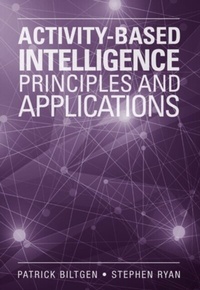
Activity-Based Intelligence
Principles and Applications
1st Edition
Published on 31. December 2015
484 pages
978-1-60807-877-6 (ISBN)
Description

This new resource presents the principles and applications in the emerging discipline of Activity-Based Intelligence (ABI). This book will define, clarify, and demystify the tradecraft of ABI by providing concise definitions, clear examples, and thoughtful discussion. Concepts, methods, technologies, and applications of ABI have been developed by and for the intelligence community and in this book you will gain an understanding of ABI principles and be able to apply them to activity based intelligence analysis.The book is intended for intelligence professionals, researchers, intelligence studies, policy makers, government staffers, and industry representatives. This book will help practicing professionals understand ABI and how it can be applied to real-world problems.
More details
Other editions
Additional editions
Book
12/2015
Artech House Publishers
€174.50
Shipment within 10-20 days
Content
- Activity-Based Intelligence: Principles and Applications
- Foreword
- Preface
- 1 Introduction and Motivation
- 1.1 The Fourth Age of Intelligence
- 1.1.1 An Era of Dynamic Change and Diverse Threats
- 1.1.2 The Convergence of Technology and the Dawn of Big Data
- 1.1.3 Multi-INT Tradecraft: Visualization, Statistics, and Spatiotemporal Analysis
- 1.1.4 The Need for a New Methodology
- 1.2 Introducing ABI
- 1.2.1 The Primacy of Location
- 1.2.2 From Target-Based to Activity-Based
- 1.2.3 Shifting the Focus to Discovery
- 1.2.4 Discovery Versus Search
- 1.2.5 Discovery: An Example
- 1.2.6 Summary: The Key Attributes of ABI
- 1.3 Organization of this Textbook
- 1.4 Disclaimer About Sources and Methods
- 1.5 A Focus on Geospatial Intelligence (GEOINT)
- 1.6 Suggested Readings
- References
- 2 ABI History and Origins
- 2.1 Wartime Beginnings
- 2.2 OUSD(I) Studies and the Origin of the Term ABI
- 2.3 Human Domain Analytics
- 2.4 ABI Research and Development
- 2.5 ABI-Enabling Technology Accelerates
- 2.6 Evolution of the Terminology
- 2.7 Summary
- References
- 3 Discovering the Pillars of ABI
- 3.1 The First Day of a Different War
- 3.2 Georeference to Discover: "Everything Happens Somewhere"
- 3.2.1 First-Degree Direct Georeference
- 3.2.2 First-Degree Indirect Georeference
- 3.2.3 Second-Degree Georeference
- 3.3 Discover to Georeference Versus Georeference to Discover
- 3.4 Data Neutrality: Seeding the Multi-INT Spatial Data Environment
- 3.5 Integration Before Exploitation: From Correlation to Discovery
- 3.6 Sequence Neutrality: Temporal Implications for Data Correlation
- 3.6.1 Sequence Neutrality's Focus on Metadata: Section 215 and the Bulk Telephony Metadata Program Under the USA Patriot Act
- 3.7 After Next: From Pillars, to Concepts, to Practical Applications
- 3.8 Summary
- References
- 4 The Lexicon of ABI
- 4.1 Ontology for ABI
- 4.2 Activity Data: "Things People Do"
- 4.2.1 "Activity" Versus "Activities"
- 4.2.2 Events and Transactions
- 4.2.3 Transactions: Temporal Registration
- 4.2.4 Event or Transaction? The Answer is (Sometimes) Yes
- 4.3 Contextual Data: Providing the Backdrop to Understand Activity
- 4.4 Biographical Data: Attributes of Entities
- 4.5 Relational Data: Networks of Entities
- 4.6 Analytical and Technological Implications
- 4.7 Summary
- References
- 5 Analytical Methods and ABI
- 5.1 Revisiting the Modern Intelligence Framework
- 5.2 The Case for Discovery
- 5.3 The Spectrum of "INTS" and Exploitation Versus Finished Intelligence
- 5.4 Decomposing an Intelligence Problem for ABI
- 5.5 The W3 Approaches: Locations Connected Through People and People Connected Through Locations
- 5.5.1 Relating Entities Through Common Locations
- 5.5.2 Relating Locations Through Common Entities
- 5.6 Assessments: What Is Known Versus What Is Believed
- 5.7 Facts: What Is Known
- 5.8 Assessments: What Is Believed or "Thought"
- 5.9 Gaps: What Is Unknown
- 5.10 Unfinished Threads
- 5.11 Leaving Room for Art And Intuition
- References
- 6 Disambiguation and Entity Resolution
- 6.1 A World of Proxies
- 6.2 Disambiguation
- 6.3 Unique Identifiers-"Better" Proxies
- 6.4 Resolving the Entity
- 6.5 Two Basic Types of Entity Resolution
- 6.5.1 Proxy-to-Proxy Resolution
- 6.5.2 Proxy-to-Entity Resolution: Indexing
- 6.6 Iterative Resolution and Limitations on Entity Resolution
- References
- 7 Discreteness and Durability in the Analytical Process
- 7.1 Real World Limits of Disambiguation and Entity Resolution
- 7.2 Applying Discreteness to Space-Time
- 7.3 A Spectrum for Describing Locational Discreteness
- 7.4 Discreteness and Temporal Sensitivity
- 7.5 Durability of Proxy-Entity Associations
- 7.7 Summary
- References
- 8 Patterns of Life and Activity Patterns
- 8.1 Entities and Patterns of Life
- 8.2 Pattern-of-Life Elements
- 8.3 The Importance of Activity Patterns
- 8.4 Normalcy and Intelligence
- 8.5 Representing Patterns of Life While Resolving Entities
- 8.5.1 Graph Representation
- 8.5.2 Quantitative and Temporal Representation
- 8.6 Enabling Action Through Patterns of Life
- References
- 9 Incidental Collection
- 9.1 A Legacy of Targets
- 9.2 Bonus Collection from Known Targets
- 9.3 Defining Incidental Collection
- 9.4 Dumpster Diving and Spatial Archive and Retrieval
- 9.5 Rethinking the Balance Between Tasking and Exploitation
- 9.6 Collecting to Maximize Incidental Gain
- 9.7 Incidental Collection and Privacy
- 9.8 Summary
- References
- 10 Data, Big Data, and Datafication
- 10.1 Data
- 10.1.1 Classifying Data: Structured, Unstructured, and Semistructured
- 10.1.2 Metadata
- 10.1.3 Taxonomies, Ontologies, and Folksonomies
- 10.2 Big Data
- 10.2.1 Volume, Velocity, and Variety.
- 10.2.2 Big Data Architecture
- 10.2.3 Big Data in the Intelligence Community
- 10.3 The Datafication of Intelligence
- 10.3.1 Collecting It "All"
- 10.3.2 Object-Based Production (OBP)
- 10.3.3 Relationship Between OBP and ABI
- 10.4 The Future of Data and Big Data
- 10.5 Summary
- References
- 11 Collection
- 11.1 Introduction to Collection
- 11.2 MOVINT with Motion Imagery
- 11.2.1 FMV
- 11.2.2 WAMI
- 11.3 MOVINT from Radar
- 11.3.1 Basic Principles of GMTI
- 11.3.2 Evolution of GMTI Collection Systems
- 11.4 Additional Sources of Activities and Transactions
- 11.5 Collection to Enable ABI
- 11.6 Persistence: The All-Seeing Eye (?)
- 11.7 The Persistence "Master Equation"
- 11.8 Space-Based Persistent Surveillance
- 11.8.1 Space-Based GMTI
- 11.8.2 Commercial Space Radar Applications
- 11.8.3 Space-Based Persistent EO Imagery
- 11.9 Summary
- References
- 12 Automated Activity Extraction
- 12.1 The Need for Automation
- 12.2 Data Conditioning
- 12.3 Georeferenced Entity and Activity Extraction
- 12.4 Object and Activity Extraction from Still Imagery
- 12.5 Object and Activity Extraction from Motion Imagery
- 12.5.1 Activity Extraction from Video
- 12.5.1 Activity and Event Extraction from WAMI
- 12.6 Tracking and Track Extraction
- 12.6.1 The Role of Sampling Rate and Resolution
- 12.6.2 Terminology: Tracks and Tracklets
- 12.6.3 The Kalman Filter
- 12.6.4 Probabilistic Tracking Frameworks
- 12.6.5 Clustering, Track Association, and Multihypothesis Tracking (MHT)
- 12.6.6 Detecting Anomalous Tracks
- 12.7 Metrics for Automated Algorithms
- 12.8 The Need for Multiple, Complimentary Sources
- 12.9 Summary
- 12.10 Acknowledgments
- References
- 13 Analysis and Visualization
- 13.1 Introduction to Analysis and Visualization
- 13.1.1 The Sexiest Job of the 21st Century.
- 13.1.2 Asking Questions and Getting Answers
- 13.2 Statistical Visualization
- 13.2.1 Scatterplots
- 13.2.2 Pareto Charts
- 13.2.3 Factor Profiling
- 13.3 Visual Analytics
- 13.4 Spatial Statistics and Visualization
- 13.4.1 Spatial Data Aggregation
- 13.4.2 Tree Maps
- 13.4.3 Three-Dimensional Scatterplot Matrix
- 13.4.4 Spatial Storytelling
- 13.5 The Way Ahead
- References
- 14 Correlation and Fusion
- 14.1 Correlation
- 14.1.1 Correlation Versus Causality
- 14.2 Fusion
- 14.2.1 A Taxonomy for Fusion Techniques
- 14.2.2 Architectures for Data Fusion
- 14.2.3 Upstream Versus Downstream Fusion
- 14.3 Mathematical Correlation and Fusion Techniques
- 14.3.1 Bayesian Probability and Application of Bayes's Theorem
- 14.3.2 Dempster-Shafer Theory
- 14.3.3 Belief Networks
- 14.4 Multi-INT Fusion For ABI
- 14.5 Examples of Multi-INT Fusion Programs
- 14.5.1 Example: A Multi-INT Fusion Architecture
- 14.5.2 Example: The DARPA Insight Program
- 14.6 Summary
- References
- 15 Knowledge Management
- 15.1 The Need for Knowledge Management
- 15.1.1 Types of Knowledge
- 15.2 Discovery of What We Know
- 15.2.1 Recommendation Engines
- 15.2.2 Data Finds Data
- 15.2.3 Queries as Data
- 15.3 The Semantic Web
- 15.3.1 XML
- 15.3.2 Resource Description Framework (RDF)
- 15.4 Graphs for Knowledge and Discovery
- 15.4.1 Graphs and Linked Data
- 15.4.2 Provenance
- 15.4.3 Using Graphs for Multianalyst Collaboration
- 15.5 Information and Knowledge Sharing
- 15.6 Wikis, Blogs, Chat, and Sharing
- 15.7 Crowdsourcing
- 15.8 Summary
- References
- 16 Anticipatory Intelligence
- 16.1 Introduction to Anticipatory Intelligence
- 16.1.1 Prediction, Forecasting, and Anticipation
- 16.2 Modeling for Anticipatory Intelligence
- 16.2.1 Models and Modeling
- 16.2.2 Descriptive Versus Anticipatory/Predictive Models
- 16.3 Machine Learning, Data Mining, and Statistical Models
- 16.3.1 Rule-Based Learning
- 16.3.2 Case-Based Learning
- 16.3.3 Unsupervised Learning
- 16.3.4 Sensemaking
- 16.4 Rule Sets and Event-Driven Architectures
- 16.4.1 Event Processing Engines
- 16.4.2 Simple Event Processing: Geofencing, Watchboxes, and Tripwires
- 16.4.3 CEP
- 16.4.4 Tipping and Cueing
- 16.5 Exploratory Models
- 16.5.1 Basic Exploratory Modeling Techniques
- 16.5.2 Advanced Exploratory Modeling Techniques
- 16.5.3 ABM
- 16.5.4 System Dynamics Model
- 16.6 Model Aggregation
- 16.7 The Wisdom of Crowds
- 16.8 Shortcomings of Model-Based Anticipatory Analytics
- 16.9 Modeling in ABI
- 16.10 Summary
- References
- 17 ABI in Policing
- 17.1 The Future of Policing
- 17.2 Intelligence-Led Policing: An Introduction
- 17.2.1 Statistical Analysis and CompStat
- 17.2.2 Routine Activities Theory
- 17.3 Crime Mapping
- 17.3.1 Standardized Reporting Enables Crime Mapping
- 17.3.2 Spatial and Temporal Analysis of Patterns
- 17.4 Unraveling the Network
- 17.5 Predictive Policing
- 17.6 Summary
- 17.7 Further Reading
- 17.8 Chapter Author Biography
- References
- 18 ABI and the D.C. Beltway Sniper
- 18.1 Introduction
- 18.2 Georeference to Discover
- 18.3 Integration Before Exploitation
- 18.4 Sequence Neutrality
- 18.5 Data Neutrality
- 18.6 Summary
- 18.7 Chapter Author Biography
- References
- 19 Analyzing Transactions in a Network
- 19.1 Analyzing Transactions with Graph Analytics
- 19.2 Discerning the Anomalous
- 19.3 Becoming Familiar with the Data Set
- 19.4 Analyzing Activity Patterns
- 19.4.1 Method: Location Classification
- 19.4.2 Method: Average Time Distance
- 19.4.3 Method: Activity Volume
- 19.4.4 Activity Tracing
- 19.5 Analyzing High-Priority Locations with a Graph
- 19.6 Validation
- 19.7 Summary
- 19.8 Chapter Author Biography
- References
- 20 ABI and the Search for Malaysian Airlines Flight 370
- 20.1 Introduction
- 10.2 Data Sparsity, Suppositions, and Misdirections
- 20.3 The Next Days: Fixating on the Wrong Entity
- 20.4 Wide Area Search and Commercial Satellite Imagery
- 20.4.1 A Tradecraft Breakthrough: Crowdsourced Imagery Exploitation
- 20.4.2 Lessons Learned in Crowdsourced Imagery Search
- 20.5 A Breakthrough: Sequence and Data Neutral Analysis of Incidentally Collected Data
- 20.6 Summary: The Search Continues
- 20.7 Chapter Author Biography
- References
- 21 Visual Analytics for Pattern-of-Life Analysis
- 21.1 Applying Visual Analytics to Pattern-of-Life Analysis
- 21.1.1 Overview of the Data Set
- 21.1.2 Exploring the Activities and Transactions of Two Randomly Selected Users
- 21.1.3 Identification of Cotravelers/Pairs in Social Network Data
- 21.2 Discovering Paired Entities in a Large Data Set
- 21.3 Summary
- 21.4 Acknowledgements
- References
- 22 Multi-INT Spatiotemporal Analysis
- 22.1 Overview
- 21.2 Human Interface Basics
- 22.2.1 Map View
- 22.2.2 Timeline View
- 22.2.3 Relational View
- 22.3 Analytic Concepts of Operations
- 22.3.1 Discovery and Filtering
- 22.3.2 Forensic Backtracking
- 22.3.3 Watchboxes and Alerts
- 22.3.4 Track Linking
- 22.4 Advanced Analytics
- 22.5 Information Sharing and Data Export
- 22.6 Summary
- References
- 23 Pattern Analysis of Ubiquitous Sensors
- 23.1 Entity Resolution Through Activity Patterns
- 23.2 Temporal Pattern of Life
- 23.3 Integrating Multiple Data Sources from Ubiquitous Sensors
- 23.4 Summary
- References
- 24 ABI Now and Into the Future
- 24.1 An Era of Increasing Change
- 24.2 ABI and a Revolution in Geospatial Intelligence
- 24.3 ABI and Object-Based Production
- 24.4 ABI Applied to Overhead Reconnaissance
- 24.5 The Future of ABI in the Intelligence Community
- 24.6 Conclusion
- 24.7 Chapter Author Biography
- References
- 25 Conclusion
- About the Authors
- Index
