

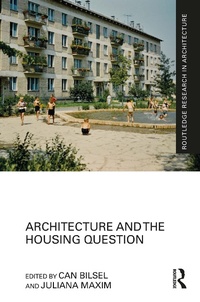
Architecture and the Housing Question
1st Edition
Published on 29. June 2022
268 pages
978-1-351-18294-2 (ISBN)
Description

Architecture and the Housing Question examines how the design and provision of housing around the world have become central both to competing political projects and to the architecture profession.
How have architects acting as housing experts helped alleviate or enforce class, race, and gender inequality? What are the disciplinary implications of taking on shelter for the multitude as an architectural assignment and responsibility? The book features essays in the historiography of architecture and the housing question, and a collection of historical case studies from Belgium, China, France, Ghana, the Netherlands, Kenya, the Soviet Union, Turkey, and the United States. The thematic organization of the collection, interrogating housing expertise, the state apparatus, segregation and colonialism, highlights the methodological questions that underpin its international outlook.
The book will appeal to students and scholars in architecture, architectural history, theory, and urban studies.
How have architects acting as housing experts helped alleviate or enforce class, race, and gender inequality? What are the disciplinary implications of taking on shelter for the multitude as an architectural assignment and responsibility? The book features essays in the historiography of architecture and the housing question, and a collection of historical case studies from Belgium, China, France, Ghana, the Netherlands, Kenya, the Soviet Union, Turkey, and the United States. The thematic organization of the collection, interrogating housing expertise, the state apparatus, segregation and colonialism, highlights the methodological questions that underpin its international outlook.
The book will appeal to students and scholars in architecture, architectural history, theory, and urban studies.
More details
Series
Edition
1. Auflage
Language
English
Place of publication
London
United Kingdom
Publishing group
Taylor & Francis Ltd
Target group
College/higher education
Product notice
Reflowable
Illustrations
9 Line drawings, black and white; 50 Halftones, black and white; 59 Illustrations, black and white
ISBN-13
978-1-351-18294-2 (9781351182942)
Copyright in bibliographic data and cover images is held by Nielsen Book Services Limited or by the publishers or by their respective licensors: all rights reserved.
Schweitzer Classification
Other editions
Additional editions
Can Bilsel | Juliana Maxim
Architecture and the Housing Question
Book
01/2024
1st Edition
Routledge
€56.00
Shipment within 10-20 days
Can Bilsel | Juliana Maxim
Architecture and the Housing Question
Book
06/2022
1st Edition
Routledge
€230.65
Shipment within 15-20 days
Persons
Can Bilsel is Professor of Architecture at the University of San Diego where he served as Chair of the Department of Art, Architecture and Art History, and the founding Director of the Architecture Program. He holds a PhD from Princeton University, SMArchS from MIT, and a B.Arch from METU in Ankara, Turkey. Bilsel has written and lectured on modern architecture and archaeology museums, and on the changing political contexts and audiences of architectural conservation. His publications include Antiquity on Display: Regimes of the Authentic in Berlin's Pergamon Museum (Oxford, 2012), "Crisis in Conservation: Istanbul's Gezi Park between Restoration and Resistance" (2017), "Our Anatolia: Organicism and the Making of the Humanist Culture in Turkey" (2007). He is currently working on a series of essays on urban protests, resistance and memorialization.
Juliana Maxim, Associate Professor and Chair of the Department of Art, Architecture and Art History at the University of San Diego, is an art and architectural historian whose work focuses on the history of modern aesthetic practices - from photography to urbanism - under the communist, centralized states of the Soviet Bloc. She completed her PhD dissertation in the History, Theory and Criticism of Architecture at MIT in 2006. Maxim was a recipient of the National Council for East European and Eurasian Research Award (2008-2010) and was an American Council for Learned Societies post-doctoral fellow (2012-2013). Her book titled The Socialist Life of Modern Architecture: Bucharest, 1955-1965 (Routledge), explores the remarkably intense and multifaceted architectural activity in postwar Romania and the mechanisms through which architecture was invested with political meaning.
Juliana Maxim, Associate Professor and Chair of the Department of Art, Architecture and Art History at the University of San Diego, is an art and architectural historian whose work focuses on the history of modern aesthetic practices - from photography to urbanism - under the communist, centralized states of the Soviet Bloc. She completed her PhD dissertation in the History, Theory and Criticism of Architecture at MIT in 2006. Maxim was a recipient of the National Council for East European and Eurasian Research Award (2008-2010) and was an American Council for Learned Societies post-doctoral fellow (2012-2013). Her book titled The Socialist Life of Modern Architecture: Bucharest, 1955-1965 (Routledge), explores the remarkably intense and multifaceted architectural activity in postwar Romania and the mechanisms through which architecture was invested with political meaning.
Content
Introduction. Architecture and the Housing Question: Specific Histories Can Bilsel and Juliana Maxim Part One. Whose History? Rethinking the Expert 1. Housing and History: The Case of the Specific Intellectual Reinhold Martin 2. Humanitarian Homemaker, Emergency Subject: Questions of Shelter and Domesticity Anooradha Iyer Siddiqi 3. "Oh, but This Isn't Architecture!": The Paradoxical Heritage of French Public Housing Sandra Parvu and Alice Sotgia Part Two. Housing and the State 4. Inventing Socialist Modern: Housing Research and Experimental Design in the Soviet Union Daria Bocharnikova 5. "Production First, Living Second": Welfare Housing and Social Transition in China Samuel Y. Liang 6. "Pillars" of the Welfare State: Postwar Mass Housing in Belgium and the Netherlands Miles Glendinning Part Three. (De)Segregation and the Housing Enclave 7. Housing the People Who "Lived Free": Inhabiting Social Housing in the Tin-Can Neighborhood Kivanc Kilinc and M. Melih Cin 8. Public Life and Public Housing: Charles Moore's Church Street South Patricia A. Morton Part Four. Land, Property, Colonization 9. Landing Architecture: Tropical Bodies, Land, and the Invisible Backdrop of Architectural History Ijlal Muzaffar 10. The Rise and Fall of California City Shannon Starkey Index
