

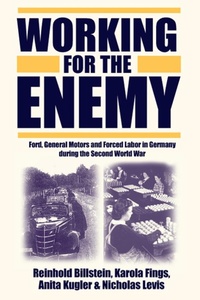
Working for the Enemy
Ford, General Motors, and Forced Labor in Germany during the Second World War
1st Edition
Published on 1. November 2004
352 pages
978-1-78238-785-5 (ISBN)
Description

General Motors, the largest corporation on earth today, has been the owner since 1929 of Adam Opel AG, Russelsheim, the maker of Opel cars. Ford Motor Company in 1931 built the Ford Werke factory in Cologne, now the headquarters of European Ford. In this book, historians tell the astonishing story of what happened at Opel and Ford Werke under the Third Reich, and of the aftermath today.
Long before the Second World War, key American executives at Ford and General Motors were eager to do business with Nazi Germany. Ford Werke and Opel became indispensable suppliers to the German armed forces, together providing most of the trucks that later motorized the Nazi attempt to conquer Europe. After the outbreak of war in 1939, Opel converted its largest factory to warplane parts production, and both companies set up extensive maintenance and repair networks to help keep the war machine on wheels.
During the war, the Nazi Reich used millions of POWs, civilians from German-occupied countries, and concentration camp prisoners as forced laborers in the German homefront economy. Starting in 1940, Ford Werke and Opel also made use of thousands of forced laborers. POWs and civilian detainees, deported to Germany by the Nazi authorities, were kept at private camps owned and managed by the companies. In the longest section of the book, ten people who were forced to work at Ford Werke recall their experiences in oral testimonies.
For more than fifty years, legal and political obstacles frustrated efforts to gain compensation for Nazi-era forced labor; in the most recent case, a $12 billion lawsuit was filed against the computer giant I.B.M. by a group of Gypsy organizations. In 1998, former forced laborers filed dozens of class action lawsuits against German corporations in U.S. courts. The concluding chapter reviews the subsequent, immensely complex negotiations towards a settlement - which involved Germany, the United States, Poland, Russia, Ukraine, Belarus, Czech Republic, Israel and several other countries, as well as dozens of well-known German corporations.
Long before the Second World War, key American executives at Ford and General Motors were eager to do business with Nazi Germany. Ford Werke and Opel became indispensable suppliers to the German armed forces, together providing most of the trucks that later motorized the Nazi attempt to conquer Europe. After the outbreak of war in 1939, Opel converted its largest factory to warplane parts production, and both companies set up extensive maintenance and repair networks to help keep the war machine on wheels.
During the war, the Nazi Reich used millions of POWs, civilians from German-occupied countries, and concentration camp prisoners as forced laborers in the German homefront economy. Starting in 1940, Ford Werke and Opel also made use of thousands of forced laborers. POWs and civilian detainees, deported to Germany by the Nazi authorities, were kept at private camps owned and managed by the companies. In the longest section of the book, ten people who were forced to work at Ford Werke recall their experiences in oral testimonies.
For more than fifty years, legal and political obstacles frustrated efforts to gain compensation for Nazi-era forced labor; in the most recent case, a $12 billion lawsuit was filed against the computer giant I.B.M. by a group of Gypsy organizations. In 1998, former forced laborers filed dozens of class action lawsuits against German corporations in U.S. courts. The concluding chapter reviews the subsequent, immensely complex negotiations towards a settlement - which involved Germany, the United States, Poland, Russia, Ukraine, Belarus, Czech Republic, Israel and several other countries, as well as dozens of well-known German corporations.
Reviews / Votes
CHOICE OUTSTANDING ACADEMIC BOOK OF THE YEAR 2001"This well-selected anthology ... ranges from analytical articles to interviews with people conscripted into the forced labor pool ... This is a vital supplement for students of the era or anyone wrestling with the legal and moral debates regarding restitution and repayment for involuntary work." ? CHOICE
"How fortunate for me to find out about Working for the Enemy ... Impeccable scholarship, perfectly-made case, fascinating research - I commend you and your dedicated colleagues." ? Dr. Neil Baldwin
"By carefully examining the automotive companies' collaboration with the Reich and placing it in an international context, the book is indispensable reading for all who are interested in the moral implications of capitalist economies under totalitarian conditions." ? The International History Review (Hans Mommsen)
"... comprehensive ... a plethora of information and moving first-person testimonies... underscores the myriad human rights implications of today's corporate policies in a global economy." ? The Nation
"... a revealing and meticulously presented series of essays ... this compelling and informative contribution ... is a significant, scholarly and welcome addition." ? Midwest Book Review
More details
Edition
1. Auflage
Language
English
Place of publication
Oxford
United Kingdom
Target group
Professional and scholarly
Illustrations
Bibliography; Index; 25 Maps; 49 Illustrations; 25 Tables, unspecified
ISBN-13
978-1-78238-785-5 (9781782387855)
DOI
10.3167/9781845450137
Copyright in bibliographic data and cover images is held by Nielsen Book Services Limited or by the publishers or by their respective licensors: all rights reserved.
Schweitzer Classification
Other editions
Additional editions
Reinhold Billstein | Karola Fings | Anita Kugler
Working for the Enemy
Ford, General Motors, and Forced Labor in Germany during the Second World War
Book
11/2004
1st Edition
Berghahn Books
€42.30
Shipment within 3-4 weeks
Persons
Reinhold Billstein is a historian of industry and urban life and heads the International Office at the University of Applied Sciences in Hamburg.
Content
PART I: PROLOGUE: THE PRE-WAR YEARS
Chapter 1. Airplanes for the Fuehrer: Adam Opel AG as Enemy Property, Model War Operation, and General Motors Subsidiary, 1939-1945
Chapter 2. 1945: How the Americans Took Over Cologne - and Discovered Ford Werke's Role in the War
Chapter 3. Walter Rietig and the Effort of Remembrance
PART II: FORCED LABOR AT FORD WERKE IN COLOGNE
Chapter 4. Forced Labor at Ford Werke in Cologne
Chapter 5. "And they took the 38 of us to Ford" NS-Dokumentationszentrum der Stadt Koeln: Interviews with former forced laborers
Chapter 6. Memory and Liability
Appendix: Organization of the Forced Labor System at War Operations
Bibliography
Index
Chapter 1. Airplanes for the Fuehrer: Adam Opel AG as Enemy Property, Model War Operation, and General Motors Subsidiary, 1939-1945
Chapter 2. 1945: How the Americans Took Over Cologne - and Discovered Ford Werke's Role in the War
Chapter 3. Walter Rietig and the Effort of Remembrance
PART II: FORCED LABOR AT FORD WERKE IN COLOGNE
Chapter 4. Forced Labor at Ford Werke in Cologne
Chapter 5. "And they took the 38 of us to Ford" NS-Dokumentationszentrum der Stadt Koeln: Interviews with former forced laborers
Chapter 6. Memory and Liability
Appendix: Organization of the Forced Labor System at War Operations
Bibliography
Index
