

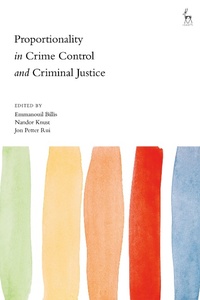
Proportionality in Crime Control and Criminal Justice
1st Edition
Published on 22. April 2021
496 pages
978-1-5099-3862-9 (ISBN)
Description

This edited volume seeks to reassess the old and to analyse and develop novel approaches to the notion of proportionality in criminal matters and the new security architecture. The discourse is not limited to conventional constitutional constellations and standard problems of sentencing in traditional criminal proceedings. Rather, the book offers an interdisciplinary and cross-jurisdictional exploration of highly topical, proportionality-related issues pertinent to penal theory and legal philosophy, criminalisation policies, security and anti-terrorism strategies, alternative types of justice delivery, and supranational enforcement as well as human rights and international criminal and humanitarian law.
In today's global risk society, with its numerous visible and invisible enemies of the state and the individual, balancing freedom and security has become nothing less than an attempt at untying a Gordian knot. Against this background, the proportionality of measures of crime prevention and repression is unquestionably an issue of utmost importance, which basic research and legal policy in rule-of-law based systems are urgently called to address.
The timely and fascinating contributions in this book, covering jurisdictions from both the common law and the civil law as well as hybrid and international jurisdictions, will appeal to academics, researchers, policy advisers and practitioners working in the areas of national and international criminal law, comparative criminal justice/criminology and legal philosophy as well as constitutional and security law.
In today's global risk society, with its numerous visible and invisible enemies of the state and the individual, balancing freedom and security has become nothing less than an attempt at untying a Gordian knot. Against this background, the proportionality of measures of crime prevention and repression is unquestionably an issue of utmost importance, which basic research and legal policy in rule-of-law based systems are urgently called to address.
The timely and fascinating contributions in this book, covering jurisdictions from both the common law and the civil law as well as hybrid and international jurisdictions, will appeal to academics, researchers, policy advisers and practitioners working in the areas of national and international criminal law, comparative criminal justice/criminology and legal philosophy as well as constitutional and security law.
More details
Edition
1. Auflage
Language
English
Place of publication
London
United Kingdom
Publishing group
Bloomsbury Publishing PLC
Target group
College/higher education
ISBN-13
978-1-5099-3862-9 (9781509938629)
Copyright in bibliographic data and cover images is held by Nielsen Book Services Limited or by the publishers or by their respective licensors: all rights reserved.
Schweitzer Classification
Other editions
Additional editions
Emmanouil Billis | Nandor Knust | Jon Petter Rui
Proportionality in Crime Control and Criminal Justice
Book
12/2022
Hart Publishing
€73.22
Shipment within 15-20 days
Persons
Emmanouil Billis is Research Group Leader at the Max Planck Institute for the Study of Crime, Security and Law in Freiburg, Germany.
Nandor Knust is Associate Professor of Law at the University of Tromsø, Norway.
Jon Petter Rui is Professor of Law at the University of Bergen, Norway.
Nandor Knust is Associate Professor of Law at the University of Tromsø, Norway.
Jon Petter Rui is Professor of Law at the University of Bergen, Norway.
Content
PART I
CONCEPTUALISING PROPORTIONALITY
1. The Typology of Proportionality
Emmanouil Billis, Max Planck Institute for the Study of Crime, Security and Law, Germany, Nandor Knust, University of Tromsø, Norway, and Jon Petter Rui, University of Bergen, Norway
2. Proportionality and the Criminal Law: Proportionality of What to What?
R A Duff, University of Stirling, UK
3. Proportionality and the Bindingness of Fundamental Rights
Ralf Poscher, Max Planck Institute for the Study of Crime, Security and Law, Germany
4. The Contribution of Fuzzy Logic and Comparative Concepts to the Rational Application of Proportionality Stricto Sensu
Christos Mylonopoulos, National and Kapodistrian University of Athens, Greece
5. The Emotional Component of Proportionality
Thomas Elholm, University of Copenhagen, Denmark
6. The Principle of Proportionality: Tracing its Historical Evolution
Nestor Courakis, University of Nicosia, Cyprus, and Vagia Polyzoidou, University of Nicosia, Cyprus
PART II
APPLYING PROPORTIONALITY: NATIONAL PARADIGMS
7. Ends and Means: Why Effective Counter-Terrorism Requires Respect for Proportionality and Rights
Lucia Zedner, University of Oxford, UK
8. Contrasting Penal and Non-Penal Responses to Terrorism: Proportionality and Human Rights in the UK
John Jackson, University of Nottingham, UK
9. Big Data and Criminal Justice. Proportionality, Efficiency and Risk in a Global Context
Richard Vogler, University of Sussex, UK
10. Proportionality Paradigm or Paradox? The Proportionality Principle in American and German Security Law Jurisprudence
Russell A Miller, Washington & Lee University, USA
11. Effectiveness, Proportionality and the Abstract and Concrete Forms of Decriminalisation. The Example of Italy
Konstanze Jarvers, Max Planck Institute for the Study of Crime, Security and Law, Germany
12. Promoting Retributive Proportionality Through Sentencing Guidelines
Julian V Roberts, University of Oxford, UK
13. Proportionality in Asset Confiscation Proceedings
Johan Boucht, University of Oslo, Norway
PART III
APPLYING PROPORTIONALITY: INTERNATIONAL PARADIGMS
14. The Proportionality Principle in Comparative Public, European Union and International Law - Reflections on the 'Proportionality Equation'
Michael Bothe, University of Frankfurt, Germany, and Emanuela-Chiara Gillard, Oxford Institute for Ethics, Law and Armed Conflict, UK
15. Proportionality and Efficiency in Sentencing under International Criminal Law
Thomas Weigend, University of Cologne, Germany
16. Proportionality, Mass Surveillance and Criminal Investigation: The Strasbourg Court Facing Big Brother
Lorena Bachmaier Winter, Complutense University of Madrid, Spain
17. Proportionality Issues in European Arrest Warrant Proceedings - Three Stories from the Field
Ilias Anagnostopoulos, National and Kapodistrian University of Athens, Greece
CONCEPTUALISING PROPORTIONALITY
1. The Typology of Proportionality
Emmanouil Billis, Max Planck Institute for the Study of Crime, Security and Law, Germany, Nandor Knust, University of Tromsø, Norway, and Jon Petter Rui, University of Bergen, Norway
2. Proportionality and the Criminal Law: Proportionality of What to What?
R A Duff, University of Stirling, UK
3. Proportionality and the Bindingness of Fundamental Rights
Ralf Poscher, Max Planck Institute for the Study of Crime, Security and Law, Germany
4. The Contribution of Fuzzy Logic and Comparative Concepts to the Rational Application of Proportionality Stricto Sensu
Christos Mylonopoulos, National and Kapodistrian University of Athens, Greece
5. The Emotional Component of Proportionality
Thomas Elholm, University of Copenhagen, Denmark
6. The Principle of Proportionality: Tracing its Historical Evolution
Nestor Courakis, University of Nicosia, Cyprus, and Vagia Polyzoidou, University of Nicosia, Cyprus
PART II
APPLYING PROPORTIONALITY: NATIONAL PARADIGMS
7. Ends and Means: Why Effective Counter-Terrorism Requires Respect for Proportionality and Rights
Lucia Zedner, University of Oxford, UK
8. Contrasting Penal and Non-Penal Responses to Terrorism: Proportionality and Human Rights in the UK
John Jackson, University of Nottingham, UK
9. Big Data and Criminal Justice. Proportionality, Efficiency and Risk in a Global Context
Richard Vogler, University of Sussex, UK
10. Proportionality Paradigm or Paradox? The Proportionality Principle in American and German Security Law Jurisprudence
Russell A Miller, Washington & Lee University, USA
11. Effectiveness, Proportionality and the Abstract and Concrete Forms of Decriminalisation. The Example of Italy
Konstanze Jarvers, Max Planck Institute for the Study of Crime, Security and Law, Germany
12. Promoting Retributive Proportionality Through Sentencing Guidelines
Julian V Roberts, University of Oxford, UK
13. Proportionality in Asset Confiscation Proceedings
Johan Boucht, University of Oslo, Norway
PART III
APPLYING PROPORTIONALITY: INTERNATIONAL PARADIGMS
14. The Proportionality Principle in Comparative Public, European Union and International Law - Reflections on the 'Proportionality Equation'
Michael Bothe, University of Frankfurt, Germany, and Emanuela-Chiara Gillard, Oxford Institute for Ethics, Law and Armed Conflict, UK
15. Proportionality and Efficiency in Sentencing under International Criminal Law
Thomas Weigend, University of Cologne, Germany
16. Proportionality, Mass Surveillance and Criminal Investigation: The Strasbourg Court Facing Big Brother
Lorena Bachmaier Winter, Complutense University of Madrid, Spain
17. Proportionality Issues in European Arrest Warrant Proceedings - Three Stories from the Field
Ilias Anagnostopoulos, National and Kapodistrian University of Athens, Greece
