

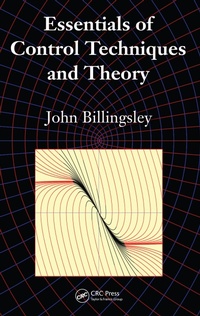
Essentials of Control Techniques and Theory
1st Edition
Published on 3. September 2018
339 pages
978-1-4200-9124-3 (ISBN)
Description

Carefully separating the essential from the ornamental, Essentials of Control Techniques and Theory presents the nuts and bolts for designing a successful controller. It discusses the theory required to support the art of designing a working controller as well as the various aspects to convince a client, employer, or examiner of your expertise.
A Compelling Account of the Basics of Control Theory
Control solutions for practicing engineers
Using the author's own Javascript On-Line Learning Interactive Environment for Simulation (Jollies), the text relies on computer-based graphical analysis methods, such as Nyquist, Nichols, root locus, and phase-plane, to illustrate how useful computer simulation can be for analyzing both linear and nonlinear systems. It explains step-by-step the design and modeling of various control systems, including discrete time systems and an inverted pendulum. Along with offering many web-based simulations, the book shows how mathematics, such as vectors, matrices, and the differential equations that govern state variables, can help us understand the concepts that underpin the controller's effects.
From frequency domain analysis to time-domain state-space representation, this book covers many aspects of classical and modern control theory. It presents important methods for designing and analyzing linear systems and controllers.
A Compelling Account of the Basics of Control Theory
Control solutions for practicing engineers
Using the author's own Javascript On-Line Learning Interactive Environment for Simulation (Jollies), the text relies on computer-based graphical analysis methods, such as Nyquist, Nichols, root locus, and phase-plane, to illustrate how useful computer simulation can be for analyzing both linear and nonlinear systems. It explains step-by-step the design and modeling of various control systems, including discrete time systems and an inverted pendulum. Along with offering many web-based simulations, the book shows how mathematics, such as vectors, matrices, and the differential equations that govern state variables, can help us understand the concepts that underpin the controller's effects.
From frequency domain analysis to time-domain state-space representation, this book covers many aspects of classical and modern control theory. It presents important methods for designing and analyzing linear systems and controllers.
Reviews / Votes
...a valuable and much-needed demystification of control theory ... The role of the blackboard is assumed by a well-matched and balanced Web site, on which JavaScript-based simulations of the book's examples and experiments can be run (and rerun with changed parameters). ... The complement of the lucid and reasoned thinking out loud is, along with coherent excerpts of JavaScript, in the hard copy. ... Forgetting for the moment that this is an intrinsically excellent book, it is also the right control theory book at the right time. ... This book has my highest recommendation among control theory books.-George Hacken, Computing Reviews, August 2010This book contains some basic notions and techniques from the control theory presented from the point of view of an engineer. Special attention is paid to the classical frequency-domain methods, practical observers, and different principles of controller design. Using the author's own Javascript On-Line Learning Interactive Environment for Simulation (Jollies), the design and modeling of various control systems is explained step-by-step (as the inverted pendulum). ... The book contains a large number of illustrative examples (including the corresponding Javascript codes and simulation results) helping to understand the application of the control theory to design of working controllers. ... very useful as a complementary reading for a course in control theory.- Mikhail I. Krastanov, in Zentralblatt MATH, 1198-1
More details
Edition
1. Auflage
Language
English
Place of publication
Baton Rouge
United States
Publishing group
Taylor & Francis Inc
Target group
College/higher education
Undergraduate students in electrical, mechanical, and control engineering; electrical engineers.
Illustrations
122 s/w Abbildungen, 1 s/w Tabelle
1 Tables, black and white; 122 Illustrations, black and white
File size
6,22 MB
ISBN-13
978-1-4200-9124-3 (9781420091243)
Copyright in bibliographic data and cover images is held by Nielsen Book Services Limited or by the publishers or by their respective licensors: all rights reserved.
Schweitzer Classification
Other editions
Additional editions
John Billingsley
Essentials of Control Techniques and Theory
Book
06/2017
1st Edition
CRC Press
€78.90
Shipment within 10-20 days
John Billingsley
Essentials of Control Techniques and Theory
Book
11/2009
1st Edition
CRC Press
€282.26
Shipment within 15-20 days
Person
John Billingsley is Chair of Mechatronic Engineering at the University of Southern Queensland in Toowoomba, Australia, and directs technology research in the National Centre for Engineering in Agriculture (NCEA).
Content
ESSENTIALS OF CONTROL TECHNIQUES-WHAT YOU NEED TO KNOW
Introduction: Control in a Nutshell, History, Theory, Art, and Practice. Modeling Time. Simulation with JavaScript "On-Line Learning Interactive Environment for Simulation" (Jollies)Introduction. Practical Control Systems. Adding Control. Frequency Domain Methods. Discrete Time Systems and Computer Control. Controlling an Inverted Pendulum.
ESSENTIALS OF CONTROL THEORY-WHAT YOU OUGHT TO KNOW
More Frequency Domain Background Theory. More Frequency Domain Methods. The Root Locus. Fashionable Topics in Control. Linking the Time and Frequency Domains. Time, Frequency, and Convolution. More about Time and State Equations. Practical Observers, Feedback with Dynamics. Digital Control in More Detail. Relationship between z- and Other Transforms. Design Methods for Computer Control. Optimal Control-Nothing but the Best. Index.
Introduction: Control in a Nutshell, History, Theory, Art, and Practice. Modeling Time. Simulation with JavaScript "On-Line Learning Interactive Environment for Simulation" (Jollies)Introduction. Practical Control Systems. Adding Control. Frequency Domain Methods. Discrete Time Systems and Computer Control. Controlling an Inverted Pendulum.
ESSENTIALS OF CONTROL THEORY-WHAT YOU OUGHT TO KNOW
More Frequency Domain Background Theory. More Frequency Domain Methods. The Root Locus. Fashionable Topics in Control. Linking the Time and Frequency Domains. Time, Frequency, and Convolution. More about Time and State Equations. Practical Observers, Feedback with Dynamics. Digital Control in More Detail. Relationship between z- and Other Transforms. Design Methods for Computer Control. Optimal Control-Nothing but the Best. Index.
