

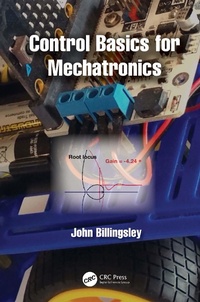
Control Basics for Mechatronics
1st Edition
Published on 28. September 2023
174 pages
978-1-000-92741-2 (ISBN)
Description

Mechatronics is a mongrel, a crossbreed of classic mechanical engineering, the relatively young pup of computer science, the energetic electrical engineering, the pedigree mathematics and the bloodhound of Control Theory.
All too many courses in control theory consist of a diet of 'Everything you could ever need to know about the Laplace Transform' rather than answering 'What happens when your servomotor saturates?' Topics in this book have been selected to answer the questions that the mechatronics student is most likely to raise.That does not mean that the mathematical aspects have been left out, far from it. The diet here includes matrices, transforms, eigenvectors, differential equations and even the dreaded z transform. But every effort has been made to relate them to practical experience, to make them digestible. They are there for what they can do, not to support pages of mathematical rigour that defines their origins.
The theme running throughout the book is simulation, with simple JavaScript applications that let you experience the dynamics for yourself. There are examples that involve balancing, such as a bicycle following a line, and a balancing trolley that is similar to a Segway. This can be constructed 'for real', with components purchased from the hobby market.
All too many courses in control theory consist of a diet of 'Everything you could ever need to know about the Laplace Transform' rather than answering 'What happens when your servomotor saturates?' Topics in this book have been selected to answer the questions that the mechatronics student is most likely to raise.That does not mean that the mathematical aspects have been left out, far from it. The diet here includes matrices, transforms, eigenvectors, differential equations and even the dreaded z transform. But every effort has been made to relate them to practical experience, to make them digestible. They are there for what they can do, not to support pages of mathematical rigour that defines their origins.
The theme running throughout the book is simulation, with simple JavaScript applications that let you experience the dynamics for yourself. There are examples that involve balancing, such as a bicycle following a line, and a balancing trolley that is similar to a Segway. This can be constructed 'for real', with components purchased from the hobby market.
More details
Edition
1. Auflage
Language
English
Place of publication
London
United Kingdom
Publishing group
Taylor & Francis Ltd
Product notice
Reflowable
Illustrations
68 Line drawings, black and white; 3 Halftones, black and white; 71 Illustrations, black and white
ISBN-13
978-1-000-92741-2 (9781000927412)
Copyright in bibliographic data and cover images is held by Nielsen Book Services Limited or by the publishers or by their respective licensors: all rights reserved.
Schweitzer Classification
Other editions
Additional editions
John Billingsley
Control Basics for Mechatronics
Book
09/2023
1st Edition
CRC Press
€47.60
Shipment within 10-20 days
John Billingsley
Control Basics for Mechatronics
Book
09/2023
1st Edition
CRC Press
€140.10
Shipment within 10-20 days
Person
As a Cambridge Mathematics Scholar, John completed the mathematics tripos in two years, then spent his third year studying electronics. Following a Graduate Apprenticeship, he designed algorithms and electronics for aircraft control systems. He then returned to Cambridge to complete his doctoral research on Predictive Control.
He remained in Cambridge as a Fellow of Sidney Sussex College. Eight years later he moved to a Readership at Portsmouth Polytechnic, now Portsmouth University and later became Professor of Robotics. He led groups researching the 'Craftsman Robot' and walking robots. He helped found companies designing embedded electronics for domestic appliances and nuclear test equipment.
In1992 John moved to Toowoomba, Australia, where he applied machine vision to precision tractor guidance. He co-founded the National Centre for Engineering in Agriculture of the University of Southern Queensland.
This year he was joint organiser of the twenty-sixth annual conference on Mechatronics and Machine Vision in Practice, a series which he inaugurated in 1994.
He remained in Cambridge as a Fellow of Sidney Sussex College. Eight years later he moved to a Readership at Portsmouth Polytechnic, now Portsmouth University and later became Professor of Robotics. He led groups researching the 'Craftsman Robot' and walking robots. He helped found companies designing embedded electronics for domestic appliances and nuclear test equipment.
In1992 John moved to Toowoomba, Australia, where he applied machine vision to precision tractor guidance. He co-founded the National Centre for Engineering in Agriculture of the University of Southern Queensland.
This year he was joint organiser of the twenty-sixth annual conference on Mechatronics and Machine Vision in Practice, a series which he inaugurated in 1994.
Content
1. Why Do You Need Control Theory? 2. Modelling Time .3. A Simulation Environment 4. Step Length Considerations. 5. Modelling a Second-Order System .6. The Complication of Motor Drive Limits. 7. Practical Controller Design 8. Adding Dynamics to the Controller 9. Sensors and Actuators. 10. Analogue Simulation. 11. Matrix State Equations. 12. Putting It into Practice. 13. Observers 14. More about the Mathematics 15. Transfer Functions 16. Solving the State Equations 17. Discrete Time and the z Operator. 18. Root locus. 19. More about the Phase Plane. 20. Optimisation and an Experiment. 21. Problem Systems. 22. Final Comments.
