

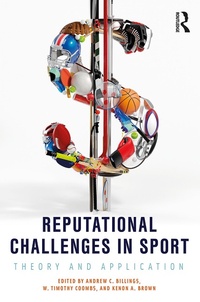
Reputational Challenges in Sport
Theory and Application
1st Edition
Published on 22. June 2018
256 pages
978-1-351-67760-8 (ISBN)
Description

Issues of reputation management are negotiated in a wide array of contexts, yet arguably one of the most visible of these areas involves how such stories unfold within the sporting arena. Whether involving individual athletes, teams, organizations, leagues, or global entities, the process of navigating issues of image repair and/or restoration and crisis-based communication has never been more byzantine with a plethora of communicative media outlets functioning in myriad manners.
Reputational Challenges in Sport explores the intersection of reputation, sport, and society. In doing so, the book advances theory and then explores individual, team, and organizational applications from varied methodological perspectives as they relate to reputation and identity management and crisis orientations. The book provides a synthesis of previous works while offering a contemporary advancement of these subjects from a variety of epistemological approaches. It gives voice to variety of perspectives that offer a robust advancement of issues relating to reputation, sport, and modern society.
Reputational Challenges in Sport explores the intersection of reputation, sport, and society. In doing so, the book advances theory and then explores individual, team, and organizational applications from varied methodological perspectives as they relate to reputation and identity management and crisis orientations. The book provides a synthesis of previous works while offering a contemporary advancement of these subjects from a variety of epistemological approaches. It gives voice to variety of perspectives that offer a robust advancement of issues relating to reputation, sport, and modern society.
More details
Edition
1. Auflage
Language
English
Place of publication
London
United Kingdom
Publishing group
Taylor & Francis Ltd
Target group
College/higher education
Product notice
Reflowable
Illustrations
12 Tables, black and white; 2 Halftones, black and white; 4 Illustrations, black and white
ISBN-13
978-1-351-67760-8 (9781351677608)
Copyright in bibliographic data and cover images is held by Nielsen Book Services Limited or by the publishers or by their respective licensors: all rights reserved.
Schweitzer Classification
Other editions
Additional editions
Andrew C. Billings | W. Timothy Coombs | Kenon A. Brown
Reputational Challenges in Sport
Theory and Application
Book
06/2018
1st Edition
Routledge
€63.80
Shipment within 10-20 days
Andrew C. Billings | W. Timothy Coombs | Kenon A. Brown
Reputational Challenges in Sport
Theory and Application
Book
06/2018
1st Edition
Routledge
€207.80
Shipment within 10-20 days
Persons
Andrew C. Billings is the director of the Alabama Program in Sports Communication and Ronald Reagan Chair of Broadcasting in the Department of Journalism & Creative Media at the University of Alabama. He also serves on many editorial boards, including as an associate editor of the journals Communication & Sport and Journal of Global Sport Management.
W. Timothy Coombs is a full professor in the Department of Communication at Texas A&M University and an honorary professor at Aarhus University in Denmark. He is currently the editor of Corporate Communications: An International Journal.
Kenon A. Brown is an assistant professor in the Department of Advertising and Public Relations at The University of Alabama.
W. Timothy Coombs is a full professor in the Department of Communication at Texas A&M University and an honorary professor at Aarhus University in Denmark. He is currently the editor of Corporate Communications: An International Journal.
Kenon A. Brown is an assistant professor in the Department of Advertising and Public Relations at The University of Alabama.
Content
Acknowledgements
Introduction "Sports Celebrity Reputation in a Mediated World of Scandal:
Reputation, Crisis, and the Presumed Power of Narrative Manufacturing"
Andrew C. Billings, University of Alabama
Unit I Theoretical Foundations
Chapter 1 "Athlete Reputational Crises: One Point for Linking Situational Crisis Communication Theory and Sport Crises"
W. Timothy Coombs, Texas A&M University
Chapter 2 "Image Repair Theory and Sport"
William L. Benoit, Ohio University
Unit II Applications Using Situational Crisis Communication Theory (SCCT)
Chapter 3 "Experimentally Examining Crisis Management in Sporting Organizations"
Natalie Brown-Devlin, University of Texas
Chapter 4 "Adding Narrative to the Situational Crisis Communication Theory: The Case for Crisis 'Narrative Management' in Sport"
James R. DiSanza, Idaho State University
Karen L. Hartman, Idaho State University
Nancy J. Legge, Idaho State University
Zac Gershberg, Idaho State University
Chapter 5 "Applying Situational Crisis Communication Theory to University Needs: A Case Study of the 2015 University of Missouri Crisis"
Lindsey Sherrill, University of Alabama
Chapter 6 "Knee-jerk Policymaking in Crisis Response: A Fumbled Play by the NFL"
Jennifer L. Harker, University of North Carolina
Chapter 7 "Reputational Challenges in the Olympics: The LGBTQ Paracrisis in Sochi"
Ryan S. Rigda, Texas A&M University
Chapter 8 "Crisis Communication and the NBA Lockout: Exploring Reactions to Crisis Strategies in Sport"
Melanie J. Formentin, Towson University
Unit III Applications Using Image Repair Theory (IRT)
Chapter 9 "Empirically Studying Individual Athletes and Image Repair during Crises"
Marion E. Hambrick, University of Louisville
Chapter 10 "#14FOREVER: Nostalgia, Pete Rose, and the Cincinnati Reds"
Todd F. McDorman, Wabash College
Chapter 11 "Empirically Examining Image Repair Theory"
Kenon A. Brown, University of Alabama
Ziyuan Zhou, University of Alabama
Qingru Xu, University of Alabama
Chapter 12 "My Brand and the Team Brand; Where to Insert the "I" in Team?"
Tom Isaacson, Northern Michigan University
Chapter 13 "The Role of Team Success and Failure in Mitigating Fan Dissatisfaction with Ticket Price Increases"
Joseph R. Blaney, Illinois State University
Chapter 14 "Abby Wambach: G.O.A.T. (Greatest of All Time) or Just a Goat?" Rachel Allison, Mississippi State University
Ann Pegoraro, Laurentian University
Introduction "Sports Celebrity Reputation in a Mediated World of Scandal:
Reputation, Crisis, and the Presumed Power of Narrative Manufacturing"
Andrew C. Billings, University of Alabama
Unit I Theoretical Foundations
Chapter 1 "Athlete Reputational Crises: One Point for Linking Situational Crisis Communication Theory and Sport Crises"
W. Timothy Coombs, Texas A&M University
Chapter 2 "Image Repair Theory and Sport"
William L. Benoit, Ohio University
Unit II Applications Using Situational Crisis Communication Theory (SCCT)
Chapter 3 "Experimentally Examining Crisis Management in Sporting Organizations"
Natalie Brown-Devlin, University of Texas
Chapter 4 "Adding Narrative to the Situational Crisis Communication Theory: The Case for Crisis 'Narrative Management' in Sport"
James R. DiSanza, Idaho State University
Karen L. Hartman, Idaho State University
Nancy J. Legge, Idaho State University
Zac Gershberg, Idaho State University
Chapter 5 "Applying Situational Crisis Communication Theory to University Needs: A Case Study of the 2015 University of Missouri Crisis"
Lindsey Sherrill, University of Alabama
Chapter 6 "Knee-jerk Policymaking in Crisis Response: A Fumbled Play by the NFL"
Jennifer L. Harker, University of North Carolina
Chapter 7 "Reputational Challenges in the Olympics: The LGBTQ Paracrisis in Sochi"
Ryan S. Rigda, Texas A&M University
Chapter 8 "Crisis Communication and the NBA Lockout: Exploring Reactions to Crisis Strategies in Sport"
Melanie J. Formentin, Towson University
Unit III Applications Using Image Repair Theory (IRT)
Chapter 9 "Empirically Studying Individual Athletes and Image Repair during Crises"
Marion E. Hambrick, University of Louisville
Chapter 10 "#14FOREVER: Nostalgia, Pete Rose, and the Cincinnati Reds"
Todd F. McDorman, Wabash College
Chapter 11 "Empirically Examining Image Repair Theory"
Kenon A. Brown, University of Alabama
Ziyuan Zhou, University of Alabama
Qingru Xu, University of Alabama
Chapter 12 "My Brand and the Team Brand; Where to Insert the "I" in Team?"
Tom Isaacson, Northern Michigan University
Chapter 13 "The Role of Team Success and Failure in Mitigating Fan Dissatisfaction with Ticket Price Increases"
Joseph R. Blaney, Illinois State University
Chapter 14 "Abby Wambach: G.O.A.T. (Greatest of All Time) or Just a Goat?" Rachel Allison, Mississippi State University
Ann Pegoraro, Laurentian University
