

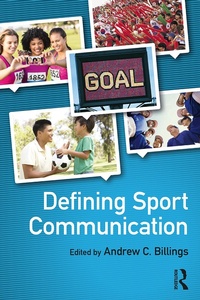
Defining Sport Communication
Published on 14. October 2016
370 pages
978-1-317-43791-8 (ISBN)
Description

Defining Sport Communication is a comprehensive resource addressing core topics and issues, including humanistic, organizational, relational, and mediated approaches to the study of sport communication. It provides foundational work in sport communication for students and scholars, reflecting the abundance of research published in recent years and the ever-increasing interest in this area of study.
Bringing together scholars from various epistemological viewpoints within communication, this volume provides a unique opportunity for defining the breadth and depth of sport communication research. It will serve as a seminal reference for existing scholarship while also providing an agenda for future research.
Bringing together scholars from various epistemological viewpoints within communication, this volume provides a unique opportunity for defining the breadth and depth of sport communication research. It will serve as a seminal reference for existing scholarship while also providing an agenda for future research.
More details
Language
English
Place of publication
London
United Kingdom
Publishing group
Taylor & Francis Ltd
Target group
College/higher education
Product notice
Reflowable
File size
0,73 MB
ISBN-13
978-1-317-43791-8 (9781317437918)
Copyright in bibliographic data and cover images is held by Nielsen Book Services Limited or by the publishers or by their respective licensors: all rights reserved.
Schweitzer Classification
Other editions
Additional editions
Andrew C. Billings
Defining Sport Communication
Book
10/2016
1st Edition
Routledge
€77.30
Shipment within 10-20 days
Andrew C. Billings
Defining Sport Communication
Book
10/2016
1st Edition
Routledge
€277.10
Shipment within 10-20 days
Person
Andrew C. Billings is the Director of the Alabama Program in Sports Communication and Ronald Reagan Chair of Broadcasting in the Department of Journalism & Creative Media at the University of Alabama. His research interests lie in the intersection of sport, mass media, consumption habits, and identity-laden content. With twelve books and over 130 journal articles and book chapters, he is one of the most published sports media scholars in the world. His books include Olympic Media: Inside the Biggest Show on Television (Routledge, 2008) and The Fantasy Sport Industry: Games within Games (Routledge, 2014) and his journal outlets include the Journal of Communication, Journalism & Mass Communication Quarterly, Mass Communication & Society, and the Journal of Broadcasting & Electronic Media. His writings have been translated into five languages. He also serves on many editorial boards, including as an Associate Editor of the journals Communication & Sport and Journal of Global Sport Management. Billings' work has won numerous awards from organizations such as the International Communication Association, National Communication Association, Broadcast Education Association, and the Association for Education in Mass Communication and Journalism. He is the current chair of the Communication & Sport Division of the National Communication Association, and a former chair of the Sport Communication Interest Group of the International Communication Association. He has lectured in nations around the world, from Spain to China to Austria. His work in the classroom has also earned him many teaching awards. He has been interviewed over 500 times by media outlets ranging from The New York Times to The Los Angeles Times to ESPN. Billings has also consulted with many sports media agencies and is a past holder of the Invited Chair of Olympism at the Autonomous University of Barcelona.
Content
Table of Contents: Defining Sport Communication
Introduction. Andrew C. Billings, University of Alabama
Unit I. Humanistic Approaches to Sport
Chapter 1. Sport as rhetorical artifact (Michael L. Butterworth, Ohio University)
Chapter 2. Sport as critical/cultural studies (Daniel A. Grano, University of North Carolina-Charlotte)
Chapter 3. Sports and the communication of ethics (Lawrence A. Wenner, Loyola Marymount University)
Chapter 4. Sport and ethnography: An embodied practice meets an embodied method (Robert Krizek, St. Louis University)
Chapter 5. Sport and political communication/Political communication and sport: Taking the flame (Davis W. Houck, Florida State University)
Chapter 6. Sport as gender/feminist studies (Lindsey J. Mean, Arizona State University)
Chapter 7. Sport and race: A disciplinary history and exhortation (Abraham I. Khan, Pennsylvania State University)
Chapter 8. Sport and GLBTQ issues (Edward M. Kian, Oklahoma State University)
Unit II. Organizational/Relational Approaches to Sport
Chapter 9. Sport as organizational communication (Jeffrey W. Kassing, Arizona State University & Robyn Matthews, Arizona State University)
Chapter 10. Sport as intergroup communication: Fans, rivalries, communities, and nations (Howard Giles, Univ. of California-Santa Barbara & Michael Stohl, Univ. of California-Santa Barbara)
Chapter 11. Sport as interpersonal communication (Paul D. Turman, South Dakota Board of Regents)
Chapter 12. Sport as family communication (Jon F. Nussbaum and Amber Worthington, Penn State University)
Chapter 13. Sport as health communication: Intersections, theories, implications (Kimberly L. Bissell, University of Alabama)
Unit III. Mediated Approaches to Sport
Chapter 14. Sport as international communication (Simon Licen, Washington State University)
Chapter 15. Sport as journalistic lens (Steve Bien-Aime, Pennsylvania State University, Erin Whiteside, University of Tennessee, & Marie Hardin, Penn State University)
Chapter 16. Sport as audience studies (Walter Gantz, Indiana University & Nicole Lewis, University of Miami)
Chapter 17. Sport as entertainment studies (Arthur A. Raney, Florida State University)
Chapter 18. Sport as broadcast studies (R. Glenn Cummins, Texas Tech University)
Chapter 19. Sport as social media networking studies (Jimmy Sanderson, University of Arkansas)
Chapter 20. Sport as gaming studies: Videogames as an arena for sport communication scholarship (Nicholas D. Bowman, West Virginia University & Andy Boyan, Albion College)
Chapter 21. Sport and advertising (Michael B. Devlin, DePaul University)
Chapter 22. Sport and public relations (Kenon A. Brown, University of Alabama & Thomas E. Isaacson, Northern Michigan University)
Introduction. Andrew C. Billings, University of Alabama
Unit I. Humanistic Approaches to Sport
Chapter 1. Sport as rhetorical artifact (Michael L. Butterworth, Ohio University)
Chapter 2. Sport as critical/cultural studies (Daniel A. Grano, University of North Carolina-Charlotte)
Chapter 3. Sports and the communication of ethics (Lawrence A. Wenner, Loyola Marymount University)
Chapter 4. Sport and ethnography: An embodied practice meets an embodied method (Robert Krizek, St. Louis University)
Chapter 5. Sport and political communication/Political communication and sport: Taking the flame (Davis W. Houck, Florida State University)
Chapter 6. Sport as gender/feminist studies (Lindsey J. Mean, Arizona State University)
Chapter 7. Sport and race: A disciplinary history and exhortation (Abraham I. Khan, Pennsylvania State University)
Chapter 8. Sport and GLBTQ issues (Edward M. Kian, Oklahoma State University)
Unit II. Organizational/Relational Approaches to Sport
Chapter 9. Sport as organizational communication (Jeffrey W. Kassing, Arizona State University & Robyn Matthews, Arizona State University)
Chapter 10. Sport as intergroup communication: Fans, rivalries, communities, and nations (Howard Giles, Univ. of California-Santa Barbara & Michael Stohl, Univ. of California-Santa Barbara)
Chapter 11. Sport as interpersonal communication (Paul D. Turman, South Dakota Board of Regents)
Chapter 12. Sport as family communication (Jon F. Nussbaum and Amber Worthington, Penn State University)
Chapter 13. Sport as health communication: Intersections, theories, implications (Kimberly L. Bissell, University of Alabama)
Unit III. Mediated Approaches to Sport
Chapter 14. Sport as international communication (Simon Licen, Washington State University)
Chapter 15. Sport as journalistic lens (Steve Bien-Aime, Pennsylvania State University, Erin Whiteside, University of Tennessee, & Marie Hardin, Penn State University)
Chapter 16. Sport as audience studies (Walter Gantz, Indiana University & Nicole Lewis, University of Miami)
Chapter 17. Sport as entertainment studies (Arthur A. Raney, Florida State University)
Chapter 18. Sport as broadcast studies (R. Glenn Cummins, Texas Tech University)
Chapter 19. Sport as social media networking studies (Jimmy Sanderson, University of Arkansas)
Chapter 20. Sport as gaming studies: Videogames as an arena for sport communication scholarship (Nicholas D. Bowman, West Virginia University & Andy Boyan, Albion College)
Chapter 21. Sport and advertising (Michael B. Devlin, DePaul University)
Chapter 22. Sport and public relations (Kenon A. Brown, University of Alabama & Thomas E. Isaacson, Northern Michigan University)
