

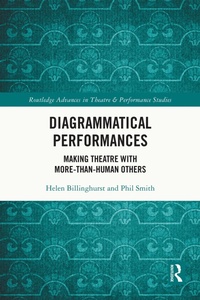
Diagrammatical Performances
Description

Diagrammatical Performances' traces some of the traditions and contemporary developments in the uses of diagrams - actual and metaphorical - in the making of performance that nurtures a relationship between humans and more-than-humans.
Addressing students, researchers, and teachers of radical theatre, eco-activists, makers of eco-theatre and site-specific performance, the book provides a radical description of the diagram, a history of its uses in theatre and performance, and a toolkit for its applications in making radical eco-theatre that swerves anthropocentric concerns for more direct engagements with the more-than-human. 'Diagrammatical Performances' draws on a global diversity of practices from those of Atis Rezistans in Haiti to the choreographies of Henry Daniel and Zab Maboungou via the embodied performance art of Ana Mendieta, Miranda Whall, and Louise Ann Wilson. It charts lineages of use through Symbolist Theatre, modernist theatres like Richard Foreman's Ontological-Hysteric Theater, while drawing on ideas from key theorists such as Astrida Neimanis, Baz Kershaw, and Donna Haraway. The book also draws upon the authors' own diagrammatical performance-making in their 'Crab & Bee' partnership - in performances such as 'Around The Hills', 'Leadworking' and 'Scoriton Mysteries' - to present accessible techniques, tactics, exercises and approaches for other performance makers to draw upon.
This book will be of great interest to students and scholars of performance, fine art, and creative writing studies, eco-activists, and media commentators on green matters.
More details
Other editions
Additional editions
Persons
Helen Billinghurst is an independent researcher and interdisciplinary artist.
Phil Smith is a performance maker, founder member of Wrights & Sites, and Honorary Associate Researcher at the University of Plymouth.
Content
About authors
Introduction
Chapter 1. What are diagrammatics?
Chapter 2. Diagrammatics in performance: Precedents, parallels, and recent applications
Chapter 3. Why is diagrammatical performance relevant now?
Chapter 4. Where did our diagrammatical performances come from?
Chapter 5. Our vision for performing space
Chapter 6. Four case studies
Chapter 7. Mini-handbook of techniques
Chapter 8. Conclusion
Index
