

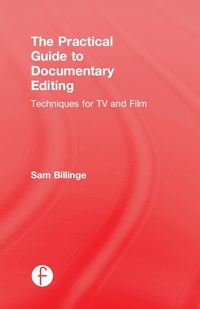
The Practical Guide to Documentary Editing
Techniques for TV and Film
1st Edition
Published on 7. April 2017
244 pages
978-1-351-87010-8 (ISBN)
Description

The Practical Guide to Documentary Editing sets out the techniques, the systems and the craft required to edit compelling professional documentary television and film. Working stage by stage through the postproduction process, author Sam Billinge explores project organization, assembling rushes, sequence editing, story structure, music and sound design, and the defining relationship between editor and director.
Written by a working documentary editor with over a decade's worth of experience cutting films for major British and international broadcasters, The Practical Guide to Documentary Editing offers a unique introduction to the craft of documentary editing, and provides working and aspiring editors with the tools to master their craft in the innovative and fast-paced world of contemporary nonfiction television and film.
Written by a working documentary editor with over a decade's worth of experience cutting films for major British and international broadcasters, The Practical Guide to Documentary Editing offers a unique introduction to the craft of documentary editing, and provides working and aspiring editors with the tools to master their craft in the innovative and fast-paced world of contemporary nonfiction television and film.
Reviews / Votes
"A brilliant introduction to the art of editing. You need process to create and method to find clarity. This book shares the secrets that allow ideas to flow and magic to happen. Documentary editing is the best job in the world. Sam Billinge's book helps you understand why."-Sean Mackenzie, Two-time BAFTA TV Award-winning Editor; Arena (1975), Amish: A Secret Life (2012)
"This thorough and informative work written by Sam Billinge, an actual practitioner in the art form of which he writes, will be my go-to book recommendation for anyone interested in learning or expanding the craft of documentary editing. When I'm asked, 'How do I learn about documentary editing,' this is the book I will be recommending to people."
-Colin Goudie, GBFTE, Editor, Rogue One: A Star Wars Story (2016), Monsters (2010)
"If you're looking to learn how to edit documentaries well, then Sam offers professional expertise and insight that will help you at every stage of the creative and collaborative process."
--Jonny Elwyn, freelance film editor and creator of jonnyelwyn.co.uk
More details
Edition
1. Auflage
Language
English
Place of publication
London
United Kingdom
Publishing group
Taylor & Francis Ltd
Target group
College/higher education
Professional and scholarly
Product notice
Reflowable
Illustrations
25 s/w Abbildungen
25 Illustrations, black and white
File size
2,65 MB
ISBN-13
978-1-351-87010-8 (9781351870108)
Copyright in bibliographic data and cover images is held by Nielsen Book Services Limited or by the publishers or by their respective licensors: all rights reserved.
Schweitzer Classification
Other editions
Additional editions
Book
04/2017
1st Edition
Routledge
€207.50
Shipment within 10-20 days
Book
04/2017
1st Edition
Routledge
€62.90
Shipment within 10-20 days
Person
Sam Billinge, GBFTE is a documentary editor with more than a decade's worth of experience editing prime-time documentaries for British and international television.
Content
Acknowledgments
Introduction
Preface
The Power of Documentary
Who are Film Editors and What Do They Do?
Part 1: The Fundamentals
Storytelling 1.0
Editing 1.0
Setting Up the Edit
Preparing to View Rushes
Track Laying the Edit
Viewing Interviews
Viewing Actuality
Viewing B-roll
Part 2: Starting to Edit
Understanding the Task Ahead
Deciding What to Cut First
Appraising a New Scene
Structuring a New Scene
Ordering Interview Clips
Trimming Interviews
Working with Actuality
Working with Voiceover
Deciding Where Voiceover is Needed
Voiceover Writing Basics
Managing a Voiceover Record
Part 3: Picture Editing
Visual Storytelling
The Kuleshov Effect
Types of Picture Sequence
Types of Shot
Structuring a Picture Sequence
Sequencing Shots
A Practical Method for Building a Sequence
The Art of the Cut
What Makes a Good Cut?
What Shots Cut Well Together?
Judging Pacing and the Rhythm of Sequences
Enhancing the Visual Style of a Sequence
Working with Cutaways
Working with Stock Footage
Working with Still Images
Part 4: Using Sound
Working with Sound Design and Music
Understanding Sound
Working with Music
Why We Use Music in Filmmaking
Some Good Ways to Use Music
A Practical Method for Working with Music
Auditioning Music
Composed, Library or Commercial Music?
Working with a Composer
Working with Library Music
Working with Commercial Music
Part 5: Story Structure
Ordering and Connecting Scenes
Common Documentary Story Structures
The Three-Act Structure
The Episodic
The Parallel Narrative
Working with Shooting Scripts & Paper Edits
Choosing a Running Order
Scene Cards
Working to a Deadline
Making Improvements
Viewing a Film for the First Time
Working to a Final Duration
Reaching Picture Lock
The Cutting Room Relationship
Workflow Summary
Conclusion
Glossary
Index
Introduction
Preface
The Power of Documentary
Who are Film Editors and What Do They Do?
Part 1: The Fundamentals
Storytelling 1.0
Editing 1.0
Setting Up the Edit
Preparing to View Rushes
Track Laying the Edit
Viewing Interviews
Viewing Actuality
Viewing B-roll
Part 2: Starting to Edit
Understanding the Task Ahead
Deciding What to Cut First
Appraising a New Scene
Structuring a New Scene
Ordering Interview Clips
Trimming Interviews
Working with Actuality
Working with Voiceover
Deciding Where Voiceover is Needed
Voiceover Writing Basics
Managing a Voiceover Record
Part 3: Picture Editing
Visual Storytelling
The Kuleshov Effect
Types of Picture Sequence
Types of Shot
Structuring a Picture Sequence
Sequencing Shots
A Practical Method for Building a Sequence
The Art of the Cut
What Makes a Good Cut?
What Shots Cut Well Together?
Judging Pacing and the Rhythm of Sequences
Enhancing the Visual Style of a Sequence
Working with Cutaways
Working with Stock Footage
Working with Still Images
Part 4: Using Sound
Working with Sound Design and Music
Understanding Sound
Working with Music
Why We Use Music in Filmmaking
Some Good Ways to Use Music
A Practical Method for Working with Music
Auditioning Music
Composed, Library or Commercial Music?
Working with a Composer
Working with Library Music
Working with Commercial Music
Part 5: Story Structure
Ordering and Connecting Scenes
Common Documentary Story Structures
The Three-Act Structure
The Episodic
The Parallel Narrative
Working with Shooting Scripts & Paper Edits
Choosing a Running Order
Scene Cards
Working to a Deadline
Making Improvements
Viewing a Film for the First Time
Working to a Final Duration
Reaching Picture Lock
The Cutting Room Relationship
Workflow Summary
Conclusion
Glossary
Index
