

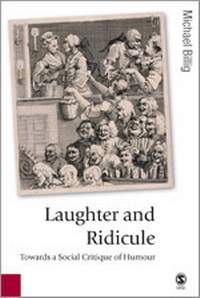
Laughter and Ridicule
Towards a Social Critique of Humour
1st Edition
Published on 19. July 2005
272 pages
978-1-84787-794-9 (ISBN)
Description

`From Thomas Hobbes' fear of the power of laughter to the compulsory, packaged "fun" of the contemporary mass media, Billig takes the reader on a stimulating tour of the strange world of humour. Both a significant work of scholarship and a novel contribution to the understanding of the humourous, this is a seriously engaging book' - David Inglis, University of Aberdeen
This delightful book tackles the prevailing assumption that laughter and humour are inherently good. In developing a critique of humour the author proposes a social theory that places humour - in the form of ridicule - as central to social life. Billig argues that all cultures use ridicule as a disciplinary means to uphold norms of conduct and conventions of meaning.
Historically, theories of humour reflect wider visions of politics, morality and aesthetics. For example, Bergson argued that humour contains an element of cruelty while Freud suggested that we deceive ourselves about the true nature of our laughter. Billig discusses these and other theories, while using the topic of humour to throw light on the perennial social problems of regulation, control and emancipation.
This delightful book tackles the prevailing assumption that laughter and humour are inherently good. In developing a critique of humour the author proposes a social theory that places humour - in the form of ridicule - as central to social life. Billig argues that all cultures use ridicule as a disciplinary means to uphold norms of conduct and conventions of meaning.
Historically, theories of humour reflect wider visions of politics, morality and aesthetics. For example, Bergson argued that humour contains an element of cruelty while Freud suggested that we deceive ourselves about the true nature of our laughter. Billig discusses these and other theories, while using the topic of humour to throw light on the perennial social problems of regulation, control and emancipation.
All prices
More details
Series
Edition
First Edition
Language
English
Place of publication
London
United Kingdom
Target group
Professional and scholarly
ISBN-13
978-1-84787-794-9 (9781847877949)
Copyright in bibliographic data and cover images is held by Nielsen Book Services Limited or by the publishers or by their respective licensors: all rights reserved.
Schweitzer Classification
Other editions
Additional editions
Book
07/2005
1st Edition
SAGE Publications Inc
€119.50
Shipment within 10-20 days
Book
07/2005
1st Edition
SAGE Publications Inc
€249.00
Shipment within 10-20 days
Person
Professor Michael Billig is professor of social sciences at the University of Loughborough. His most recent books are Ideology and Opinions: Studies in Rhetorical Sociology (SAGE, 1991) and Talking of the Royal Family (1992).
Michael Billig has been Professor of Social Sciences at Loughborough University, UK, since 1985. He took his undergraduate degree at Bristol University, where he also completed his Ph.D. in experimental social psychology, under the supervision of Henri Tajfel. Michael considers Tajfel to have have been one of the most important figures in the history of social psychology. After leaving Bristol to take up a lectureship at Birmingham University, Michael turned away from experimental social psychology, which he found to be too intellectually and methodologically restricting.
In his work, Michael has attempted to approach social psychological issues from a broader base within the social sciences. He has written books on a variety of topics. His books for SAGE include Banal Nationalism, in which he argued that in established nation-states there is an everyday, often unnoticed form of nationalism. Ideological Dilemmas, written in collaboration with other members of the Loughborough Discourse and Rhetoric Group, suggested that we should study ideology by examining how people argue and use language in everyday life. SAGE also published his book The Hidden Roots of Critical Psychology, which argues that the neglected figure of the third earl of Shaftesbury should be seen as a pivotal influence in the history of psychology, especially in the history of critical psychology. Michael has also written books on rhetoric, fascism, Freud's theory of repression, attitudes towards the British Royal Family and the history of rock'n'roll. His current work argues forcefully that academic social scientists use too much technical terminology and that ordinary concepts are often much clearer than technical ones.
Michael Billig has been Professor of Social Sciences at Loughborough University, UK, since 1985. He took his undergraduate degree at Bristol University, where he also completed his Ph.D. in experimental social psychology, under the supervision of Henri Tajfel. Michael considers Tajfel to have have been one of the most important figures in the history of social psychology. After leaving Bristol to take up a lectureship at Birmingham University, Michael turned away from experimental social psychology, which he found to be too intellectually and methodologically restricting.
In his work, Michael has attempted to approach social psychological issues from a broader base within the social sciences. He has written books on a variety of topics. His books for SAGE include Banal Nationalism, in which he argued that in established nation-states there is an everyday, often unnoticed form of nationalism. Ideological Dilemmas, written in collaboration with other members of the Loughborough Discourse and Rhetoric Group, suggested that we should study ideology by examining how people argue and use language in everyday life. SAGE also published his book The Hidden Roots of Critical Psychology, which argues that the neglected figure of the third earl of Shaftesbury should be seen as a pivotal influence in the history of psychology, especially in the history of critical psychology. Michael has also written books on rhetoric, fascism, Freud's theory of repression, attitudes towards the British Royal Family and the history of rock'n'roll. His current work argues forcefully that academic social scientists use too much technical terminology and that ordinary concepts are often much clearer than technical ones.
Content
Introduction
A Critique of Positive Humour
PART ONE: HISTORICAL ASPECTS
Superiority Theories
Hobbes and other Misogelasts
Incongruity Theories and Gentlemanly Laughter
Victorian Relief Theory
Bergson and the Function of Humour
Freud and the Hidden Secrets of Jokes
PART TWO: THEORETICAL ASPECTS
Laughter and Unlaughter
Embarrassment, Humour and the Social Order
Final Remarks
A Critique of Positive Humour
PART ONE: HISTORICAL ASPECTS
Superiority Theories
Hobbes and other Misogelasts
Incongruity Theories and Gentlemanly Laughter
Victorian Relief Theory
Bergson and the Function of Humour
Freud and the Hidden Secrets of Jokes
PART TWO: THEORETICAL ASPECTS
Laughter and Unlaughter
Embarrassment, Humour and the Social Order
Final Remarks
