

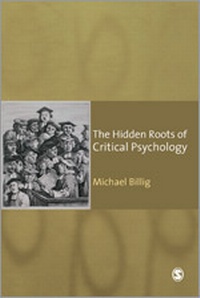
The Hidden Roots of Critical Psychology
Understanding the Impact of Locke, Shaftesbury and Reid
1st Edition
Published on 12. February 2008
232 pages
978-1-84920-213-8 (ISBN)
Description

`Billig's is a fascinating work of brilliant scholarship. It is written in an elegant style, spiced with humour, and gives one the feeling that it was a labour of love. It can be recommended without reservation' - Journal of Community and Applied Social Psychology
`This is a quite extraordinary and original book. Billig has managed seamlessly to interweave History of Philosophy, History of Psychology, Critical Psychology and a deep grasp of the social nature of language and, moreover, do so in a very readable fashion' - Graham Richards, Formerly Professor of History of Psychology, Staffordshire University and Director of the British Psychological Society History of Psychology Centre, London
`I can't quite capture how much I enjoyed this book. In beautiful, witty prose and through exemplary scholarship, Billig has produced an historical work that engages with profoundly important ideas not just for contemporary critical psychology but for psychology in general. Books as good as this are rare' - Alan Collins, Senior Lecturer in Psychology, Lancaster University
Today new forms of critical psychology are challenging the cognitive revolution that has dominated psychology for the past three decades. This book explores the historical roots of these new psychologies. It demonstrates that their ideas are not quite as new as is often supposed.
In the early modern period, thinkers like the Earl of Shaftesbury and Thomas Reid reacted against Locke's cognitive psychology in ways that were surprisingly modern, if not post-modern. However, until now, they have been virtually written out of psychology's history. It is now time to recognize the great originality of their psychological thinking.
Writing in a non-technical style, Michael Billig seeks to overturn the dominant views of psychology's history. In so doing, he gives a fascinating account of the times, bringing psychology's hidden past vividly back to life.
`This is a quite extraordinary and original book. Billig has managed seamlessly to interweave History of Philosophy, History of Psychology, Critical Psychology and a deep grasp of the social nature of language and, moreover, do so in a very readable fashion' - Graham Richards, Formerly Professor of History of Psychology, Staffordshire University and Director of the British Psychological Society History of Psychology Centre, London
`I can't quite capture how much I enjoyed this book. In beautiful, witty prose and through exemplary scholarship, Billig has produced an historical work that engages with profoundly important ideas not just for contemporary critical psychology but for psychology in general. Books as good as this are rare' - Alan Collins, Senior Lecturer in Psychology, Lancaster University
Today new forms of critical psychology are challenging the cognitive revolution that has dominated psychology for the past three decades. This book explores the historical roots of these new psychologies. It demonstrates that their ideas are not quite as new as is often supposed.
In the early modern period, thinkers like the Earl of Shaftesbury and Thomas Reid reacted against Locke's cognitive psychology in ways that were surprisingly modern, if not post-modern. However, until now, they have been virtually written out of psychology's history. It is now time to recognize the great originality of their psychological thinking.
Writing in a non-technical style, Michael Billig seeks to overturn the dominant views of psychology's history. In so doing, he gives a fascinating account of the times, bringing psychology's hidden past vividly back to life.
Reviews / Votes
"Billig (Loughborough Univ., UK) provides a fascinating, thought-provoking history of the early origins of contemporary critical psychology. The author characterizes critical psychology as an approach that assumes the mind is socially and historically constructed. He contrasts this with mainstream cognitive psychology, in which the mind is reduced to the processes of individual thought. Although this debate is commonly viewed as having a short history (origins in the mid-20th century), Billig traces its origins back to the early-modern period (17th century), when John Locke's conception of a cognitive-based psychology first appeared. Locke's individualistic perspective was challenged by the socially based conceptions of the Earl of Shaftsbury (Anthony Ashley Cooper, Locke's foster son) and Thomas Reid. This book is especially valuable because it uncovers hidden lines of intellectual influence, which thus challenge assumptions about the founding of psychological schools of thought. In his conclusion, Billig points to the need to revise the history of psychology and to bring social and historical inquiry back into psychology. Summing Up: Highly recommended. Upper-division undergraduates, graduate students, researchers, and faculty." -- H.L. Minton * CHOICE magazine *All prices
More details
Language
English
Place of publication
London
United Kingdom
Target group
College/higher education
Professional and scholarly
ISBN-13
978-1-84920-213-8 (9781849202138)
Copyright in bibliographic data and cover images is held by Nielsen Book Services Limited or by the publishers or by their respective licensors: all rights reserved.
Schweitzer Classification
Other editions
Additional editions
Michael Billig
The Hidden Roots of Critical Psychology
Understanding the Impact of Locke, Shaftesbury and Reid
Book
02/2008
1st Edition
SAGE Publications Inc
€106.00
Shipment within 10-20 days
Michael Billig
The Hidden Roots of Critical Psychology
Understanding the Impact of Locke, Shaftesbury and Reid
Book
02/2008
1st Edition
SAGE Publications Inc
€231.76
Shipment within 10-20 days
Person
Professor Michael Billig is professor of social sciences at the University of Loughborough. His most recent books are Ideology and Opinions: Studies in Rhetorical Sociology (SAGE, 1991) and Talking of the Royal Family (1992).
Michael Billig has been Professor of Social Sciences at Loughborough University, UK, since 1985. He took his undergraduate degree at Bristol University, where he also completed his Ph.D. in experimental social psychology, under the supervision of Henri Tajfel. Michael considers Tajfel to have have been one of the most important figures in the history of social psychology. After leaving Bristol to take up a lectureship at Birmingham University, Michael turned away from experimental social psychology, which he found to be too intellectually and methodologically restricting.
In his work, Michael has attempted to approach social psychological issues from a broader base within the social sciences. He has written books on a variety of topics. His books for SAGE include Banal Nationalism, in which he argued that in established nation-states there is an everyday, often unnoticed form of nationalism. Ideological Dilemmas, written in collaboration with other members of the Loughborough Discourse and Rhetoric Group, suggested that we should study ideology by examining how people argue and use language in everyday life. SAGE also published his book The Hidden Roots of Critical Psychology, which argues that the neglected figure of the third earl of Shaftesbury should be seen as a pivotal influence in the history of psychology, especially in the history of critical psychology. Michael has also written books on rhetoric, fascism, Freud's theory of repression, attitudes towards the British Royal Family and the history of rock'n'roll. His current work argues forcefully that academic social scientists use too much technical terminology and that ordinary concepts are often much clearer than technical ones.
Michael Billig has been Professor of Social Sciences at Loughborough University, UK, since 1985. He took his undergraduate degree at Bristol University, where he also completed his Ph.D. in experimental social psychology, under the supervision of Henri Tajfel. Michael considers Tajfel to have have been one of the most important figures in the history of social psychology. After leaving Bristol to take up a lectureship at Birmingham University, Michael turned away from experimental social psychology, which he found to be too intellectually and methodologically restricting.
In his work, Michael has attempted to approach social psychological issues from a broader base within the social sciences. He has written books on a variety of topics. His books for SAGE include Banal Nationalism, in which he argued that in established nation-states there is an everyday, often unnoticed form of nationalism. Ideological Dilemmas, written in collaboration with other members of the Loughborough Discourse and Rhetoric Group, suggested that we should study ideology by examining how people argue and use language in everyday life. SAGE also published his book The Hidden Roots of Critical Psychology, which argues that the neglected figure of the third earl of Shaftesbury should be seen as a pivotal influence in the history of psychology, especially in the history of critical psychology. Michael has also written books on rhetoric, fascism, Freud's theory of repression, attitudes towards the British Royal Family and the history of rock'n'roll. His current work argues forcefully that academic social scientists use too much technical terminology and that ordinary concepts are often much clearer than technical ones.
Content
Introduction
History and Psychology
Locke
The Father of Cognitive Psychology
Locke's New Way of Ideas
Shaftesbury
The Rebellious Foster-Son
Shaftesbury
Moral and Social Sense
Shaftesbury
Almost a Pre-post-modern Figure
Thomas Reid
A Common Sense Psychology
Concluding Remarks
Psychology in the Age of Discoveries
History and Psychology
Locke
The Father of Cognitive Psychology
Locke's New Way of Ideas
Shaftesbury
The Rebellious Foster-Son
Shaftesbury
Moral and Social Sense
Shaftesbury
Almost a Pre-post-modern Figure
Thomas Reid
A Common Sense Psychology
Concluding Remarks
Psychology in the Age of Discoveries
