

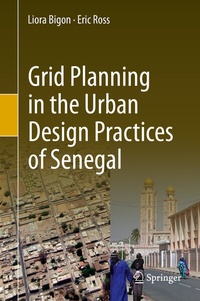
Grid Planning in the Urban Design Practices of Senegal
Description

This book is the first to trace the genealogy of an indigenous grid-pattern settlement design practice in Africa, and more specifically in Senegal. It does so by analyzing how the precolonial grid-plan design tradition of this country has become entangled with French colonial urban grid-planning, and with present-day, hybrid, planning cultures. By thus, it transcends the classic precolonial-colonial-postcolonial metahistorical divides.
This properly illustrated book consists of five chapters, including an introductory chapter (historiography, theory and context) and a concluding chapter. The chapters' text has both a chronological and thematic rationale, aimed at enhancing Islamic Studies by situating sub-Saharan Africa's urbanism within mainstream research on the Muslim World; and at contributing directly to the wider project of de-Eurocentrizing urban planning history by developing a more inclusive, truly global, urban history.
More details
Other editions
Additional editions
Persons
Liora Bigon is a Senior Lecturer in the Department of Multidisciplinary Studies at HIT- Holon Institute of Technology, where she teaches (post-)colonial, urban and Islamic histories. She holds a PhD from the University of Manchester in architectural history and has written extensively on sub-Saharan Africa urban cultures, including: Garden Cities and Colonial Planning: Transnationality and Urban Ideas in Africa and Palestine (Manchester University Press, 2014, edited with Yossi Katz); French Colonial Dakar: The Morphogenesis of an African Regional Capital (Manchester University Press, 2016); Place Names in Africa: Colonial Urban Legacies, Entangled Histories (Springer, 2014, edited); and Gridded Worlds: An Urban Anthology (Springer, 2018, edited with Reuben Rose-Redwood).
Eric Ross is a Professor of Geography at Al Akhawayn University in Ifrane, Morocco, where he has been teaching since 1998. He holds a PhD in Islamic Studies from McGill University. He is an urban and cultural geographer whose research focuses on Muslim Africa. Ross has conducted research on Sufism and urbanization in Senegal as well as on cultural heritage and development in Morocco. He is the author of Sufi City: Urban Design and Archetypes in Touba (University of Rochester Press, 2008); and first author of Assessing Tourism in Essaouira (Al Akhawayn University Press, 2002). In addition, Ross has published articles for academic journals such as Urban Studies and Planning Perspectives, has authored chapters in eleven edited volumes, and has written entries for specialized encyclopedias including the Wiley-Blackwell Encyclopedia of Urban and Regional Studies and Oxford Research Encyclopedia of African History.
