

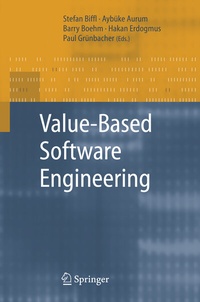
Value-Based Software Engineering
Description

Biffl and his co-editors invited leading researchers and structured their contributions into three parts, following an introduction into the area by Boehm himself. They first detail the foundations of VBSE, followed by a presentation of state-of-the-art methods and techniques. The third part demonstrates the benefits of VBSE through concrete examples and case studies.
This book deviates from the more anecdotal style of many management-oriented software engineering books and so appeals particularly to all readers who are interested in solid foundations for high-level aspects of software engineering decision making, i.e., to product or project managers driven by economics and to software engineering researchers and students.
More details
Other editions
Additional editions
Persons
Dr. Stefan Biffl is an associate professor of software engineering at the Institute of Software Technology and Interactive Systems, Vienna University of Technology. He received his MS and PhD in computer science from the Vienna University of Technology and his MS in social and economic sciences from the University of Vienna. He is founder of the Quality Software Engineering research group (QSE) at the Vienna University of Technology. His research interests include project and quality management in software engineering, software inspection, decision support for software engineering processes, and collaboration among project stakeholders. He is a member of the ACM and IEEE.
Dr. Aybüke Aurum is a senior lecturer at the School of Information Systems, Technology and Management, University of New South Wales. She received her BSc and MSc in geological engineering, and MEngSc and PhD in computer science. She is the founder and group leader of the Requirements Engineering Research Group (ReqEng) at the University of New South Wales. She also works as a visiting researcher in National ICT, Australia (NICTA). She is chief editor of "Managing Software Engineering Knowledge" published by Springer in 2003. Her research interests include Management of Software Development Process, Software Inspection, Requirements Engineering, Decision Making and Knowledge Management.
Dr. Paul Grünbacher Associate Professor at Johannes Kepler University Linz and a research associate at the Center for Software Engineering (University of Southern California, Los Angeles). He studied Business Informatics and holds a Ph.D. from the University of Linz. Paul's research focuses on applying collaborative methods and tools to support and automate complex software and system engineering activities such as requirements elicitation and negotiation or software inspections. He is a member of ACM, ACM SIGSOFT, and IEEE. He is General Chair of ASE 2004, the 19th IEEEInternational Conference on Automated Software Engineering.
Barry Boehm is known for four main contributions to software engineering. He was the first to identify software as the primary expense of future computer systems, he developed COCOMO, the spiral model, and pedegogy. Boehm worked at RAND, TRW, Inc, DARPA, and is currently TRW Professor of Software Engineering, Computer Science Department, and Director, USC Center for Software Engineering. Recent awards include the Office of the Secretary of Defense Award for Excellence (1992), the ASQC Lifetime Achievement Award (1994), and the ACM Distinguished Research Award in Software Engineering (1997). He is an AIAA Fellow, an ACM Fellow, an IEEE Fellow, and a member of the National Academy of Engineering.
