

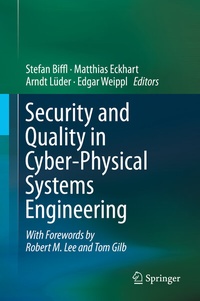
Security and Quality in Cyber-Physical Systems Engineering
With Forewords by Robert M. Lee and Tom Gilb
1st Edition
Published on 9. November 2019
XXV, 507 pages
978-3-030-25312-7 (ISBN)
Description

This book examines the requirements, risks, and solutions to improve the security and quality of complex cyber-physical systems (C-CPS), such as production systems, power plants, and airplanes, in order to ascertain whether it is possible to protect engineering organizations against cyber threats and to ensure engineering project quality.
The book consists of three parts that logically build upon each other. Part I "Product Engineering of Complex Cyber-Physical Systems" discusses the structure and behavior of engineering organizations producing complex cyber-physical systems, providing insights into processes and engineering activities, and highlighting the requirements and border conditions for secure and high-quality engineering. Part II "Engineering Quality Improvement" addresses quality improvements with a focus on engineering data generation, exchange, aggregation, and use within an engineering organization, and the need for proper data modeling and engineering-result validation. Lastly, Part III "Engineering Security Improvement" considers security aspects concerning C-CPS engineering, including engineering organizations' security assessments and engineering data management, security concepts and technologies that may be leveraged to mitigate the manipulation of engineering data, as well as design and run-time aspects of secure complex cyber-physical systems.
The book is intended for several target groups: it enables computer scientists to identify research issues related to the development of new methods, architectures, and technologies for improving quality and security in multi-disciplinary engineering, pushing forward the current state of the art. It also allows researchers involved in the engineering of C-CPS to gain a better understanding of the challenges and requirements of multi-disciplinary engineering that will guide them in their future research and development activities. Lastly, it offers practicing engineers and managers with engineering backgrounds insights into the benefits and limitations of applicable methods, architectures, and technologies for selected use cases.
The book consists of three parts that logically build upon each other. Part I "Product Engineering of Complex Cyber-Physical Systems" discusses the structure and behavior of engineering organizations producing complex cyber-physical systems, providing insights into processes and engineering activities, and highlighting the requirements and border conditions for secure and high-quality engineering. Part II "Engineering Quality Improvement" addresses quality improvements with a focus on engineering data generation, exchange, aggregation, and use within an engineering organization, and the need for proper data modeling and engineering-result validation. Lastly, Part III "Engineering Security Improvement" considers security aspects concerning C-CPS engineering, including engineering organizations' security assessments and engineering data management, security concepts and technologies that may be leveraged to mitigate the manipulation of engineering data, as well as design and run-time aspects of secure complex cyber-physical systems.
The book is intended for several target groups: it enables computer scientists to identify research issues related to the development of new methods, architectures, and technologies for improving quality and security in multi-disciplinary engineering, pushing forward the current state of the art. It also allows researchers involved in the engineering of C-CPS to gain a better understanding of the challenges and requirements of multi-disciplinary engineering that will guide them in their future research and development activities. Lastly, it offers practicing engineers and managers with engineering backgrounds insights into the benefits and limitations of applicable methods, architectures, and technologies for selected use cases.
More details
Other editions
Additional editions
Stefan Biffl | Matthias Eckhart | Arndt Lüder
Security and Quality in Cyber-Physical Systems Engineering
With Forewords by Robert M. Lee and Tom Gilb
Book
11/2019
Springer
€149.79
Shipment within 7-9 days
Persons
Stefan Biffl is an Associate Professor of Software Engineering at the Institute of Information Systems Engineering, at TU Wien. From 2010 to 2016, he was the Head of the Christian Doppler Laboratory Software Engineering Integration for Flexible Automation Systems (CDL-Flex). Since 2018, he has been an advisor at the Christian Doppler Laboratory for Security and Quality Improvement in the Production System Lifecycle (CDL-SQI). A focus of his work is the investigation of methods for cyber-physical systems engineering data analysis and integration as a foundation for the analysis and improvement of collaborative engineering processes.
Matthias Eckhart is a researcher at SBA Research and the Christian Doppler Laboratory for Security and Quality Improvement in the Production System Lifecycle (CDL-SQI).
Arndt Lüder is acting Head of the Institute of Ergonomics, Manufacturing Systems and Automation (IAF) at the Otto von Guericke University in Magdeburg. Since 2018, he has been an advisor at the Christian Doppler Laboratory for Security and Quality Improvement in the Production System Lifecycle (CDL-SQI). The main focus of his work is the application of innovative technologies in the area of factory automation.
Edgar Weippl is co-founder and Research Director of SBA Research, a Comet research center for information security. Since 2018, he has also been the Head of the Christian Doppler Research Laboratory Security and Quality Improvement in the Production System Lifecycle (CDL-SQI). His research focuses on the development of information security and quality improvement concepts, methods, and mechanisms. He was also the General Chair or PC Chair of major conferences including ACM CCS (2016), ACM SACMAT (2015, 2017) and ESORICS (2015).
Matthias Eckhart is a researcher at SBA Research and the Christian Doppler Laboratory for Security and Quality Improvement in the Production System Lifecycle (CDL-SQI).
Arndt Lüder is acting Head of the Institute of Ergonomics, Manufacturing Systems and Automation (IAF) at the Otto von Guericke University in Magdeburg. Since 2018, he has been an advisor at the Christian Doppler Laboratory for Security and Quality Improvement in the Production System Lifecycle (CDL-SQI). The main focus of his work is the application of innovative technologies in the area of factory automation.
Edgar Weippl is co-founder and Research Director of SBA Research, a Comet research center for information security. Since 2018, he has also been the Head of the Christian Doppler Research Laboratory Security and Quality Improvement in the Production System Lifecycle (CDL-SQI). His research focuses on the development of information security and quality improvement concepts, methods, and mechanisms. He was also the General Chair or PC Chair of major conferences including ACM CCS (2016), ACM SACMAT (2015, 2017) and ESORICS (2015).
Content
1 Introduction to Security and Quality Improvement in Complex Cyber-Physical Systems Engineering.- 2 Engineering in an International Context: Risks and Challenges.- 3 Managing complexity within the Engineering of Product and Production systems.- 4 Engineering of Signaling Systems.- 5 On the Need for Data-Based Model-Driven Engineering.- 6 On Testing Data-Intensive Software Systems.- 7 Product/ion-Aware Analysis of Collaborative Systems Engineering Processes.- 8 Engineering Data Logistics for Agile Automation Systems Engineering: Requirements and Solution Concepts with AutomationML.- 9 Efficient and Flexible Test Automation in Production Systems Engineering.- 10 Re-engineering Variants of MATLAB/Simulink Software Systems.- 11 Security Analysis and Improvement of Data Logistics in AutomationML based Engineering Networks.- 12 Securing Information against Manipulation in the Production Systems Engineering Process.- 13 Design and Run-time Aspects of Secure Cyber-Physical Systems.- 14 Digital Twins for Cyber-Physical Systems Security: State of the Art and Outlook.- 15 Radio Frequency (RF) Security in Industrial Engineering Processes.- 16 Secure and Safe IIoT Systems via Machine and Deep Learning Approaches.- 17 Revisiting Practical Byzantine Fault Tolerance Through Blockchain Technologies.- 18 Conclusions and Outlook on Security and Quality in Complex Cyber-Physical Systems Engineering.
