

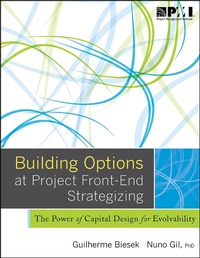
Building Options at Project Front-End Strategizing
The Power of Capital Design for Evolvability
Published on 1. July 2014
214 pages
978-1-62825-072-5 (ISBN)
Description

How do project teams overcome differences to adopt a design plan that strikes a balance between short-term affordability and long-term adaptability? In the book, Building Options at Project Front-End Strategizing: The Power of Capital Design for Evolvability, Guilherme Biesek and Nuno Gil cite research indicating the need for a formal framework to develop front-end strategies that ensure cost-effective management of the project through future change. Biesek and Gil found limitations in the current practices and theory for management of capital projects, and turned to real options reasoning and design literature. Project teams often resort to real options reasoning, because investment in design flexibility is similar to buying options. If future changes are minimal or favorable the options can be exercised to adapt the design economically. In the event the future is not favorable to the project, a limited investment has been lost.
More details
Language
English
Place of publication
Chicago
United States
Product notice
Windows
File size
6,37 MB
ISBN-13
978-1-62825-072-5 (9781628250725)
Copyright in bibliographic data and cover images is held by Nielsen Book Services Limited or by the publishers or by their respective licensors: all rights reserved.
Schweitzer Classification
Other editions
Additional editions
Guilherme Biesek | Nuno Gil
Building Options at Project Front-End Strategizing
The Power of Capital Design for Evolvability
Book
07/2014
Project Management Institute
€65.75
Article exhausted; check different version
Content
- Intro
- Title Page
- Copyright Page
- Table of Contents
- Manuscript Summary
- Acknowledgements
- List of Tables
- List of Figures
- Chapter 1-Introduction
- 1.1 - Problem Articulation
- 1.2 - Conceptual Context and Research Gap
- 1.3 - Research Purpose, Objectives, and Research Questions
- 1.4 - Manuscript Structure
- Chapter 2-Literature Review
- 2.1 - Capital Management of Projects: Integrating Risk Management and Design Flexibility at Front-End Strategizing
- 2.2 - Real Options: Theory and Practice
- 2.3 - Final Considerations
- Chapter 3-Research Method
- 3.1 - Research Design
- 3.2 - Research Validity and Reliability
- Chapter 4-Exploratory Study: Uncovering Design for Evolvability Practices in Single-Funder Capital Project Environments
- 4.1 - Introduction
- 4.2 - Research Context
- 4.3 - Front-End Strategizing
- 4.4 - Using Options Logic in Capital Design for Evolvability
- 4.5 - Assessing the Flexibility Built-In
- 4.6 - Final Observations
- Chapter 5-Design for Evolvability in Multi-Funder Environments: Insights from an Embedded Case Study at Network Rail
- 5.2 - The NR Capital Project Context
- 5.3 - Design for Evolvability in NR Capital Projects
- 5.4 - Final Considerations
- Chapter 6-A Proof-Of-Principle of a Method to Design for Evolvability
- 6.1 - Introduction
- 6.2 - Part 1-Analyzing Options
- 6.3 - Part 2-Designing Alternatives
- 6.4 - Part 3-Project Strategizing
- 6.5 - Design for Evolvability Champion
- Chapter 7-A Two-Group Controlled Experiment: Lab-Based Simulation of the Salford Crescent Redevelopment Project
- 7.1 - The Value of Theory-Oriented Experimental Research
- 7.2 - The Purpose of a Lab-Based Simulation of Front-End Strategizing
- 7.3 - Details of the Capital Project Informing the Simulation Experiment
- 7.4 - Generation of Experimental Data
- 7.5 - Analysis of the Simulation Results
- Chapter 8-Final Considerations: Research Implications and Outlook
- 8.1 - Summary
- 8.2 - Contributions to Theory and Practice
- 8.3 - Limitations and Future Research Directions
- 8.4 - Final Considerations
- References
- Appendices
- A - Interview Protocol
- B - Questionnaire to Assess Overall Satisfaction with the Front-End Strategizing Process
- C - Instructor's Guide
- D - Estimating Volatility from Historical Data
- E - Generic and Bespoke Design Briefs
- F - Route Map for Cross-Pennine, Yorkshire & Humber and North West
- G - TOC Franchises around the Salford Crescent Area
- H - Meeting Agenda
- I - Harvard-Style Case Study
