

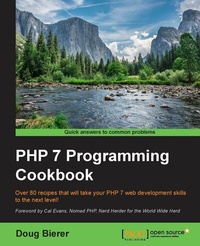
PHP 7 Programming Cookbook
Over 80 recipes that will take your PHP 7 web development skills to the next level!
Published on 8. July 2025
610 pages
978-1-78588-254-8 (ISBN)
Description

Over 80 recipes that will take your PHP 7 web development skills to the next level!
Key Features
[*] This is the most up-to-date book in the market on PHP
[*] It covers the new features of version 7.x, best practices for server-side programming, and MVC frameworks
[*] The recipe-based approach will allow you to explore the unique capabilities that PHP offers to web programmers
Book DescriptionPHP 7 comes with a myriad of new features and great tools to optimize your code and make your code perform faster than in previous versions. Most importantly, it allows you to maintain high traffic on your websites with low-cost hardware and servers through a multithreading web server. This book demonstrates intermediate to advanced PHP techniques with a focus on PHP 7. Each recipe is designed to solve practical, real-world problems faced by PHP developers like yourself every day. We also cover new ways of writing PHP code made possible only in version 7. In addition, we discuss backward-compatibility breaks and give you plenty of guidance on when and where PHP 5 code needs to be changed to produce the correct results when running under PHP 7. This book also incorporates the latest PHP 7.x features. By the end of the book, you will be equipped with the tools and skills required to deliver efficient applications for your websites and enterprises.What you will learn
[*] Use advanced PHP 7 features, such as the Abstract Syntax Tree, Uniform Variable Syntax, Scalar Type Hints, Generator Delegation, Anonymous Classes, and the Context Sensitive Lexer
[*] Discover where and when PHP 5 code needs to be re-written to avoid backwards-compatibility breaks
[*] Improve the overall application security and error handling by taking advantage of classes that implement the new throwable interface
[*] Solve practical real-world programming problems using PHP 7
[*] Develop middle-wareclasses that allow PHP developers to gluedifferent open source libraries together seamlessly
[*] Define and Implement PSR-7 classes
[*] Create custom middleware using PSR-7 compliant classes
[*] Test and debug your code, and get to know the best practices
Who this book is forIf you are an aspiring web developer, mobile developer, or backend programmer, then this book is for you as it will take your PHP programming skills to next level. Basic knowledge of PHP programming is assumed.
Key Features
[*] This is the most up-to-date book in the market on PHP
[*] It covers the new features of version 7.x, best practices for server-side programming, and MVC frameworks
[*] The recipe-based approach will allow you to explore the unique capabilities that PHP offers to web programmers
Book DescriptionPHP 7 comes with a myriad of new features and great tools to optimize your code and make your code perform faster than in previous versions. Most importantly, it allows you to maintain high traffic on your websites with low-cost hardware and servers through a multithreading web server. This book demonstrates intermediate to advanced PHP techniques with a focus on PHP 7. Each recipe is designed to solve practical, real-world problems faced by PHP developers like yourself every day. We also cover new ways of writing PHP code made possible only in version 7. In addition, we discuss backward-compatibility breaks and give you plenty of guidance on when and where PHP 5 code needs to be changed to produce the correct results when running under PHP 7. This book also incorporates the latest PHP 7.x features. By the end of the book, you will be equipped with the tools and skills required to deliver efficient applications for your websites and enterprises.What you will learn
[*] Use advanced PHP 7 features, such as the Abstract Syntax Tree, Uniform Variable Syntax, Scalar Type Hints, Generator Delegation, Anonymous Classes, and the Context Sensitive Lexer
[*] Discover where and when PHP 5 code needs to be re-written to avoid backwards-compatibility breaks
[*] Improve the overall application security and error handling by taking advantage of classes that implement the new throwable interface
[*] Solve practical real-world programming problems using PHP 7
[*] Develop middle-wareclasses that allow PHP developers to gluedifferent open source libraries together seamlessly
[*] Define and Implement PSR-7 classes
[*] Create custom middleware using PSR-7 compliant classes
[*] Test and debug your code, and get to know the best practices
Who this book is forIf you are an aspiring web developer, mobile developer, or backend programmer, then this book is for you as it will take your PHP programming skills to next level. Basic knowledge of PHP programming is assumed.
All prices
More details
Edition
Digital original
Language
English
Place of publication
Birmingham
United Kingdom
Target group
Professional and scholarly
US School Grade: College Graduate Student
Edition type
Digital original
File size
27,01 MB
ISBN-13
978-1-78588-254-8 (9781785882548)
Copyright in bibliographic data and cover images is held by Nielsen Book Services Limited or by the publishers or by their respective licensors: all rights reserved.
Schweitzer Classification
Other editions
Additional editions
Doug Bierer
PHP 7 Programming Cookbook
Over 80 recipes that will take your PHP 7 web development skills to the next level!
Book
08/2016
Packt Publishing
€65.60
Shipment within 3-4 weeks
Person
Bierer Doug :
Doug Bierer has been hooked on computers since his first program, written on a DEC PDP-8, in 1971. In his wide-ranging career, he has been a professional contract programmer since 1978, having written applications in BASIC, PL/I, assembler, FORTH, C, C++, dBase/FoxBase/Clipper, Pascal, Perl, Java, and PHP. He deployed his first website in 1993 while living in San Francisco. He speaks four languages, has traveled extensively, and now resides in Thailand. He also spent some years doing system administration and TCP/IP networking. Some of his technical works include PHP 7 Programming Cookbook and Learning MongoDB 4.x (Packt), as well as Learning PHP and MySQL, Learning PHP Security and Learning Doctrine (O'Reilly Media).
Doug Bierer has been hooked on computers since his first program, written on a DEC PDP-8, in 1971. In his wide-ranging career, he has been a professional contract programmer since 1978, having written applications in BASIC, PL/I, assembler, FORTH, C, C++, dBase/FoxBase/Clipper, Pascal, Perl, Java, and PHP. He deployed his first website in 1993 while living in San Francisco. He speaks four languages, has traveled extensively, and now resides in Thailand. He also spent some years doing system administration and TCP/IP networking. Some of his technical works include PHP 7 Programming Cookbook and Learning MongoDB 4.x (Packt), as well as Learning PHP and MySQL, Learning PHP Security and Learning Doctrine (O'Reilly Media).
Content
Table of Contents
Buidling the Foundation
Using PHP 7 High Performance Features
Working with PHP Functional Programming
Working with PHP OOP
Interacting with a Database
Building Scalable Websites
Accessing Web Services
Working with Date/Time and International Aspects
Developing Middleware
Looking at Advanced Algorithms
Implementing Design Patterns
Improving Web Security
Best Practices, Testing and Debugging
Appendix A
Buidling the Foundation
Using PHP 7 High Performance Features
Working with PHP Functional Programming
Working with PHP OOP
Interacting with a Database
Building Scalable Websites
Accessing Web Services
Working with Date/Time and International Aspects
Developing Middleware
Looking at Advanced Algorithms
Implementing Design Patterns
Improving Web Security
Best Practices, Testing and Debugging
Appendix A

