

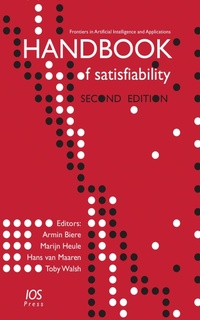
Handbook of Satisfiability
Second Edition
1st Edition
Published on 15. May 2021
1484 pages
978-1-64368-161-0 (ISBN)
Description

Propositional logic has been recognized throughout the centuries as one of the cornerstones of reasoning in philosophy and mathematics. Over time, its formalization into Boolean algebra was accompanied by the recognition that a wide range of combinatorial problems can be expressed as propositional satisfiability (SAT) problems. Because of this dual role, SAT developed into a mature, multi-faceted scientific discipline, and from the earliest days of computing a search was underway to discover how to solve SAT problems in an automated fashion.
This book, the Handbook of Satisfiability, is the second, updated and revised edition of the book first published in 2009 under the same name. The handbook aims to capture the full breadth and depth of SAT and to bring together significant progress and advances in automated solving. Topics covered span practical and theoretical research on SAT and its applications and include search algorithms, heuristics, analysis of algorithms, hard instances, randomized formulae, problem encodings, industrial applications, solvers, simplifiers, tools, case studies and empirical results. SAT is interpreted in a broad sense, so as well as propositional satisfiability, there are chapters covering the domain of quantified Boolean formulae (QBF), constraints programming techniques (CSP) for word-level problems and their propositional encoding, and satisfiability modulo theories (SMT). An extensive bibliography completes each chapter.
This second edition of the handbook will be of interest to researchers, graduate students, final-year undergraduates, and practitioners using or contributing to SAT, and will provide both an inspiration and a rich resource for their work.
Edmund Clarke, 2007 ACM Turing Award Recipient:
""SAT solving is a key technology for 21st century computer science.""
Donald Knuth, 1974 ACM Turing Award Recipient:
""SAT is evidently a killer app, because it is key to the solution of so many other problems.""
Stephen Cook, 1982 ACM Turing Award Recipient:
""The SAT problem is at the core of arguably the most fundamental question in computer science: What makes a problem hard?""
This book, the Handbook of Satisfiability, is the second, updated and revised edition of the book first published in 2009 under the same name. The handbook aims to capture the full breadth and depth of SAT and to bring together significant progress and advances in automated solving. Topics covered span practical and theoretical research on SAT and its applications and include search algorithms, heuristics, analysis of algorithms, hard instances, randomized formulae, problem encodings, industrial applications, solvers, simplifiers, tools, case studies and empirical results. SAT is interpreted in a broad sense, so as well as propositional satisfiability, there are chapters covering the domain of quantified Boolean formulae (QBF), constraints programming techniques (CSP) for word-level problems and their propositional encoding, and satisfiability modulo theories (SMT). An extensive bibliography completes each chapter.
This second edition of the handbook will be of interest to researchers, graduate students, final-year undergraduates, and practitioners using or contributing to SAT, and will provide both an inspiration and a rich resource for their work.
Edmund Clarke, 2007 ACM Turing Award Recipient:
""SAT solving is a key technology for 21st century computer science.""
Donald Knuth, 1974 ACM Turing Award Recipient:
""SAT is evidently a killer app, because it is key to the solution of so many other problems.""
Stephen Cook, 1982 ACM Turing Award Recipient:
""The SAT problem is at the core of arguably the most fundamental question in computer science: What makes a problem hard?""
More details
Series
Language
English
Place of publication
London
Netherlands
Publishing group
IOS Press
Target group
Professional and scholarly
File size
10,63 MB
ISBN-13
978-1-64368-161-0 (9781643681610)
Copyright in bibliographic data and cover images is held by Nielsen Book Services Limited or by the publishers or by their respective licensors: all rights reserved.
Schweitzer Classification
Other editions
Additional editions
Book
05/2021
1st Edition
IOS Press,US
€309.50
Shipment within 10-20 days
Content
- Intro
- Title Page
- Preface First Edition
- Preface Second Edition
- Contents
- Part I. Theory and Algorithms
- Chapter 1. A History of Satisfiability
- Chapter 2. CNF Encodings
- Chapter 3. Complete Algorithms
- Chapter 4. CDCL SAT Solving
- Chapter 5. Look-Ahead Based SAT Solvers
- Chapter 6. Incomplete Algorithms
- Chapter 7. Proof Complexity and SAT Solving
- Chapter 8. Fundaments of Branching Heuristics
- Chapter 9. Preprocessing in SAT Solving
- Chapter 10. Random Satisfiability
- Chapter 11. Exploiting Runtime Variation in Complete Solvers
- Chapter 12. Automated Configuration and Selection of SAT Solvers
- Chapter 13. Symmetry and Satisfiability
- Chapter 14. Minimal Unsatisfiability and Autarkies
- Chapter 15. Proofs of Unsatisfiability
- Chapter 16. Worst-Case Upper Bounds
- Chapter 17. Fixed-Parameter Tractability
- Part II. Applications and Extensions
- Chapter 18. Bounded Model Checking
- Chapter 19. Planning and SAT
- Chapter 20. Software Verification
- Chapter 21. Combinatorial Designs by SAT Solvers
- Chapter 22. Connections to Statistical Physics
- Chapter 23. MaxSAT
- Chapter 24. Maximum Satisfiability
- Chapter 25. Model Counting
- Chapter 26. Approximate Model Counting
- Chapter 27. Non-Clausal SAT and ATPG
- Chapter 28. Pseudo-Boolean and Cardinality Constraints
- Chapter 29. QBF Theory
- Chapter 30. QBFs reasoning
- Chapter 31. Quantified Boolean Formulas
- Chapter 32. SAT Techniques for Modal and Description Logics
- Chapter 33. Satisfiability Modulo Theories
- Chapter 34. Stochastic Boolean Satisfiability
- Subject Index
- Cited Author Index
- Contributing Authors and Affiliations
