

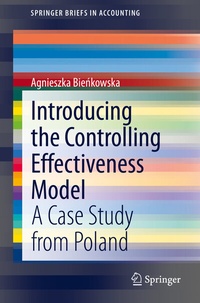
Introducing the Controlling Effectiveness Model
A Case Study from Poland
Published on 13. May 2021
VII, 104 pages
978-3-030-73808-2 (ISBN)
Description

Focusing on the controlling management method, this book considers the conditions that must be met within a given organization in order for controlling to achieve the desired level of product quality, allowing it to enhance the performance of the organization as a whole.
The book describes the influence of each identified group of conditions on the Controlling Effectiveness Model and includes empirical research, conducted at various organizations operating in Poland, that verifies its theoretical assumptions. In terms of analyzing the empirical data, description and statistical inference methods were used, such as students' t-test scores for independent samples, non-parametric r-Pearson correlation and linear regression analysis. Additionally, the book includes moderators and mediators executed using Process Macro for SPSS by Hayes, and multigroup path analysis executed using SPSS AMOS.
The book describes the influence of each identified group of conditions on the Controlling Effectiveness Model and includes empirical research, conducted at various organizations operating in Poland, that verifies its theoretical assumptions. In terms of analyzing the empirical data, description and statistical inference methods were used, such as students' t-test scores for independent samples, non-parametric r-Pearson correlation and linear regression analysis. Additionally, the book includes moderators and mediators executed using Process Macro for SPSS by Hayes, and multigroup path analysis executed using SPSS AMOS.
More details
Series
Edition
1st ed. 2021
Language
English
Place of publication
Cham
Switzerland
Publishing group
Springer International Publishing
Target group
Professional and scholarly
Product notice
Reflowable
Illustrations
VII, 104 p. 9 illus., 7 illus. in color.
File size
1,87 MB
ISBN-13
978-3-030-73808-2 (9783030738082)
DOI
10.1007/978-3-030-73808-2
Schweitzer Classification
Other editions
Additional editions
Book
05/2021
Springer
€53.49
Shipment within 7-9 days
Person
Agnieszka Bienkowska is the Vice-Rector of Wroclaw University of Science and Technology (Poland) and Professor of WUST at the Faculty of Computer Science and Management, Department of Management Systems and Organizational Development. Her research areas are focused on modern methods of management (especially controlling) and HRM solutions in organizations.
Content
Chapter 1. Introduction.- Chapter 2. Controlling quality and effectiveness - Controlling Effectiveness Model.- Chapter 3. Factors influencing the functioning of controlling.- Chapter 4. Research methodology.- Chapter 5. Conclusions.
