

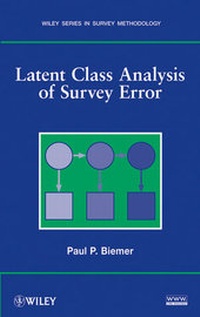
Latent Class Analysis of Survey Error
Description

Reviews / Votes
"Biemer (statistics, RTI International and survey research anddevelopment, U. of North Carolina at Chapel Hill) provides acomprehensive source on the primary statistical tools andtechniques used in the modeling and estimation of classificationerrors, with a particular focus on latent class techniques andmodels for categorical data from complex sample surveys . . . thebook would be useful as a text for graduate level courses inmeasurement error and survey methodology, as well as a referencefor researchers and professionals in business, government, andsocial sciences who are responsible for developing, implementing,or evaluating surveys." (Booknews, 1 April 2011) "By combining theoretical, methodological and practical aspectsof estimating classification error, the book provides a guide forthe practitioner as well as a text for the student of survey errorevaluation". (RTI International, 18 January 2011)More details
Other editions
Additional editions
Person
Content
Abbreviations.
1. Survey Error Evaluation.
1.1 Survey Error.
1.1.1 An Overview of Surveys.
1.1.2 Survey Quality and Accuracy and Total Survey Error.
1.1.3 Nonsampling Error.
1.2 Evaluating the Mean-Squared Error.
1.2.1 Purposes of MSE Evaluation.
1.2.2 Effects of Nonsampling Errors on Analysis.
1.2.3 Survey Error Evaluation Methods.
1.2.4 Latent Class Analysis.
1.3 About This Book.
2. A General Model for Measurement Error.
2.1 The Response Distribution.
2.1.1 A Simple Model of the Response Process.
2.1.2 The Reliability Ratio.
2.1.3 Effects of Response Variance on Statistical Inference.
2.2 Variance Estimation in the Presence of Measurement Error.
2.2.1 Binary Response Variables.
2.2.2 Special Case: Two Measurements.
2.2.3 Extension to Polytomous Response Variables.
2.3 Repeated Measurements.
2.3.1 Designs for Parallel Measurements.
2.3.2 Nonparallel Measurements.
2.3.3 Example: Reliability of Marijuana Use Questions.
2.3.4 Designs Based on a Subsample.
2.4 Reliability of Multiitem Scales.
2.4.1 Scale Score Measures.
2.4.2 Cronbach's Alpha.
2.5 True Values, Bias, and Validity.
2.5.1 A True Value Model.
2.5.2 Obtaining True Values.
2.5.3 Example: Poor- or Failing-Grade Data.
3. Response Probability Models for Two Measurements.
3.1 Response Probability Model.
3.1.1 Bross' Model.
3.1.2 Implications for Survey Quality Investigations.
3.2 Estimating p, ¿, and f.
3.2.1 Maximum-Likelihood Estimates of p, ¿, and f.
3.2.2 The EM Algorithm for Two Measurements.
3.3 Hui-Walter Model for Two Dichotomous Measurements.
3.3.1 Notation and Assumptions.
3.3.2 Example: Labor Force Misclassifi cations.
3.3.3 Example: Mode of Data Collection Bias.
3.4 Further Aspects of the Hui-Walter Model.
3.4.1 Two Polytomous Measurements.
3.4.2 Example: Misclassifi cation with Three Categories.
3.4.3 Sensitivity of the Hui-Walter Method to Violations in the Underlying Assumptions.
3.4.4 Hui-Walter Estimates of Reliability.
3.5 Three or More Polytomous Measurements.
4. Latent Class Models for Evaluating Classifi cation Errors.
4.1 The Standard Latent Class Model.
4.1.1 Latent Variable Models.
4.1.2 An Example from Typology Analysis.
4.1.3 Latent Class Analysis Software.
4.2 Latent Class Modeling Basics.
4.2.1 Model Assumptions.
4.2.2 Probability Model Parameterization of the Standard LC Model.
4.2.3 Estimation of the LC Model Parameters.
4.2.4 Loglinear Model Parameterization.
4.2.5 Example: Computing Probabilities Using Loglinear Parameters.
4.2.6 Modifi ed Path Model Parameterization.
4.2.7 Recruitment Probabilities.
4.2.8 Example: Computing Probabilities Using Modified Path Model Parameters.
4.3 Incorporating Grouping Variables.
4.3.1 Example: Loglinear Parameterization of the Hui-Walter Model.
4.3.2 Example: Analysis of Past-Year Marijuana Use with Grouping Variables.
4.4 Model Estimation and Evaluation.
4.4.1 EM Algorithm for the LL Parameterization.
4.4.2 Assessing Model Fit.
4.4.3 Model Selection.
4.4.4 Model-Building Strategies.
4.4.5 Model Restrictions.
4.4.6 Example: Continuation of Marijuana Use Analysis.
5. Further Aspects of Latent Class Modeling.
5.1 Parameter Estimation.
5.1.1 Simulation and "Expeculation".
5.1.2 Model Identifi ability.
5.1.3 Checking Identifi ability with Expeculation.
5.1.4 Data Sparseness.
5.1.5 Boundary Estimates.
5.1.6 Local Maxima.
5.1.7 Latent Class Flippage.
5.2 Local Dependence Models.
5.2.1 Unexplained Heterogeneity.
5.2.2 Correlated Errors.
5.2.3 Bivocality.
5.2.4 A Strategy for Modeling Local Dependence.
5.2.5 Example: Locally Dependent Measures of Sexual Assault.
5.3 Modeling Complex Survey Data.
5.3.1 Objectives of Survey Weighting.
5.3.2 LCA with Complex Survey Data.
5.3.3 Including Design Variables in the Fitted Model.
5.3.4 Weighted and Rescaled Frequencies.
5.3.5 Pseudo-Maximum-Likelihood Estimation.
5.3.6 Treating the Average Cell Weight as an Offset Parameter.
5.3.7 Two-Step Estimation.
5.3.8 Illustration of Weighted and Unweighted Analyses.
5.3.9 Conclusions and Recommendations.
6. Latent Class Models for Special Applications.
6.1 Models for Ordinal Data.
6.2 A Latent Class Model for Reliability.
6.2.1 Generalized Kappa Statistics.
6.2.2 Comparison of Error Model and Agreement Model Concepts of Reliability.
6.2.3 Reliability of Self-Reports of Race.
6.3 Capture-Recapture Models.
6.3.1 Latent Class Capture-Recapture Models.
6.3.2 Modeling Erroneous Enumerations.
6.3.3 Parameter Estimation.
6.3.4 Example: Evaluating the Census Undercount.
6.3.5 Example: Classifi cation Error in a PES.
7. Latent Class Models for Panel Data.
7.1 Markov Latent Class Models.
7.1.1 Manifest Markov Models.
7.1.2 Example: Application of the MM Model to Labor Force Data.
7.1.3 Markov Latent Class Models.
7.1.4 Example: Application of the MLC Model to Labor Force Data.
7.1.5 The EM Algorithm for MLC Models.
7.1.6 MLC Model with Grouping Variables.
7.1.7 Example: CPS Labor Force Status Classification Error.
7.1.8 Example: Underreporting in Consumer Expenditure Survey.
7.2 Some Nonstandard Markov Models.
7.2.1 Manifest Mover-Stayer Model.
7.2.2 Latent Class Mover-Stayer Model.
7.2.3 Second-Order MLC Model.
7.2.4 Example: CEIS Analysis with Four Timepoints.
7.2.5 MLC Model with Time-Varying Grouping Variables.
7.2.6 Example: Assessment of Subject Interests.
7.2.7 Multiple Indicators at One or More Waves.
7.3 Further Aspects of Markov Latent Class Analysis.
7.3.1 Estimation Issues with MLCA.
7.3.2 Methods for Panel Nonresponse.
7.3.3 Example: Assessment of Subject Interests with Nonresponse.
8. Survey Error Evaluation: Past, Present, and Future.
8.1 History of Survey Error Evaluation Methodology.
8.1.1 The US Census Bureau Model for Survey Error.
8.1.2 From Bross' Model to the Standard LC and MLC Models.
8.1.3 Loglinear Models with Latent Variables.
8.2 Current State of the Art.
8.2.1 Criticisms of LCA for Survey Error Evaluation.
8.2.2 General Strategy for Applying LC and MLC Models.
8.3 Some Ideas for Future Directions.
8.4 Conclusions.
Appendix A. Two-Stage Sampling Formulas.
Appendix B. Loglinear Modeling Essentials.
B.1 Loglinear versus ANOVA Models: Similarities and Differences.
B.2 Modeling Cell and Other Conditional Probabilities.
B.3 Generalization to Three Variables.
B.4 Estimation of Loglinear and Logit Models.
References.
Index.
