

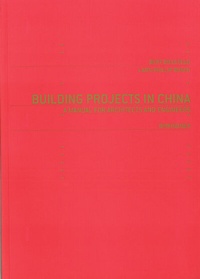
Building Projects in China
Description

Building Projects in China is the first publication on the book market to give a comprehensive overview of the planning activities of foreign architects in China. This practical handbook outlines legal framework conditions, introduces the Chinese building market, and gives practical descriptions of the execution of projects on site. To complete the picture, international planning firms share their experience on projects of the most various sizes and types in China. What makes projects in China so challenging is the tension between the traditional, historical planning environment of an Asian big city and a modernity that is in many ways already ahead of the Western world.
Interest in the Chinese building and planning market has been steadily growing for many years. Now, for the first time, a repository of knowledge as exhaustively researched as this one is finally available.
More details
Other editions
Additional editions

Persons
Dr. Bert Bielefeld is an architect and assistant professor at Universität Dortmund. He did research and earned his doctorate in the field of architectural export. Lars-Phillip Rusch is an architect and research associate of the faculty of civil engineering at Universität Dortmund.
Content
After the death of Mao Zedong and Hua Guofeng`s transitional government, Deng Xiaoping, known as a pragmatist, took up the reins of Chinese government in 1978. Given the extensive measures resulting from the permanent state of revolution that had lasted for over a decade, Deng had a unique empire at his disposal: over a billion people who had just been subjected to the experiment of having all their traditional values deleted as if from a computer hard disk.
Apart from the fact that historical memories cannot be expunged without difficulty, this represented an enormous opportunity to create something new. Since the 1990s, China has been experiencing what are so far the greatest architectural changes in human history. They were launched by protagonists who, if they were between 45 and 65 years old in 1996 were between 15 and 35 in 1966, in other words at the beginning of the Cultural Revolution.
These people were affected either actively as Red Guards, or passively as criticized class enemies. In retrospect, members of this generation are to be seen as victims by dint of the traumas they suffered, their lack of school education and the chaotic conditions that persisted for years. It is precisely the members of this generation who in the 1990s were placed in the position of being able to decide about the new face of China, at the same time as Jiang Zemin`s "three representatives" campaign, which made the close alliance of political and economic power again acceptable. In 1992, in other words after Deng Xiaoping`s southern tour of inspection, the so-called "outward appearance" or image project buildings - xingxiang gongcheng - were given a great boost.
The party leader`s positive appraisal of the city of Shenzhen spurred party secretaries in all China`s larger cities to imitate the new southern metropolis and create a favourable impression with their own economic development. And in order to make this visible to all, skyscrapers had to be built in places where experienced town planners would not necessarily have put them. Quite a number of projects like this were in fact ultimately seen to have been mistakes, or the developers ran out of money, often meaning that the shell was already complete and remained as an unused architectural ruin.
After the traditional values of moderation had been driven out of a whole generation, it is hardly surprising that they temporarily lost their sense of scale as well. It has already been shown that traditional Chinese building stock was of no particular value to most protagonists. Then we have the well-preserved stone buildings, though from the Chinese point of view these were built by imperialist aggressors, according to the school books. But respect for the technical achievement and aesthetics of the most important buildings is always present alongside rage about this phase of Chinese history. Hybrids of Chinese and Western architecture, like lilong buildings in Shanghai or the two-storey courtyard buildings with German-looking fagades and tiled roofs in Qingdao, are much more likely to be threatened with, or actually face, demolition.
