

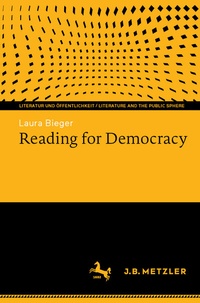
Reading for Democracy
Description

Is literature of political use, and if yes, how might this use be defined? "Reading for Democracy" addresses this question in a series of essays, with topics ranging from 'reading as a political practice' to 'the relational aesthetics of literary engagement', from 'the public sphere as a space of appearance' to 'public intellectuals and the predicament of popularity', from 'Jesmyn Ward's poetics of breathing while Black' to 'the art of the essay in the digital age'. In considering these topics, it engages with a range of philosophical, sociological, media and literary critical works by scholars including Jürgen Habermas, Michael Warner, John Dewey, Hannah Arendt, Jean-Paul Sartre, Theodor Adorno, Nicolas Bourriaud and Pierre Bourdieu. But the baseline of the essays collected in this volume is an understanding of literature as a social practice, a collective doing and making that involves a multiplicity of human and non-human actors (writers, readers, publishers, agents, book covers, prize committees, English departments, literary characters and styles, adaptations for stage and screen). In this framework, literary texts are not stable objects. They are bonding agents in a complex and shifting web of relations, and in this capacity they catalyze and channel the activities necessary to forge these relations (reading, writing, publishing, republishing, citing, reciting, reviewing, recommending). Moving back and forth between two shape-shifting actors-the reading public and a socially engaged literature-the assembled essays show how the political functions and uses of literature are defined from within this constellation; or, more precisely, through the collective and reflective forms of judgment, including aesthetic judgement, that are tried and institutionalized in practicing literature. And that are essential to negotiating the shape of the world. Which is what the political is all about.
More details
Other editions
Additional editions
Person
Laura Bieger ist Universitätsprofessorin für American Studies an der Ruhr-Universität Bochum.
Content
Reading for Democracy.- Jean-Paul Sartre, Richard Wright, and the Relational Aesthetics of Literary Engagement.- Learning from Hannah Arendt; or, The Public Sphere as a Space of Appearance and the Fundamental Opacity of the Face-to-Face.- What Dewey Knew: The Public as Problem, Practice, and Art.- Public Intellectuals, Cultural Fields, and the Predicament of Popularity; or, Richard Wright Meets Pierre Bourdieu.- Authorizing Native Son : A Relational Approach to Engaged Literature.- Jesmyn Ward's Poetics of Breathing While Black.- The 1619 Project as Aesthetic and Social Practice; or, the Art of the Essay in the Digital Age.- Audre Lorde's Berlin; or, Writing Beyond the Page.- Coda: The Value of the Political.
