

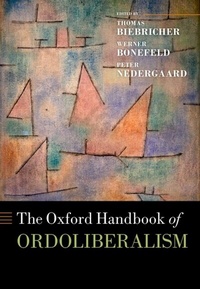
The Oxford Handbook of Ordoliberalism
1st Edition
Published on 22. September 2022
800 pages
978-0-19-260543-6 (ISBN)
Description

Since the financial crisis of 2008, ordoliberalism emerged from relative obscurity to become one of the crucial terms of analysis across a wide range of academic literatures and public discussion. In fact, it became the main reference for a number of issues, including assessments of the attempted resolution of the Eurozone crisis, arguments about German hegemony in Europe, debates over the future of economic liberalism and controversies about authoritarian liberalism. What is striking about ordoliberalism is its pronounced ambiguity, as some view it as a more refined and potentially progressive variant of neoliberalism, while others cast it as a blueprint for a regime of austerity reigning over a society of competition with only rudimentary democratic institutions. And while ordoliberalism is often portrayed as a quintessentially German tradition, its impact has not been confined to the German context, extending all the way to the unlikely case of China. In short, ordoliberalism is a phenomenon of arguably considerable influence that remains poorly understood, as it is mystified by its proponents and vilified by its critics. The Oxford Handbook of Ordoliberalism contains a selection of chapters written by an international cast of experts on ordoliberalism that aim to elucidate and analyze the latter in all of its many facets. From the intellectual origins and prime exemplars to its main theoretical themes and practical applications up to the most recent debates taking place across a range of disciplines, this volume offers the first comprehensive account of ordoliberalism for the English-speaking world.
More details
Other editions
Additional editions
Thomas Biebricher | Werner Bonefeld | Peter Nedergaard
The Oxford Handbook of Ordoliberalism
Book
09/2022
Oxford University Press
€202.50
Shipment within 15-20 days
Persons
Thomas Biebricher received his doctorate in Political Science from the University of Freiburg in 2003. From 2003 to 2009 he was a Visiting Assistant Professor at the Department of Political Science of the University of Florida in Gainesville. From 2009 to 2012 he was Junior Research Group Director at the Cluster of Excellence 'Normative Orders' at the Goethe University in Frankfurt where he continued to hold various other positions until 2020. In 2014 he spent some months on a research stay at the Institute of European Studies at the University of British Columbia in Vancouver. Since July 2020 he is Associate Professor for the History of Economic Governance at the Department of Management, Politics, and Philosophy at Copenhagen Business School.
Werner Bonefeld is Professor in Politics at the University of York. Before coming to York, he taught at the Universities of Frankfurt and Edinburgh. His research is in the area of political economy as a critical social theory. His work has contributed to the development of Open Marxism, which integrates early Frankfurt School critical theory and the critique of political economy. He has published about the restructuring of the British State, the global economy, European integration, antisemitism, critical theory and Marx. With Chris O'Kane he is co-editor of the Bloomsbury Series Critical Theory and the Critique of Society.
Peter Nedergaard is professor of Political Science at the University of Copenhagen since 2008. Before that, he was Professor, Associate Professor, and Assistant Professor at Copenhagen Business School. He holds a Ph.D. in Political Science from University of Aarhus. His research interests are European politics and the political economy of European integration, Nordic cooperation, and international political economy. In relation to this he has analyzed the common agricultural policy, the market integration, Nordic cooperation, employment policy, international trade policy, as well as the administration of EU and Nordic cooperation. He has published extensively in these areas.
Content
- Introduction
- 1: Thomas Biebricher, Werner Bonefeld, and Peter Nedergaard: Why a book on Ordoliberalism?
- Part I. Contexts
- 2: Bertram Schefold: Theoretical context: Ordoliberalism as a new synthesis of earlier German economic thought
- 3: Ralf Ptak: Historical context of the theoretical formation: Weimar democracy, Weltwirtschaftskrise and the rise of National Socialism
- 4: William Callison: Historical Context of Ordoliberalism's Theoretical Development
- 5: Philip Mirowski: Ordoliberalism within the Historical Trajectory of Neoliberalism
- 6: Thomas Biebricher: Ordoliberalism and Conservatism
- Part II. Key thinkers and key texts
- 7: Manuel Wörsdörfer: Walter Eucken: Foundations of Economics
- 8: Michelle Everson: Franz Böhm: Private Law Society and Lessons for our Age
- 9: Raphaël Fèvre: Wilhelm Röpke: The Social Crisis of Our Time
- 10: Stefan Kolev and Nils Goldschmidt: Alexander Rüstow: The Failure of Economic Liberalism
- 11: Ralf Ptak: Alfred Müller-Armack: The "State Idea" and the Economic Order - Metamorphoses from 1932 to 1978
- 12: Ralf Ptak: Leonhard Miksch: "Competition as a Task" in Science, Journalism and Politics
- 13: Christian Joerges: Ernst-Joachim Mestmäcker: A vision of European Economic Constitutionalism
- 14: Malte Dold: Viktor Vanberg: The Constitution of Markets and Public Choice
- 15: Viktor J. Vanberg: Adam Smith: Classical Political Economy and Ordoliberalism
- 16: Alec Dinnin: Ortega y Gasset: The fear of mass society
- 17: Renato Cristi: Carl Schmitt: Decisionism
- Part III. Political economy
- 18: Klaus Tuori: Economic Constitution and the State
- 19: Dieter Plehwe: The Economic State and the Ordoliberal Critique of Keynesianism: Anti-economic state or just a different type of economic state?
- 20: Jonathan White: Rule of Law (Rechtsstaat) and Social Order
- 21: Ralf Havertz: The Strong State and "the Taming of Freedom"
- 22: Hagen Schulz-Forberg: Balancing the World: (De-)centralisation, regionalism, and international organisation in the world economy
- 23: Josef Hien: The Social Market Economy and Ordoliberalism - a difficult relationship
- Part IV. Politics
- 24: Joshua Rahtz: The Politics of Order and Law: Ordnungspolitik
- 25: Rune Møller Stahl: Politics and the Order of Society
- 26: Astrid Séville and Sebastian Pieper: Politics of Decision-Making: Government by Experts and the Politics of Depoliticisation
- 27: Philip Manow: Myth, Religion, and Social Market Economy
- Part V. Policies
- 28: Angela Wigger: Competition Laws and Their Enforcement in theProject of European Integration. An Artefact of Ordoliberal Influence?
- 29: Ekkehard A. Köhler: Ordoliberal Economic Policy
- 30: Harald Hagemann: Economic Crisis Policy
- 31: Harald Hagemann: Labour Market Policy
- 32: Jörg Bibow: Walter Eucken on Currency Matters and Central Banking
- 33: Stefan Kolev and Nils Goldschmidt: Vitalpolitik
- 34: Lars Cornelissen: Post-War Ordoliberalism, Race, and the Politics of Development
- Part VI. Contemporary issues
- 35: Quinn Slobodian: Ordoliberals on Federalism and Europe
- 36: Federico Bruno: Eurozone Policy and Crisis
- 37: Remi Maier-Rigaud: Social Policy in an Entrepreneurial Society
- 38: Frieder Vogelmann: Ordoliberalism as Political Rationality in Foucault's Genealogy of Liberalism
