

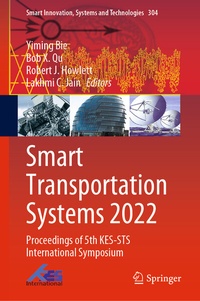
Smart Transportation Systems 2022
Proceedings of 5th KES-STS International Symposium
1st Edition
Published on 14. May 2022
X, 200 pages
978-981-19-2813-0 (ISBN)
Description

This book gathers selected papers presented at the KES International Symposium on Smart Transportation Systems (KES STS 2022). Modern transportation systems have undergone a rapid transformation in recent years, producing a range of technological innovations such as connected vehicles, self-driving cars, electric vehicles, Hyperloop, and even flying cars, and with them, fundamental changes in transport systems around the world. The book discusses current challenges, innovations, and breakthroughs in smart transportation systems, as well as transport infrastructure modeling, safety analysis, freeway operations, intersection analysis, and other related cutting-edge topics.
More details
Series
Language
English
Place of publication
Singapore
Singapore
Publishing group
Springer Singapore
Target group
Professional and scholarly
Product notice
Reflowable
Illustrations
X, 200 p. 66 illus., 50 illus. in color.
File size
13,45 MB
ISBN-13
978-981-19-2813-0 (9789811928130)
DOI
10.1007/978-981-19-2813-0
Schweitzer Classification
Other editions
Additional editions
Yiming Bie | Bob X. Qu | Robert J. Howlett
Smart Transportation Systems 2022
Proceedings of 5th KES-STS International Symposium
Book
05/2022
Springer
€246.09
Shipment within 3-4 weeks
Persons
Yiming Bie is Professor of Transportation Engineering with the School of Transportation, Jilin University, China. He obtained his Ph.D. degree at Jilin University in June 2012. His research interests include public transportation operations, traffic control, and intersection design. He has authored or co-authored over 70 journal articles at top-tier journals such as Transportation Research Part C, Computer-Aided Civil and Infrastructure Engineering, Journal of Transportation Engineering-ASCE. The algorithms developed by him were adopted by the most popular adaptive traffic control system in China and has been implemented to more than 20 cities. Recently, his research is focused on electric bus operations in cold regions. He is Principal Investigator for two projects funded by National Natural Science Foundation of China and a few projects from other funding agencies. In 2019, he was conferred the outstanding reviewer recognition by Journal of Transportation Engineering-ASCE.
Bob X. Qu is Professor and Research Group Leader at the Division of Geology and Geotechnics, Chalmers University of Technology. Throughout his academic career, he has been endeavoring to practically improve transport safety, efficiency, equity, and sustainability through traffic ?ow modeling, network optimization, and most recently emerging technologies. In particular, his research has been applied to improvement of emergency services, operations of electric vehicles and connected automated vehicles, and management of vulnerable road users. He has authored or co-authored over 90 journal articles published at top-tier journals in the area of transport engineering, and he is a recipient of many prestigious awards. His research has been supported by Australian Research Council Discovery Programme, Queensland Department of Transport and Main Roads, Sydney Trains, National Natural Science Foundation of China, Swedish Innovation Agency Vinnova, and European Union.
Dr. Robert J. Howlett is Executive Chair of KES International, a non-profit organization that facilitates knowledge transfer and the dissemination of research results in areas including Intelligent Systems, Sustainability, and Knowledge Transfer. He is Visiting Professor at Bournemouth University in the UK. His technical expertise is in the use of intelligent systems to solve industrial problems. He has been successful in applying artificial intelligence, machine learning, and related technologies to sustainability and renewable energy systems; condition monitoring, diagnostic tools and systems; and automotive electronics and engine management systems. His current research work is focused on the use of smart microgrids to achieve reduced energy costs and lower carbon emissions in areas such as housing and protected horticulture.
Dr. Lakhmi C. Jain, Ph.D., ME, BE(Hons), Fellow (Engineers Australia), is with the University of Technology Sydney, Australia, and Liverpool Hope University, UK. She serves the KES International for providing a professional community the opportunities for publications, knowledge exchange, cooperation, and teaming. Involving around 5,000 researchers drawn from universities and companies worldwide, KES facilitates international cooperation and generates synergy in teaching and research. KES regularly provides networking opportunities for professional community through one of the largest conferences of its kind in the area of KES.
Bob X. Qu is Professor and Research Group Leader at the Division of Geology and Geotechnics, Chalmers University of Technology. Throughout his academic career, he has been endeavoring to practically improve transport safety, efficiency, equity, and sustainability through traffic ?ow modeling, network optimization, and most recently emerging technologies. In particular, his research has been applied to improvement of emergency services, operations of electric vehicles and connected automated vehicles, and management of vulnerable road users. He has authored or co-authored over 90 journal articles published at top-tier journals in the area of transport engineering, and he is a recipient of many prestigious awards. His research has been supported by Australian Research Council Discovery Programme, Queensland Department of Transport and Main Roads, Sydney Trains, National Natural Science Foundation of China, Swedish Innovation Agency Vinnova, and European Union.
Dr. Robert J. Howlett is Executive Chair of KES International, a non-profit organization that facilitates knowledge transfer and the dissemination of research results in areas including Intelligent Systems, Sustainability, and Knowledge Transfer. He is Visiting Professor at Bournemouth University in the UK. His technical expertise is in the use of intelligent systems to solve industrial problems. He has been successful in applying artificial intelligence, machine learning, and related technologies to sustainability and renewable energy systems; condition monitoring, diagnostic tools and systems; and automotive electronics and engine management systems. His current research work is focused on the use of smart microgrids to achieve reduced energy costs and lower carbon emissions in areas such as housing and protected horticulture.
Dr. Lakhmi C. Jain, Ph.D., ME, BE(Hons), Fellow (Engineers Australia), is with the University of Technology Sydney, Australia, and Liverpool Hope University, UK. She serves the KES International for providing a professional community the opportunities for publications, knowledge exchange, cooperation, and teaming. Involving around 5,000 researchers drawn from universities and companies worldwide, KES facilitates international cooperation and generates synergy in teaching and research. KES regularly provides networking opportunities for professional community through one of the largest conferences of its kind in the area of KES.
Content
- Intro
- Preface
- Contents
- About the Editors
- Complexity Quantification of Car-Following Dynamic Traffic in the Internet of Vehicles Environment
- 1 Introduction
- 2 Model
- 2.1 Quantitative Metrics of Car-Following Dynamic Traffic Complexity
- 2.2 The Establishment of the Quantitative Model
- 3 Experiment Plan and Data Processing
- 3.1 Experimental Design
- 3.2 Data Processing
- 3.3 Result Analysis
- 4 Conclusion
- References
- Driving Secondary Task Load Quantification Based on the AHP Algorithm Under the Voice Interaction Scenario
- 1 Introduction
- 2 Voice-Based Interactive Driving Simulation Test
- 2.1 Design of Test
- 2.2 Test Index Collection
- 2.3 Test Data Processing
- 3 Model Construction
- 3.1 Build a Hierarchical Analysis Matrix
- 3.2 Calculate the Consistency Index CI
- 3.3 Find the Consistency Indicator RI
- 3.4 Calculate the Consistency Ratio, CR
- 3.5 Weight Calculation
- 4 Conclusions
- References
- Investigating the Influence of ADAS on Drivers' Evasive Behaviors During Car-Following on Highways
- 1 Introduction
- 2 Methodology
- 2.1 Experiment
- 2.2 Data Extraction
- 2.3 Modeling Evasive Behaviors
- 2.4 K-means Clustering
- 3 Results
- 3.1 NCEs Classification by K-means Clustering
- 3.2 Comparison of the Probability of Different Evasive Behaviors
- 3.3 Analysis of the Influence of THW on Different Evasive Behaviors
- 4 Discussion and Conclusion
- References
- Effect Factors Analysis of Driver's Freeway Route Deviation Based on Questionnaire Survey Data
- 1 Introduction
- 2 Research Content
- 2.1 Questionnaire Design
- 2.2 Respondents
- 3 Effect Factors of Route Deviation
- 3.1 Exploratory Factor Analysis (EFA)
- 3.2 Questionnaire Reliability and Validity Tests
- 4 The Effect of Driver Cognitive Models on Route Deviation
- 5 The Effect of Demographic Factors on Route Deviation
- 6 Response to Effect Factors of Route Deviation
- 7 Conclusion
- References
- Demand Analysis of Customizable Car Sharing Functions Based on Kano Model
- 1 Introduction
- 1.1 Background and Study Motivation
- 1.2 Current Research Status
- 2 Research Contents and Methods
- 2.1 Interview Research and Questionnaire Survey
- 2.2 Survey Method of Importance Degree
- 3 Building a Hierarchy of Needs Model
- 3.1 Identify and Screen the Kano Category of Personalized Demand Items for Car Sharing
- 4 Importance Ranking of Personalized Demand Items
- 4.1 Calculating Initial Weights of Personalized Demand Items for Car Sharing
- 4.2 Weight Adjustment and Determining the Importance Ranking of Personalized Demand items for car Sharing Functions
- 5 Conclusion
- References
- Characteristics Extraction and Increasing Block Fine Modeling for Repeated Speeding Behaviors
- 1 Introduction
- 2 Off-Site Law Enforcement Data Collection and Preprocessing
- 3 Speeding Behavior Feature Extraction
- 3.1 Speeding Frequency Within Each Range
- 3.2 Speeding Range and Interval Time
- 4 Increasing Block Fine Model Development
- 4.1 The Number of Speeding Violations Within Each Block
- 4.2 Model Construction of Fines
- 4.3 Optimization of Fines for Each Level
- 5 Case Analysis
- 6 Conclusions and Future Research Directions
- References
- An Effective Berths-Based Approach to Calculate the Capacity of Drop-Off Exclusive Roadway
- 1 Introduction
- 2 Lane Function Layout Types of Drop-Off Exclusive Roadway
- 3 Calculation Approach of the Capacity of Multi-lane Drop-Off Exclusive Roadway Based on Effective Berths
- 3.1 The Theoretical Model Based on Time-Space Trajectory Theory
- 3.2 Concept of Effective Berths
- 3.3 Calculation Approach of the Capacity of Drop-Off Exclusive Roadway
- 4 Determination of the Effective Berth Factors Based on Simulation
- 4.1 Basic Assumptions and Parameter Settings
- 4.2 Simulation Results Analysis
- 5 Case Analysis
- 6 Conclusions
- References
- Impact Analysis of Wired Charging and Wireless Charging on Electric Bus Operation: A Simulation-Based Method
- 1 Introduction
- 2 Problem Description
- 2.1 Problem Environment Descriptions
- 2.2 Basic Operation Strategies
- 3 Example Analysis
- 3.1 Simulation Parameter Setting
- 3.2 Establishment of Simulation Environment
- 3.3 Results and Analysis
- 4 Conclusions
- References
- A Data-Driven Method for Diagnosing ATS Architecture by Anomaly Detection
- 1 Introduction
- 2 Problem Description and Methodology Overview
- 3 Architecture Embedding Model
- 3.1 Knowledge Representation in ATS Architecture
- 3.2 Training Model with Negative Sampling
- 4 Experiments
- 4.1 Preparing Dataset
- 4.2 Evaluation Results
- 5 Conclusions and Future Work
- References
- Dynamic Electric Bus Control Method for the Route with Dedicated Bus Lane
- 1 Introduction
- 2 Methodology
- 2.1 Problem Analysis
- 2.2 Calculation of Travel Time of the Electric Bus
- 2.3 Energy Consumption Calculation of the Electric Bus
- 3 Solution Algorithm
- 4 Case Study
- 4.1 Data Description
- 4.2 Results Analysis
- 5 Conclusions
- References
- Evaluating the Impact of Signal Control on Emissions at Intersections
- 1 Introduction
- 2 Literature Review
- 3 Methods
- 3.1 VSP Model
- 3.2 Mixed Traffic Flow VSP
- 4 Case Study and Results
- 4.1 VISSIM Simulation
- 4.2 Signal Timing Optimization
- 4.3 Emission Calculation
- 5 Summary
- References
- Investigating Contributing Factors of Hard-Braking Events on Urban Road Network
- 1 Introduction
- 2 Materials and Methods
- 2.1 Process of Raw Data
- 2.2 Identification of Hard Braking Event
- 2.3 The Measure of Potential Factors
- 2.4 Statistical Methods
- 3 Results and Discussions
- 3.1 Estimates of Contributing Factors of HBE
- 3.2 Explanation of Contributing Factors
- 4 Conclusion
- References
- Usage Pattern Analysis of e-scooter Sharing System: A Case Study in Gothenburg, Sweden
- 1 Introduction
- 2 Literature Review
- 3 Study Area and Data
- 3.1 Extracting Trip Transactions from Position Data
- 4 Results
- 4.1 Usage Demand and Trip Characteristics
- 4.2 Differences of Using SESS Different Zones
- 5 Conclusion
- References
- Smart Pavement: An Attention-Based Classification Model for Road Pavement Material
- 1 Introduction
- 2 Relation Work
- 3 Method
- 3.1 Basic Network
- 3.2 Self-attention Module
- 4 Experiments
- 4.1 Datasets
- 4.2 Experimental Setting
- 4.3 Comparison to Existing Methods
- 4.4 Case Study
- 5 Discussion
- References
- Traffic Flow Model of the Weaving Section in Signalized Roundabouts
- 1 Introduction
- 2 Model Development
- 2.1 Description
- 2.2 Model Methodology
- 3 Model Validation
- 3.1 Simulation Condition Setting
- 3.2 Parameter Calibration
- 3.3 Result Analysis
- 4 Conclusions
- References
- On the Impact Analysis of Emergency Vehicles Preemption on Signalized Intersections with Connected Vehicles
- 1 Introduction
- 2 Methodology
- 3 Case Study
- 4 Conclusion
- References
- Spatiotemporal Distribution of Traffic Violations in a Medium-Sized City Luzhou
- 1 Introduction
- 2 Method
- 2.1 Data
- 2.2 Analytical Approach
- 3 Results
- 3.1 Temporal Characteristics
- 3.2 Spatial Characteristics
- 4 Discussions and Conclusions
- References
- Scenario-Oriented Contract Based Design for Safety of Autonomous Vehicles
- 1 Introduction
- 2 Literature Review
- 3 Methodology
- 4 Running CARLA Simulation
- 4.1 Creation of a Scene in Scenic
- 4.2 Creation of Scenarios in Scenic
- 5 Results
- 5.1 Case 1: Results Without Controller Implementing Contracts
- 5.2 Case 2: Results with Controller Implementing Contracts
- 5.3 Discussion About Results
- 6 Conclusion and Future Work
- References
- Dynamic Imputation Methodology for Multi-source Streaming Mobility Data
- 1 Introduction
- 2 Related Work
- 2.1 Time Series Data Imputation
- 2.2 Streaming Data Imputation
- 3 Materials and Methods
- 3.1 Matrix Factorisation
- 3.2 Spatio-Temporal Profiling
- 3.3 Estimation of Missing Values
- 3.4 Imputation Strategy
- 3.5 Data and Computer Code
- 4 Results and Benchmarking
- 4.1 Validation Strategy
- 4.2 Imputation Results
- 5 Conclusion
- References
- Author Index
