

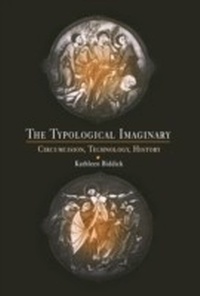
The Typological Imaginary
Circumcision, Technology, History
1st Edition
Published on 9. October 2013
160 pages
978-0-8122-0127-7 (ISBN)
Description

In this book Kathleen Biddick investigates the fate of the enduring timelines fabricated by early Christians to distinguish themselves from their Jewish neighbors. Ranging widely across the history of text, technology, and book art, she relates three interwoven stories: the Christians' translation of circumcision into a graphic problem of writing on the heart; the temporal construction of Christian notions of history based on the binary supersession of an Old Testament past by the present of a new dispensation; and the traumatic repetition of the graphic cutting off of Christians from Jews in academic history and anthropology.
Moving beyond well-studied theological polemics, Biddick works from the relatively unfamiliar vantage point of the graphic technologies used in medieval and early modern texts and print sources, from maps to trial transcripts to universal histories. Addressing current concerns about the posthuman condition by linking them to a deeper genealogy of disembodiment at the technological heart of imaginary fantasies, she argues that such supersessionary practices extend to contemporary psychoanalytic and postcolonial texts, even as they propose alternative ways of thinking about memory and temporality. Crucial to Biddick's study is the ethical challenge of unbinding the typological imaginary, not in order to disavow theological difference but rather to open up the encounter between Christian and Jew to less deadening teleological readings.
Making a significant contribution to the large debate over the transition from "scriptural" to "scientific" culture in Europe, The Typological Imaginary also succeeds in shedding light on the centrality of Jews to medieval and Enlightenment history.
Moving beyond well-studied theological polemics, Biddick works from the relatively unfamiliar vantage point of the graphic technologies used in medieval and early modern texts and print sources, from maps to trial transcripts to universal histories. Addressing current concerns about the posthuman condition by linking them to a deeper genealogy of disembodiment at the technological heart of imaginary fantasies, she argues that such supersessionary practices extend to contemporary psychoanalytic and postcolonial texts, even as they propose alternative ways of thinking about memory and temporality. Crucial to Biddick's study is the ethical challenge of unbinding the typological imaginary, not in order to disavow theological difference but rather to open up the encounter between Christian and Jew to less deadening teleological readings.
Making a significant contribution to the large debate over the transition from "scriptural" to "scientific" culture in Europe, The Typological Imaginary also succeeds in shedding light on the centrality of Jews to medieval and Enlightenment history.
All prices
More details
Language
English
Place of publication
Pennsylvania
United States
Target group
College/higher education
US School Grade: College Graduate Student
Illustrations
16 illus.
16 illus.
File size
5,72 MB
ISBN-13
978-0-8122-0127-7 (9780812201277)
Copyright in bibliographic data and cover images is held by Nielsen Book Services Limited or by the publishers or by their respective licensors: all rights reserved.
Schweitzer Classification
Other editions
Additional editions
Book
09/2003
University of Pennsylvania Press
€56.00
Shipment within 10-20 days
Person
Kathleen Biddick is Professor of History at the University of Notre Dame. She is author of The Shock of Medievalism and The Other Economy: Pastoral Husbandry on a Medieval Estate.
Content
List of Illustrations
Introduction: Typology Never Lets Go
Chapter One: Christians Mapping Jews: Cartography, Temporality, and the Typological Imaginary
Chapter Two: Printing Excision: The Graphic Afterlife of Medieval Universal Histories
Chapter Three: Graphic Reoccupation, the Faithful Synagogue, Foucault's Genealogy
Chapter Four: Lachrymose History, the Typological Imaginary, and the Lacanian Enlightenment
Chapter Five: Translating the Foreskin
Notes
Index
Acknowledgments
Introduction: Typology Never Lets Go
Chapter One: Christians Mapping Jews: Cartography, Temporality, and the Typological Imaginary
Chapter Two: Printing Excision: The Graphic Afterlife of Medieval Universal Histories
Chapter Three: Graphic Reoccupation, the Faithful Synagogue, Foucault's Genealogy
Chapter Four: Lachrymose History, the Typological Imaginary, and the Lacanian Enlightenment
Chapter Five: Translating the Foreskin
Notes
Index
Acknowledgments

