

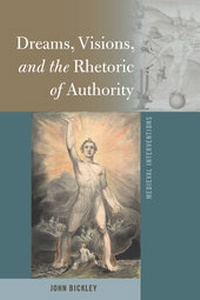
Dreams, Visions, and the Rhetoric of Authority
Description

In Dreams, Visions, and the Rhetoric of Authority, John Bickley explores the ways dreams and visions in literature function as authorizing devices, both affirming and complicating a text's authority. After providing a framework for categorizing the diverse genres and modes of dream and vision texts, Bickley demonstrates how the theme of authority and strategies for textual self-authorization play out in four highly influential works: the Book of Daniel, Macrobius's Commentary on the Dream of Scipio, Julian of Norwich's Revelations of Love, and Chaucer's Hous of Fame.
More details
Other editions
Additional editions
Person
John Bickley received his Ph.D. in humanities from Florida State University, where he was the recipient of a doctoral presidential fellowship and focused on medieval literature, medievalism, and adaptation theory. He earned his M.A. in English literature from the University of North Carolina at Chapel Hill. Among his scholarly works,
Bickley has published entries for Southern Writers: A New Biographical Dictionary,
co-authored an introduction and bibliographical material for the Penguin Classics edition of Joel Chandler Harris's Nights with Uncle Remus (2003), and contributed to a casebook on Woody Allen.
Content
Introduction: Dreams, Visions, and the Rhetoric of Authority - The Authority of Form: Dream and Vision Genres - Authorizing Strategies in the Dreams and Visions of Daniel - Macrobius: Establishing the Authoritative Philosophical Form - Julian of Norwich: The Authorizing Discourses of the Medieval Visionary - Fractured Authority: Chaucer's Ironic Dream Vision - Conclusion: The Rhetoric of Authority - Appendix: Dream and Vision Genres - Index.
