

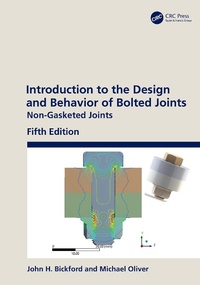
Introduction to the Design and Behavior of Bolted Joints
Non-Gasketed Joints
5th Edition
Published on 30. December 2022
614 pages
978-0-429-52070-9 (ISBN)
Description

The fully updated Fifth Edition of John H. Bickford's classic work, updated by Michael Oliver, provides a practical, detailed guide for the design threaded bolted joints, the tightening of threaded joints, and the latest design procedures for long-term life. New sections on materials, threads, and their strength have been added, and coverage of FEA for design analysis is now included.
Referencing the latest standards, this new edition combines fastener materials, explanation of how fasteners are made, and how fasteners fit together, supplementing the basic design coverage included in previous versions of this authoritative text.
Introduction to the Design and Behavior of Bolted Joints: Non-Gasketed Joints will be of interest to engineers involved in the design and testing of bolted joints.
Referencing the latest standards, this new edition combines fastener materials, explanation of how fasteners are made, and how fasteners fit together, supplementing the basic design coverage included in previous versions of this authoritative text.
Introduction to the Design and Behavior of Bolted Joints: Non-Gasketed Joints will be of interest to engineers involved in the design and testing of bolted joints.
More details
Edition
5th edition
Language
English
Place of publication
London
United Kingdom
Publishing group
Taylor & Francis Ltd
Target group
Professional and scholarly
Illustrations
44 Tables, black and white; 384 Line drawings, black and white; 9 Halftones, black and white; 393 Illustrations, black and white
ISBN-13
978-0-429-52070-9 (9780429520709)
Copyright in bibliographic data and cover images is held by Nielsen Book Services Limited or by the publishers or by their respective licensors: all rights reserved.
Schweitzer Classification
Other editions
Additional editions
John H. Bickford | Michael Oliver
Introduction to the Design and Behavior of Bolted Joints
Non-Gasketed Joints
Book
12/2022
5th Edition
CRC Press
€240.90
Shipment within 15-20 days
Persons
John H. Bickford worked as a Private Consultant, Middletown, Connecticut prior to his retirement. He also served as Vice-President and Manager of the Power-Dyne Division at Raymond Engineering, Inc. in Middletown, Connecticut. He is a member of the American Society of Mechanical Engineers, and Founder and former President of the Bolting Technology Council.
Michael Oliver earned his B.S. degree from North Carolina State University, and his M.S. and Ph.D. from the University of Dayton. His work with fastener technology began when he worked at Delphi Automotive in Dayton, Ohio, as their Senior Fastener Engineer, running their Fastener Test Lab for 10 years. During this time period Dr. Oliver received his Ph.D. in Threaded Fasteners. He spent the rest of his career dealing with sustainment issues of aerospace structures, which also included aerospace threaded fasteners. His lab performed thread inspections using System 23 thread gaging as well as TIR on various locations on threaded fasteners. We obtained thread and under-head coefficient of friction values, established torque/clamp-load correlations, and created residual torque values for quality audits. Testing was a big part of my job. The remining time was spent traveling the world dealing with is called quality spills (some company did something that usually changed either the frictional coefficient(s) or material properties of one of the members of the threaded bolted joint).
Michael Oliver earned his B.S. degree from North Carolina State University, and his M.S. and Ph.D. from the University of Dayton. His work with fastener technology began when he worked at Delphi Automotive in Dayton, Ohio, as their Senior Fastener Engineer, running their Fastener Test Lab for 10 years. During this time period Dr. Oliver received his Ph.D. in Threaded Fasteners. He spent the rest of his career dealing with sustainment issues of aerospace structures, which also included aerospace threaded fasteners. His lab performed thread inspections using System 23 thread gaging as well as TIR on various locations on threaded fasteners. We obtained thread and under-head coefficient of friction values, established torque/clamp-load correlations, and created residual torque values for quality audits. Testing was a big part of my job. The remining time was spent traveling the world dealing with is called quality spills (some company did something that usually changed either the frictional coefficient(s) or material properties of one of the members of the threaded bolted joint).
Content
Basic Concepts. Materials. Stress and Strength Considerations. Threads and Their Strength. Stiffness and Strain Considerations. Introduction to Assembly. Torque Control of Preload. Torque and Turn Control. Other Ways to Control Preload. Theoretical Behavior of the Joint under Tensile Loads.Behavior of the Joint Load in Tension: A Closer Look. In-Service Behavior of a Shear Joint. Introduction to Joint Failure. Self-Loosening. Fatigue Failure. Corrosion. Selecting Preload for an Existing Joint. Design of Joints Loaded in Tension. Design of Joints Loaded in Shear. Appendix A: Units and Symbol Log. Appendix B: Glossary of Fastener and Bolted Joint Terms. Appendix C: Sources of Bolting Information and Standards. Appendix D: English and Metric Conversion Factors. Appendix E: Tensile Stress Areas for English and Metric Threads with Estimated ''Typical'' Preloads and Torques for As-Received Steel Fasteners. Appendix F: Basic Head, Thread, and Nut Lengths. Index.
