

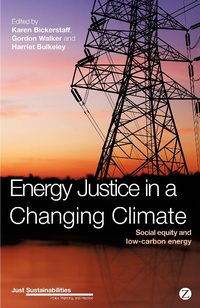
Energy Justice in a Changing Climate
Social Equity and Low-Carbon Energy
1st Edition
Published on 10. October 2013
232 pages
978-1-78032-578-1 (ISBN)
Description

Energy justice is one of the most critical, and yet least developed, concepts associated with sustainability. Much has been written about the sustainability of low-carbon energy systems and policies - with an emphasis on environmental, economic and geopolitical issues. However, less attention has been directed at the social and equity implications of these dynamic relations between energy and low-carbon objectives - the complexity of injustice associated with whole energy systems (from extractive industries, through to consumption and waste) that transcend national boundaries and the social, political-economic and material processes driving the experience of energy injustice and vulnerability.
Drawing on a substantial body of original research from an international collaboration of experts this unique collection addresses energy poverty, just innovation, aesthetic justice and the justice implications of low-carbon energy systems and technologies. The book offers new thinking on how interactions between climate change, energy policy, and equity and social justice can be understood and develops a critical agenda for energy justice research.
Drawing on a substantial body of original research from an international collaboration of experts this unique collection addresses energy poverty, just innovation, aesthetic justice and the justice implications of low-carbon energy systems and technologies. The book offers new thinking on how interactions between climate change, energy policy, and equity and social justice can be understood and develops a critical agenda for energy justice research.
Reviews / Votes
Climate change produces injustice - and the authors of this book argue powerfully that policies to mitigate it are paradoxically in danger of having the same effect. The remedy is a clearer understanding of the processes that drive mitigation injustice and Energy Justice in a Changing Climate provides exactly that understanding. * Andrew Dobson, Keele University * This book does a great job of highlighting the energy vulnerabilities of households and communities along with the social justice implications of various policies and practices that promote lower carbon energy systems. Particularly important is how it brings contemporary social theories to the understanding of energy justice, and the critical analysis offered of proposed lower carbon technologies such as microgeneration, microgrids, nuclear and CCS. * Diana Liverman, Regents Professor in the School of Geography and Development, University of Arizona * Energy Justice in a Changing Climate is a wide-ranging and timely exploration of the justice and vulnerability issues associated with decarbonizing energy systems in the global North. It combines conceptual frameworks from the social sciences with original case material to highlight the equity and justice implications of low-carbon energy technologies, infrastructures and policies. Furthermore, it marks a significant shift in thinking about energy futures in a warming world, away from a narrow consideration of carbon management and towards a concern with how low-carbon energy systems (re)shape inequalities in energy access and social power. * Gavin Bridge, Professor of Economic Geography, Durham University *More details
Series
Edition
1. Auflage
Language
English
Place of publication
United Kingdom
Publishing group
Bloomsbury Publishing PLC
Target group
College/higher education
Professional and scholarly
ISBN-13
978-1-78032-578-1 (9781780325781)
Copyright in bibliographic data and cover images is held by Nielsen Book Services Limited or by the publishers or by their respective licensors: all rights reserved.
Schweitzer Classification
Other editions
Additional editions
Karen Bickerstaff | Gordon Walker | Harriet Bulkeley
Energy Justice in a Changing Climate
Social Equity and Low-Carbon Energy
Book
10/2013
Zed Books Ltd
€126.28
Shipment within 3-4 weeks
Persons
Karen Bickerstaff is senior lecturer in geography at Exeter University and leads the department's Environment and Sustainability Research Group. Her research interests centre on public engagements with technological risk, innovation and low-carbon transformations. Recent projects have examined nuclear waste policy and controversy in the UK, the efficacy of domestic energy efficiency interventions and the ethical dimensions of low-carbon energy technologies. She led the Interdisciplinary Cluster on Energy Systems, Equity and Vulnerability (InCluESEV), running from 2009 to 2012, which has fostered an international collaborative network developing new ways of thinking about, and researching, energy vulnerability and justice.
Gordon Walker is professor of risk, environment and justice at the Lancaster Environment Centre, Lancaster University. He researches and writes across a wide agenda, including matters of environmental justice, energy demand, social practice, socio-technical transitions, community innovation and renewable energy technologies, and the governance of forms of 'natural' and technological risk. He has led a series of research projects on these themes funded by the UK research councils, the European Union and government departments. His most recent book is Environmental Justice: Concepts, evidence and politics, and he is currently co-director of the Dynamics of Energy, Mobility and Demand (DEMAND) research centre.
Harriet Bulkeley is professor of geography at Durham University. Her research interests are the nature and politics of environmental governance, and focus on climate change, energy and urban sustainability. Her recent books include Cities and Climate Change: Critical introductions to the city (2013), Governing Climate Change (with Peter Newell, 2010) and Cities and Low Carbon Transitions (with Vanesa Castan-Broto, Mike Hodson and Simon Marvin, eds, 2011). She has undertaken a number of research projects funded by the ESRC, EPSRC and Leverhulme Trust, and is currently co-investigator for the Ofgem-funded Customer Led Network Revolution project on smart electricity grids (2011-14) and an ESRC project examining the role of China and Brazil in low-carbon transitions in southern Africa. Harriet was appointed an adviser to DECC in 2012, and she has undertaken commissioned research for the Joseph Rowntree Foundation, UNHabitat and the World Bank.
Gordon Walker is professor of risk, environment and justice at the Lancaster Environment Centre, Lancaster University. He researches and writes across a wide agenda, including matters of environmental justice, energy demand, social practice, socio-technical transitions, community innovation and renewable energy technologies, and the governance of forms of 'natural' and technological risk. He has led a series of research projects on these themes funded by the UK research councils, the European Union and government departments. His most recent book is Environmental Justice: Concepts, evidence and politics, and he is currently co-director of the Dynamics of Energy, Mobility and Demand (DEMAND) research centre.
Harriet Bulkeley is professor of geography at Durham University. Her research interests are the nature and politics of environmental governance, and focus on climate change, energy and urban sustainability. Her recent books include Cities and Climate Change: Critical introductions to the city (2013), Governing Climate Change (with Peter Newell, 2010) and Cities and Low Carbon Transitions (with Vanesa Castan-Broto, Mike Hodson and Simon Marvin, eds, 2011). She has undertaken a number of research projects funded by the ESRC, EPSRC and Leverhulme Trust, and is currently co-investigator for the Ofgem-funded Customer Led Network Revolution project on smart electricity grids (2011-14) and an ESRC project examining the role of China and Brazil in low-carbon transitions in southern Africa. Harriet was appointed an adviser to DECC in 2012, and she has undertaken commissioned research for the Joseph Rowntree Foundation, UNHabitat and the World Bank.
Content
Introduction: making sense of energy justice - Karen Bickerstaff, Gordon Walker and Harriet Bulkeley
1. Household energy vulnerability as 'assemblage' - Rosie Day and Gordon Walker
2. Precarious domesticities: energy vulnerability among urban young adults - Stefan Bouzarovski, Saska Petrova, Matthew Kitching and Josh Baldwick
3. Energy justice in sustainability transitions research - Malcolm Eames and Miriam Hunt
4. Energy justice and the low-carbon transition: assessing low-carbon community programmes in the UK - Sara Fuller and Harriet Bulkeley
5. Energy justice and climate change: reflections from a Joseph Rowntree Foundation research programme - Katharine Knox
6. Equity across borders: a whole-systems approach to micro-generation - Charlotte Adams, Sandra Bell, Philip Taylor, Varvara Alimisi, Guy Hutchinson, Ankit Kumar and Britta Rosenlund Turner
7. Fair distribution of power-generating capacity: justice, microgrids and utilizing the common pool of renewable energy - Maarten Wolsink
8. Framing energy justice in the UK: the nuclear case - Catherine Butler and Peter Simmons
9. Justice in energy system transitions: the case of carbon capture and storage - Duncan McLaren, Kristian Krieger and Karen Bickerstaff
1. Household energy vulnerability as 'assemblage' - Rosie Day and Gordon Walker
2. Precarious domesticities: energy vulnerability among urban young adults - Stefan Bouzarovski, Saska Petrova, Matthew Kitching and Josh Baldwick
3. Energy justice in sustainability transitions research - Malcolm Eames and Miriam Hunt
4. Energy justice and the low-carbon transition: assessing low-carbon community programmes in the UK - Sara Fuller and Harriet Bulkeley
5. Energy justice and climate change: reflections from a Joseph Rowntree Foundation research programme - Katharine Knox
6. Equity across borders: a whole-systems approach to micro-generation - Charlotte Adams, Sandra Bell, Philip Taylor, Varvara Alimisi, Guy Hutchinson, Ankit Kumar and Britta Rosenlund Turner
7. Fair distribution of power-generating capacity: justice, microgrids and utilizing the common pool of renewable energy - Maarten Wolsink
8. Framing energy justice in the UK: the nuclear case - Catherine Butler and Peter Simmons
9. Justice in energy system transitions: the case of carbon capture and storage - Duncan McLaren, Kristian Krieger and Karen Bickerstaff
