

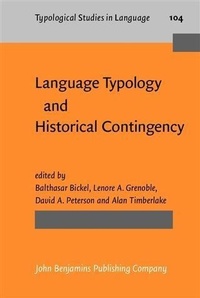
Language Typology and Historical Contingency
In honor of Johanna Nichols
1st Edition
Published on 13. December 2013
VIII, 512 pages
978-90-272-7080-1 (ISBN)
Description

What is the range of diversity in linguistic types, what are the geographical distributions for the attested types, and what explanations, based on shared history or universals, can account for these distributions? This collection of articles by prominent scholars in typology seeks to address these issues from a wide range of theoretical perspectives, utilizing cutting-edge typological methodology. The phenomena considered range from the phonological to the morphosyntactic, the areal coverage ranges in scale from micro-areal to worldwide, and the types of historical contingency range from contact-based to genealogical in nature. Together, the papers argue strongly for a view in which, although they use distinct methodologies, linguistic typology and historical linguistics are one and the same enterprise directed at discovering how languages came to be the way they are and how linguistic types came to be distributed geographically as they are.
More details
Other editions
Additional editions
Balthasar Bickel | Lenore A. Grenoble | David A. Peterson
Language Typology and Historical Contingency
In honor of Johanna Nichols
Book
12/2013
John Benjamins Publishing Co
€104.94
Shipment within 10-15 days
Persons
Content
- Language Typology and Historical Contingency
- Editorial page
- Title page
- LCC data
- Table of contents
- Preface
- Part I. Structures and typologies
- Discourse semantics and the form of the verb predicate in Karachay-Balkar
- 1. Introduction
- 2. Methodological notes
- 3. Summary of Karachay-Balkar verb morphology
- 4. Discourse data
- 5. Discourse functions of clauses and the frequency of predicate forms
- 6. Major predicate forms in narrative clauses
- 6.1 The use of finite forms
- 6.2 The use of the consecutive converb in -(I)p
- 7. A hypothesis on the choice between the major predicate forms
- 8. Causal-temporal relation and the choice of predicate form
- 8.1 Dynamic scenario
- 8.2 Natural sequence
- 8.3 Plain temporal sequence
- 9. Systematicity of the finite versus nonfinite choice: Experimental verification
- 9.1 Method and data
- 9.2 Results
- 9.3 Discussion
- 10. Minor predicate forms used in narrative clauses
- 10.1 Parallel converb in -A/-j
- 10.2 Perfect masdar + locative
- 10.3 Perfect masdar + zamanda
- 10.4 Perfect masdar + ablative.
- 10.5 Perfect masdar +suffix -lAj
- 10.6 Conditional
- 10.7 Past
- 10.8 Particle da 'and'
- 11. Predicate forms used in descriptive clauses
- 11.1 Nominal/adverb
- 11.2 Nominal/adverb + edi
- 11.3 bar 'existent, there is'
- 11.4 bar/zoq edi 'there was/there was not'
- 11.5 bol?an 'was'
- 11.6 bola edi 'was'
- 11.7 Perfect
- 11.8 Parallel converb
- 12. Conclusions
- Abbreviations
- References
- Typology and channel of communication
- 1. Introduction
- 2. Locus of marking: Dependent-marking and head-marking
- 3. Grammatical relations: Agreement, case-marking, and alignment
- 4. Framing: Verb-framed and satellite-framed
- 5. Subject or topic prominence
- 6. Reference tracking
- 7. Simultaneous morphology
- 8. Conclution
- References
- Appendix: Selected list of books on linguistics of sign languages
- Marking versus indexing
- 1. Introduction: The Nichols marking-locus typology
- 1.1 Domain of typology
- 1.2 Phrase-level application
- 2. Marking versus indexing
- 2.1 Indexing as an orthogonal dimension in phrasal relations
- 2.2 Initial orienting example
- 2.3 Information in modified NP constructions
- 2.4 Zero indexing: A Kayardild example
- 2.5 Double indexing: A Beja example
- 3. Indexing and marking: A more systematic typology
- 3.1 Indexing in dependent-marking structures
- 3.1.1 DM, DI
- 3.1.2 DM, HI
- 3.2 Indexing in head-marking structures
- 3.2.1 HM, ØI
- 3.2.2 HM, 2I
- 3.2.3 HM, HI
- 3.2.4 Summary
- 3.3 Indexing in double-marking structures
- 3.3.1 Double marking: ØI on both elements
- 3.3.2 Double marking: DI on head, ØI on dependent
- 3.3.3 Double-marking: DI on both head and dependent
- 3.3.4 Double marking: 2I on head, ØI on dependent
- 3.3.5 Double marking: 2I on head, DI on dependent
- 3.3.6 Double marking, 2I on head, HI on dependent
- 4. Conclusions
- Abbreviations
- References
- Head-marking languages and linguistic theory
- 1. Introduction
- 2. Some challenges posed by head-marked syntax
- 3. Generative approaches
- 4. The Role and Reference Grammar approach
- 5. The layered structure of the clause and the layered structure of the word
- 6. Conclusion
- References
- Lessons of variability in clause coordination
- 1. Difficulties in the description of variation in coordinating constructions
- 2. Examples of clausal coordination in five languages
- 2.1 Bezhta
- 2.2 Chamalal
- 2.3 Khvarshi
- 2.4 Avar
- 2.5 Tabassaran
- 2.6 Conclusion
- 3. Strategies and principles
- 3.1 Strategies for forming coordinating constructions
- 3.1.1 Coding of the dependent clause
- 3.1.2 Linear order of clauses
- 3.1.3 Coding the target of the anaphoric reduction
- 3.2 Principles of forming coordinating constructions
- 3.2.1 Identification of NPs that are connected by an anaphoric relation
- 3.2.2 Syntactic characteristics of basic sentence alignment
- 3.2.3 Syntactic positions of coreferential NPs
- 3.2.4 The linear sequence of main and dependent clauses under syntactic subordination
- 4. Variation in coordinating constructions in terms of strategies and principles
- 4.1 Bezhta
- 4.2 Chamalal
- 4.3 Khvarshi
- 4.4 Avar
- 4.5 Tabassaran
- 5. Conclusion
- 5.1 Linguistic diversity
- 5.2 The method of multifactor second-order calculus
- 5.3 The non-specific nature of principles and strategies
- 5.4 Motivation of principles
- 5.5 The motivation of strategies
- 5.6 The typology of related languages
- 5.7 Coordinating constructions in historical perspective
- References
- Noun classes grow on trees
- 1. Introduction
- 2. Background on noun classification in Tsez
- 3. Approaches to noun classification in Tsez
- 4. The current project
- 4.1 Decision-tree modeling
- 4.2 Testing
- 4.3 Results
- 5. Conclusions
- References
- Affecting valence in Khumi
- 1. Introduction
- 2. Basic morphosyntax
- 2.1 Nominal marking
- 2.2 Verbal participant coding
- 3. Prefixal valence-affecting morphology
- 4. Suffixal valence-affecting morphology
- 4.1 The benefactive/malefactive applicative -pë1
- 4.2 Causative/applicative -hay3
- 5. Summary and some observations on development
- References
- Capturing diversity in language acquisition research
- 1. Introduction
- 2. Variation and language acquisition
- 3. The data scarcity problem
- 4. Traditional approaches to sampling
- 5. An alternative: Clustered Sampling
- 6. An example: A clustered sample capturing complexity variation
- 7. Discussion
- 8. Conclusions
- References
- Part II. Distributions in time and space
- Who inherits what, when?
- 1. Areality and contact
- 2. Kinds of contact events
- 3. Pama-Nyungan languages
- 4. Australian phonological norms
- 5. (North)(east)ern Australia
- 6. A pre-Pama-Nyungan history for Cape York
- 7. Conclusions
- Abbreviations
- References
- Appendix 1. Number of contrastive lateral phonemes in Australian phonologies, compared with other regions in the world
- Polysynthesis in the Arctic/Sub-Arctic
- 1. Introduction
- 2. Polysynthesis as a one-way road?
- 3. Symptoms of old versus new polysynthesis
- 4. Application to other regions
- 5. How old is polysynthesis in the Amur-Sakhalin-Hokkaido region?
- Abbreviations
- References
- A (micro-)accretion zone in a remnant zone?
- 1. Introduction
- 2. Lower Fungom: A linguistic overview
- 3. Lower Fungom as a (micro-)accretion zone
- 4. Lower Fungom and accretion-zone dynamics
- 5. Linguistic diversity in space and time and language documentation
- References
- A history of Iroquoian gender marking
- 1. Introduction
- 2. The North Iroquoian genders
- 3. Chafe's reconstruction
- 4. Problems with Chafe's reconstruction
- 5. An alternative proposal
- 6. Some oddities of Tuscarora
- 7. Conclusion
- References
- The satem shift, Armenian siser?n, and the early Indo-European of the Balkans
- 1. Introduction
- 2. Palato-velars and the centum-satem line
- 2.1 Chickpeas
- 2.2 Grass peas
- 3. Conclusion
- References
- Penultimate lengthening in Bantu
- 1. Introduction
- 2. Bantu penultimate lengthening: An overview
- 3. Discussion
- 4. Antepenultimate and pre-antepenultimate shortening
- 5. Conclusion
- References
- Appendices
- Appendix 1. Languages with PL that have lost the PB *V/VV contrast
- Appendix 2. Languages without PL that have lost the PB *V/VV contrast
- Appendix 3. Languages with positionally restricted vowel length
- Culture and the spread of Slavic
- 1. Introduction
- 2. Slavic Urheimat
- 3. Slavic Urheimat: II
- 4. Slavic Demic dislocation: I and II
- 5. Slavic Demic dislocation: III
- 6. Slavic culture in the Danube valley
- 7. Issues in language spread: Ethnogenesis
- 8. Issues in language spread: Commentary
- 8.1 Multiethnicity
- 8.2 Sociolinguistics
- 8.3 Demic movement
- 8.4 Prehistory
- 8.5 Ethnos: Structure and praxis
- 9. Summary
- References
- The syntax and pragmatics of Tungusic revisited
- 1. Introduction
- 2. Syntax and pragmatics in Tungusic, revisited
- 3. Clause combining
- 3.1 Parataxis
- 3.2 Coordinating particles and conjunctions
- 3.3 Evenki under Russian influence
- 4. Subordination
- 4.1 Converbs and subordination
- 4.2 Narrative structure and converbs
- 4.3 Contact and subordination: The impact of Russian
- 5. Language contact, borrowability, and shift
- 5.1 Coordination and conjunctions
- 5.2 Converbs
- 6. Conclusion: Clause combining, contact, and shift
- References
- Some observations on typological features of hunter-gatherer languages
- 1. Introduction
- 2. Method of typological comparison
- 3. Typological peculiarities
- 3.1 Order of meaningful elements
- 3.2 Phonology
- 3.3 Lexicon
- 4. Conclusion and prospects
- Acknowledgment
- References
- Typologizing phonetic precursors to sound change
- 1. Introduction
- 2. Phonetic precursors defined
- 3. Quantifying phonetic precursor robustness
- 4. Toward a typology of phonetic precursor robustness
- 5. Conclusions
- References
- Distributional biases in language families
- 1. Introduction
- 2. The Family Bias Method: The basic ideas
- 3. Illustrations of the method
- 3.1 A Scenario A example: A-before-P order
- 3.2 A Scenario B example: Coding of property concepts in predicate position
- 4. Evidence for the theoretical assumptions of the method
- 5. The problem of small families
- 6. Extending the Family Bias Method to multivariate distributions
- 6.1 Example 1: Relative clause position and word order
- 6.2 Example 2: Hotbeds of pronominal gender
- 7. Discussion
- 8. Conclusions
- References
- The morphology of imperatives in Lak
- 1. Introduction
- 2. The Lak imperative: Basic rules
- 2.1 Uslar on the Lak imperative
- 2.2 Èldarova on the Lak imperative
- 2.3 Additional observations on Lak verbs and imperatives
- 3. Imperative formation in Dargi
- 4. Prolegomenon to the Appendices
- 5. Conclusions
- References
- Appendix 1. Lak 2sg.aff.tr.iv stem vowels by verb
- Appendix 2. Lak 2sg.aff.tr.iv stem vowel by stem vowel with reference to Èldarova
- Subgrouping in Tibeto-Burman
- 1. Introduction
- 2. Type-identifying versus individual-identifying evidence
- 3. Tibeto-Burman
- References
- Part II. A (cautionary) note on methodology
- Real data, contrived data, and the Yokuts Canon
- 1. Introduction
- 1.1 The scope of Yokuts data contrivance
- 1.2 The sample survey
- 2. When and why contrived forms are used
- 2.1 The treatment of contrived data elsewhere
- 3. Potential problems fostered by contrived data
- 3.1 Reliance on erroneous generalizations
- 3.2 Misapplication of generalizations
- 3.3 Canonization
- 4. Is this practice as innocent as it seems?
- 5. The logic of discovery and the history of science
- 5.1 The logic of discovery and the logic of justification
- 6. Conclusion and queries
- 6.1 Robustness
- 7. Postscript: Newman's legacy
- References
- Name index
- Subject index
