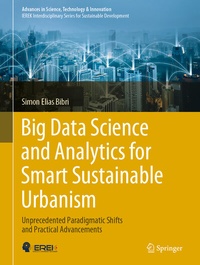
Big Data Science and Analytics for Smart Sustainable Urbanism
Description

We are living at the dawn of what has been termed 'the fourth paradigm of science,' a scientific revolution that is marked by both the emergence of big data science and analytics, and by the increasing adoption of the underlying technologies in scientific and scholarly research practices. Everything about science development or knowledge production is fundamentally changing thanks to the ever-increasing deluge of data. This is the primary fuel of the new age, which powerful computational processes or analytics algorithms are using to generate valuable knowledge for enhanced decision-making, and deep insights pertaining to a wide variety of practical uses and applications.
This book addresses the complex interplay of the scientific, technological, and social dimensions of the city, and what it entails in terms of the systemic implications for smart sustainable urbanism. In concrete terms, it explores the interdisciplinary and transdisciplinary field of smart sustainable urbanism and the unprecedented paradigmatic shifts and practical advances it is undergoing in light of big data science and analytics. This new era of science and technology embodies an unprecedentedly transformative and constitutive power-manifested not only in the form of revolutionizing science and transforming knowledge, but also in advancing social practices, producing new discourses, catalyzing major shifts, and fostering societal transitions. Of particular relevance, it is instigating a massive change in the way both smart cities and sustainable cities are studied and understood, and in how they are planned, designed, operated, managed, and governed in the face of urbanization. This relates to what has been dubbed data-driven smart sustainable urbanism, an emerging approach based on a computational understanding of city systems and processes that reduces urban life to logical and algorithmic rules and procedures, while also harnessing urban big data to provide a more holisticand integrated view or synoptic intelligence of the city. This is increasingly being directed towards improving, advancing, and maintaining the contribution of both sustainable cities and smart cities to the goals of sustainable development.
This timely and multifaceted book is aimed at a broad readership. As such, it will appeal to urban scientists, data scientists, urbanists, planners, engineers, designers, policymakers, philosophers of science, and futurists, as well as all readers interested in an overview of the pivotal role of big data science and analytics in advancing every academic discipline and social practice concerned with data-intensive science and its application, particularly in relation to sustainability.
More details
Other editions
Additional editions