

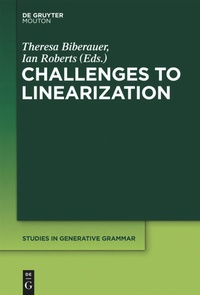
Challenges to Linearization
Description

The ten contributions in this volume focus on a range of linearization challenges, all of which aim to shed new light on the central, still largely mysterious question of how the abundant evidence that linguistic structures are hierarchically organised can plausibly be reconciled with the fact that actually realised linguistic strings are typically sequentially ordered. Some of the contributions present particularly challenging data, those on the mixed spoken and signed output of bimodal Italian children, Quechua nominal morphology, Kannada reduplication and Taqbaylit of Chemini "floating prepositions" all being cases in point. Others have a typological focus, highlighting and attempting to explain striking patterns like the Final-over-Final Constraint or considering the predictions of particular theoretical approacesh (the movement theory of Control, multidominance, Distributed Morphology) in relation to structures that we do and don't expect to be "possible linguistic structures". Broader architectural questions also receive attention from various perspectives.
This volume will be of interest to advanced students and researchers with interests in the externalisation of ling
More details
Other editions
Additional editions
Persons
Content
2 - Three types of linearization and the temporal aspects of speech [Seite 37]
3 - Backward dependencies must be short [Seite 63]
4 - Challenging linearization: Simultaneous mixing in the production of bimodal bilinguals [Seite 99]
5 - Multiple multiple spellout [Seite 135]
6 - Linearization and post-syntactic operations in the Quechua DP [Seite 177]
7 - Unattested word orders and left-branching structure [Seite 217]
8 - Linearizing the control relation: A typology [Seite 241]
9 - Linearizing multidominance structures [Seite 275]
10 - The puzzles of wh-questions with coordinated wh-pronouns [Seite 301]
11 - The representational anomalies of floating markers: Light prepositions in Taqbaylit of Chemini [Seite 337]
12 - Index [Seite 383]
