

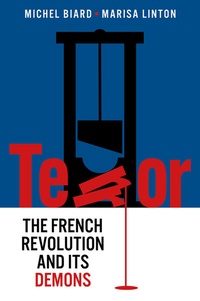
Terror
Description

At the heart of how history sees the French Revolution lies the enigma of the Terror. How did this archetypal revolution, founded on the principles of liberty and equality and the promotion of human rights, arrive at circumstances where it carried out the violent and terrible repression of its opponents? The guillotine, initially designed to be a 'humane' form of capital punishment, became a formidable instrument of political repression and left a deep imprint, not only on how we see the Revolution, but also on how France's image has been depicted in the world.
This book reconstructs the Terror in all its complexity. It shows that the popular view of a so-called 'system of terror' was retrospectively invented by the group of revolutionaries who overthrew Robespierre, as a way of trying to exonerate themselves from culpability. What we think of as 'the Terror' is best understood as an improvised and sometimes chaotic response to events, based on the urgent needs of a revolutionary government confronted by a succession of political and military crises. It was a government of 'exception' - a crisis government.
Terror brings together a wealth of factual elements, along with recent thinking on the ideological, emotional and tactical dimensions of revolutionary politics, to throw new light on how the phenomenon of terror came to demonise the image and memory of the French Revolution. It will be essential reading for students and scholars of the French Revolution and for anyone concerned with the ways in which political conflict can descend into violence.
More details
Other editions
Additional editions
Persons
Marisa Linton is Professor Emerita in History, Kingston University.
Content
Acknowledgements
Foreword by Timothy Tackett
Introduction: The Demons of Terror
Chapter 1: The Terror - a Concept Imposed by the Thermidoreans
1. How the 'system of terror' and the black legend of Robespierre were retrospectively invented
2. Developing use of the word 'terror' between 1789 and 1794
3. 'Terror as the order of the day': an unsaid, unofficial yet widespread order from the Convention
Chapter 2: The Meaning of 'Terror' Before the Revolution
1. Terror and Enlightenment. A problematic connection
2. The concept of 'terror' in the Ancien Régime
3. The role of terror in political theory
Chapter 3: Terror in the Heart: The Weight of Fear and Emotions
1. The spectre of conspiracy and treason
2. The flow of emotions and fears
3. The impossible combination of virtue and terror
Chapter 4: The Revolution and its Opponents: Clashes and the Intensification of Repression
1. Legislation targeting refractory clergy and émigrés
2. 'The suspects': how the net of suspicion widened
3. Repression against 'federalism' and the emblematic case of the Lyon revolt
Chapter 5: Creating Revolutionary Law: A Time of Political Exception
1. From ordinary law to 'revolutionary' law
2. 'Revolutionary institutions and their role in repression
3. The recourse to extraordinary justice
Chapter 6: Terror in the Convention: Political conflict as an engine of 'terror'
1. The Convention and the clubs: from political strife to 'purging'
2. From arrests to political trials
3. Death as a means to eliminate opponents in the Convention
4. The elimination of factions, the apogee of 'terror' or the will to end it?
Chapter 7: Paris and the Vendée at the heart of the 'terror'
1. Paris, capital of the sans-culotte movement
2. Paris, epicentre of the 'terror'
3. The 'military Vendée', a zone of civil war
Chapter 8: Who Lived and Who Died? The Difficult Balance Sheets of Terror
1. Working out the death toll
2. Fraternal France and fratricidal France
Conclusion: How the Convention Reconstructed Itself After Thermidor
Chronology for the Years of the Convention
Maps
Some Further Reading
Notes
Index
