

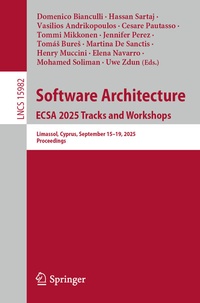
Software Architecture. ECSA 2025 Tracks and Workshops
Description

This book constitutes the refereed proceedings of the tracks and workshops which complemented the 19th European Conference on Software Architecture, ECSA 2025, held in Limassol, Cyprus, during September 15-19, 2025.
The 13 full papers and 19 short papers presented in this volume were carefully reviewed and selected from 56 submissions.
They are grouped into the following topics: Tools and Demos; Tutorial; Doctoral Symposium; 1st International Workshop on AI-Assisted Software Architecting (AISA);
5th International Workshop on Agility with Microservices Programming (AMP); 1st International Workshop on Architecting Digital Twin of an Organization (ArchDTO); 12th Workshop on Adaptive and Reconfigurable Systems and Architectures (AROSA); 8th International Workshop on Context-Aware, Autonomous and Smart Architectures (CASA); 1st International Workshop on Software Architecture for Data-Intensive Systems (SADIS).
More details
Other editions
Additional editions
Content
.- Tools and Demos.
.- SAVAT: A Tool for Visualizing the Impact of Changes in Microservices.
.- Infragenie: Living Software Architecture Diagrams From Docker Compose Files.
.- ServLessSense: Serverless Smell Detection Tool.
.- CUBEX: A CubeSat Exemplar for Teaching Software Architecture Principles.
.- Tutorial.
.- Software Architecture in the Age of Agentic AI.
.- Doctoral Symposium.
.- Requirements-compliant IT system deployment architectures for IoT
systems.
.- GreenDevLoop: Power-Aware Software Development with CI/CD, AI
and Feedback.
.- Architecting Carbon-aware Software-as-a-Service.
.- Temporal Network Analysis of Microservice Architectural Degradation.
.- AISA workshop.
.- The Impact of AI-Generated Solutions on Software Architecture and
Productivity: Results from a Survey Study.
.- Autonomic Microservice Management via Agentic AI and MAPE-K
Integration.
.- Application of AI in Software Architecture Development at Volvo
Construction Equipment.
.- Towards Benchmarking Design Pattern Detection Under Obfuscation:
Reproducing and Evaluating Attention-Based Detection Method.
.- LLM-Based Explainability at Design Time: Detecting Elasticity
Antipatterns in Software Architectures.
.- AI-Powered Architecting for Industry 4.0 Cyber-Physical Production
Systems: A Novel Approach, Research Problems and Challenges.
.- AMP workshop.
.- Assessing the Impact of Asynchronous Communication on Resilience
and Robustness: A Comparative Study of Microservice and Monolithic
Architectures.
.- Exploring Micro Frontends: A Case Study Application in E-Commerce.
.- Industrial views on DevOps adoption before and after implementation:
A qualitative comparison.
.- The (C)omprehensive (A)rchitecture (P)attern (I)ntegration method:
Navigating the sea of technology.
.- ArchDTO workshop.
.- Requirements for a Digital Twin of Organizations for Advancing
Cybersecurity Risk Management.
.- AROSA Workshop.
.- Comprehensive Exploration of Resilience and Adaptability in IoT-based
System-of-Systems: Bibliometric and Full-Text Literature Analysis.
.- Recent Literature Review on Modeling Explainable Medical
Cyber-Physical Systems: A Bibliometric Analysis.
.- Silver Box Testing for Scaling Software Development Fidelity:
Enhancing Quality and Efficiency.
.- CASA Workshop.
.- The Lifecycle Workbench - A Configurable Framework for Digitized
Product Maintenance Services.
.- Exploring Static Analysis for Understanding Self-Adaptive Systems.
.- SADIS Workshop.
.- AutoML: A Tertiary Study of Phases, Methods, Tools, and Frameworks.
.- FAIR-ER Data: Proposing a data model for Data Cooperatives.
.- GLOVES 2.0: Global Counterfactual-based Visual Explanations.
.- Temporal Harmonization of Heterogeneous Software Logs: A Unified
Model for Time-Series Analysis.
.- Making a Pipeline Production-Ready: Challenges and Lessons Learned
in the Healthcare Domain.
.- DQGen: Scalable Metadata-Driven Automation for Data Quality
Validation in Data-Intensive Applications.
.- A Visionary Architecture for Adaptive Data Contracts in
Behavior-Driven IoT Systems.
