

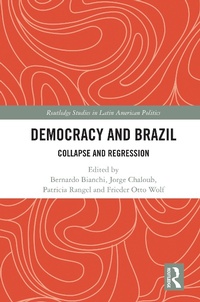
Democracy and Brazil
Collapse and Regression
1st Edition
Published on 23. September 2020
300 pages
978-1-000-16844-0 (ISBN)
Description

Democracy and Brazil: Collapse and Regression discusses the de-democratization process underway in contemporary Brazil.
The relative political stability that characterized domestic politics in the 2000s ended with the sudden emergence of a series of massive protests in 2013, followed by the controversial impeachment of Dilma Rousseff in 2016 and the election of Jair Bolsonaro in 2018. In this new, more conservative period in Brazilian politics, a series of institutional reforms deepened the distance between citizens and representatives. Brazil's current political crisis cannot be understood without reference to the continual growth of right-wing and ultra-right discourse, on the one hand, and to the neoliberal ideology that pervades the minds of large parts of the Brazilian elite, on the other. Twenty experts on Brazil across different fields discuss the ongoing political turmoil in the light of distinct problems: geopolitics, gender, religion, media, indigenous populations, right-wing strategies, and new forms of coup, among others. Updated analyses enriched with historical perspective help to illuminate the intricate issues that will determine the country's fate in years to come.
Democracy and Brazil: Collapse and Regression will interest students and scholars of Brazilian Politics and History, Latin America, and the broader field of democracy studies.
The relative political stability that characterized domestic politics in the 2000s ended with the sudden emergence of a series of massive protests in 2013, followed by the controversial impeachment of Dilma Rousseff in 2016 and the election of Jair Bolsonaro in 2018. In this new, more conservative period in Brazilian politics, a series of institutional reforms deepened the distance between citizens and representatives. Brazil's current political crisis cannot be understood without reference to the continual growth of right-wing and ultra-right discourse, on the one hand, and to the neoliberal ideology that pervades the minds of large parts of the Brazilian elite, on the other. Twenty experts on Brazil across different fields discuss the ongoing political turmoil in the light of distinct problems: geopolitics, gender, religion, media, indigenous populations, right-wing strategies, and new forms of coup, among others. Updated analyses enriched with historical perspective help to illuminate the intricate issues that will determine the country's fate in years to come.
Democracy and Brazil: Collapse and Regression will interest students and scholars of Brazilian Politics and History, Latin America, and the broader field of democracy studies.
Reviews / Votes
'Understanding the Brazilian 'case' of authoritarian counter-revolution is crucial both to support its citizens and to clarify the stakes of a global struggle. This volume is an essential contribution which we all need to study.'Etienne Balibar, Ancien Professeur a l'Universite de Paris-Nanterre, Anniversary Chair in Modern European Philosophy
'The example of Brazil is clearly presented as an appropriate terrain for beginning to understand the new constellation of dominant powers in the present phase of global politics.'
Marilena Chaui, Professor Emeritus of the University of Sao Paulo and Professor Honoris Causa of the Universite de Paris VIII
'The still young democracy in Brazil is at its most perilous moment after its reestablishment from dictatorship rule. What happened that in the course of less than a decade, Brazil moved from a social democratic regime, to impeachment of its first female President, and then to new authoritarian regime that uses the democratic tools and particularly the mass media, to undermine democracy and the public sphere? The plurality of perspectives underlying the contributions to this volume come together in an in-depth understanding of the on-going attacks on progressive politics. This book-is-a-must to read for those interested in the future of democracy in Latin America and Brazil.'
Carlos Alberto Torres, Distinguished Professor at UCLA and Director of Paulo Freire Institute
More details
Series
Edition
1. Auflage
Language
English
Place of publication
London
United Kingdom
Publishing group
Taylor & Francis Ltd
Target group
College/higher education
Illustrations
1 Tables, black and white; 9 Line drawings, black and white; 9 Illustrations, black and white
ISBN-13
978-1-000-16844-0 (9781000168440)
Copyright in bibliographic data and cover images is held by Nielsen Book Services Limited or by the publishers or by their respective licensors: all rights reserved.
Schweitzer Classification
Other editions
Additional editions
Book
05/2022
1st Edition
Routledge
€65.50
Shipment within 15-20 days
Book
09/2020
1st Edition
Routledge
€206.80
Shipment within 15-20 days
Persons
Bernardo Bianchi is a visiting professor at the Pontifical Catholic University of Rio de Janeiro (PUC-Rio), Brazil, and a research associate the the Centre Marc Bloch (CMB), Humboldt University Berlin, Germany. His main research interests are political philosophy, history of philosophy and contemporary political theory, as well as social theory.
Jorge Chaloub is an adjunct professor in the Department of Political Science at the Federal University of Juiz de Fora (UFJF), Brazil. He is also senior advisor to the Moreira Salles Institute (IMS) in Rio de Janiero. His research interests include political theory, Brazilian political thought, political philosophy, social theory, and the history of contemporary Brazil.
Patricia Rangel holds a PhD in Political Science from the University of Brasilia and a post-PhD in sociology by the University of Sao Paulo, Brazil, with a research stay at the Latin American Institute at the Freien Universitaet Berlin, Germany. She has co-edited titles as Gender and Feminisms: Argentina, Brazil and Chile under Transformation (2019) and Women's Political Participation in Latin America (2018); She works in the fields of political science, gender studies, and feminist research.
Frieder Otto Wolf is an honorary professor at The Free University of Berlin, Germany. He is a fellow of the research instutute the He is a fellow at the research institute The Rosa Luxemburg Foundation and sits on the advisory boards of the journals Das Argument, Historical Materialism, Cosmopolitiques, and Ecologie et Politique. He works in the fields of political philosophy, radical philosophy, critical Marxism, and the epistemology of the social and historical sciences, with an emphasis on applications to the fields of political ecology and alternative economic strategies.
Jorge Chaloub is an adjunct professor in the Department of Political Science at the Federal University of Juiz de Fora (UFJF), Brazil. He is also senior advisor to the Moreira Salles Institute (IMS) in Rio de Janiero. His research interests include political theory, Brazilian political thought, political philosophy, social theory, and the history of contemporary Brazil.
Patricia Rangel holds a PhD in Political Science from the University of Brasilia and a post-PhD in sociology by the University of Sao Paulo, Brazil, with a research stay at the Latin American Institute at the Freien Universitaet Berlin, Germany. She has co-edited titles as Gender and Feminisms: Argentina, Brazil and Chile under Transformation (2019) and Women's Political Participation in Latin America (2018); She works in the fields of political science, gender studies, and feminist research.
Frieder Otto Wolf is an honorary professor at The Free University of Berlin, Germany. He is a fellow of the research instutute the He is a fellow at the research institute The Rosa Luxemburg Foundation and sits on the advisory boards of the journals Das Argument, Historical Materialism, Cosmopolitiques, and Ecologie et Politique. He works in the fields of political philosophy, radical philosophy, critical Marxism, and the epistemology of the social and historical sciences, with an emphasis on applications to the fields of political ecology and alternative economic strategies.
Content
1. De-democratization in Contemporary Brazil: From 2015 to 2019 Part I Political Collapse 2. Initial Observations on the Brazilian Disaster 3. Cycles of Democracy and the Racial Issue in Brazil (1978-2019) 4. Democratization and De-democratization in Left-Led Brazil: From "Low-Conflict Progressivism" to "Hyper-Reactionary Neoliberalism" 5. The Right and Neo-Golpismo in Latin America. A Comparative Reading of Honduras (2009), Paraguay (2012), and Brazil (2016) 6. Corruption and Neoliberalism in Contemporary Brazil 7. Bolsonaro and the Current Stage of the Brazilian Social Crisis: Historical Continuities as a Backdrop for the Present Situation 8. The Post-Depressive Constellation: From Political Effervescence to the Rise of Right-Wing Authoritarianism in Brazil Part II Social Regression 9. Paulo Freire's Legacy and the Ideological Battle in Brazil 10. The Urban Crisis in Brazil: from the Neodevelopmentalist Experiment to the Rise of Bolsonarismo 11. De-democratization in Brazil and the New Puzzle of Women's Political Representation 12. Politics of Devastation: Remarks on De-democratization, Indigenous Peoples, and the Environment in Contemporary Brazil 13. Politics and Religion in Contemporary Brazil: The Neoconservative Turn in Evangelical Christianity 14. What is Post-Truth? A Tentative Answer with Brazil as a Case Study 15. Psychiatric Power: Exclusion and Segregation in the Brazilian Mental Health System 16. A Return to the Past or a New Beginning? Why the Brazilian Case Merits Broader Discussion
