

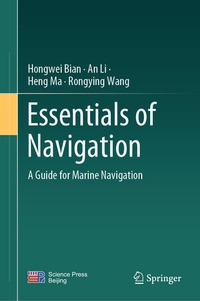
Essentials of Navigation
Description

This book gives a basic introduction to navigation, from key concepts, basic principles, main technologies, equipment systems to the knowledge frame of navigation. The ten chapters fall into three parts: Chapters I~III introduce the elementary knowledge of navigation; Chapters IV~IX are devoted to the basic principles, and the optimization principle of integrated navigation as well; and Chapter X discusses the application of marine navigation, indicating the basic outline of the marine navigation system. The book clearly reflects the systematic idea of navigation knowledge from multiple perspectives, which is helpful for readers to build a holistic understanding of navigation from the concept, principle, characteristics, technology to the equipment system. At the end of each chapter, reflections beyond the fundamental knowledge of navigation are included to help readers further develop their scientific thinking and general literacy. This book is written primarily for students majoring in navigation, and it may also be of interest to researchers and practitioners engaged in navigation.
More details
Other editions
Additional editions
Persons
Dr. Hongwei Bian received his M.E. degrees in Naval University of Engineering (NUE), Wuhan, China, in 1997 and D.E. degrees in Shanghai Jiao Tong University, Shanghai, China, in 2005.
He is currently a Professor of the School of Electrical Engineering, NUE. His research interests include inertial navigation, integrated navigation, information fusion and polar navigation. He has won one first prize of provincial level teaching achievement and four provincial level second prizes of scientific and technological progress. He has published 4 books including a national science academic monographs, 3 Professional teaching materials; and published more than 100 papers and owned 10 invention patents.
Prof. An Li, a domestic well-known Navigation Expert, received his M.E. degrees in Southeast University, Nanjing, China, in 2001. He is the standing director of China Institute of Navigation, standing director of China Association of Higher Education. His research interests include inertial navigation and gravimeter technology. He has won one National Third-class Invention Award, two first prize of provincial level teaching achievement and eight provincial level second prizes of scientific and technological progress. He has published more than 60 papers, 4 academic monographs. Dr. Heng Ma received his B.E. degree in Navigation Engineering and the Ph.D. degree in Navigation Guidance and Control from Naval University of Engineering, Wuhan, China, in 2000 and 2008, respectively. Since December 2008, he has been in Naval University of Engineering as Lecturer. He focuses on the research of inertial navigation technology and integrated navigation system and polar navigation.Dr. Rongying Wang received his B.E. degree in Navigation Engineering and the Ph.D. degree in Navigation Guidance and Control from Naval University of Engineering, Wuhan, China, in 2004 and 2011, respectively. Since June 2011, he has been in Naval University of Engineering as Lecturer. Dr. Wang focuses on the research of inertial navigation technology and integrated navigation system. His recent research interests include: polar navigation and virtual simulation training system, etc.
Content
Chapter 1 Introduction.- Chapter 2 Navigation Coordinate System.- Chapter 3 PNT Parameters.- Chapter 4 Direct Positioning.- Chapter 5 Direct Attitude Measurement.- Chapter 6 Velocity Measurement.- Chapter 7 Gimbaled Attitude Measurement.- Chapter 8 Inertial Navigation.- Chapter 9 Integrated Navigation.- Chapter 10 Integrated Bridge System.
