

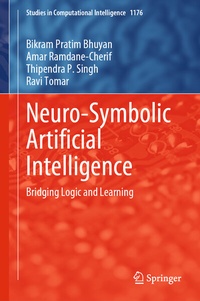
Neuro-Symbolic Artificial Intelligence
Description

This book highlights and attempts to fill a crucial gap in the existing literature by providing a comprehensive exploration of the emerging field of neuro-symbolic AI. It introduces the concept of neuro-symbolic AI, highlighting its fusion of symbolic reasoning and machine learning. The book covers symbolic AI and knowledge representation, neural networks and deep learning, neuro-symbolic integration approaches, reasoning and inference techniques, applications in healthcare and robotics, as well as challenges and future directions. By combining the power of symbolic logic and knowledge representation with the flexibility of neural networks, neuro-symbolic AI offers the potential for more interpretable and trustworthy AI systems. This book is a valuable resource for researchers, practitioners, and students interested in understanding and applying neuro-symbolic AI.
More details
Other editions
Additional editions
Persons
Dr. Bikram Pratim Bhuyan is an assistant professor (Senior Scale) at the University of Petroleum and Energy Studies in Dehradun, India. He is also a research scholar at the LISV Laboratory, Université Paris-Saclay, France. With over 7 years of teaching experience in the field, he brings a wealth of knowledge to his work. He has an additional 3 years of industrial experience, providing him with a well-rounded perspective on the subject matter. He has received various scholarships for his master's and Ph.D. studies, demonstrating his dedication and excellence in academia.
Dr. Amar Ramdane-Cherif received his Ph.D. from Pierre and Marie Curie University in Paris in 1998. In 2007, he obtained his HDR degree from University of Versailles. From 2000 to 2007, he was an associate professor at the University of Versailles and worked in PRISM Laboratory. Since 2008, he is a full professor at University of Versailles-Paris-Saclay wherein he works in the LISV laboratory. His research interests include ambient intelligence, semantic representation of knowledge, modeling of the ambient environment, multimodal interaction between person/machine and machine/ environment, system of fusion and fission of events, ambient assistance, software architecture, software quality, quality evaluation methods, functional and non-functional measurement of real-time, and reactive and software embedded systems.
Dr. Thipendra P Singh is currently positioned as a professor in the School of Computer Science & Technology, Bennett University, Greater Noida, NCR, India. He holds a Doctorate in Computer Science from Jamia Millia Islamia University, New Delhi. He is a senior member of IEEE and member of various other professional bodies including IEI, ACM, EAI, ISTE, IAENG, etc., and also on the editorial/reviewer panel of different journals. He is also on the board of studies of different Indian and abroad Universities.
Dr. Ravi Tomar is working as a senior architect at Persistent Systems, India. He is an experienced academician with a history in the higher education industry for a decade. He is skilled in Computer Networking, Stream processing, Python, Oracle Database, C++, Core Java, J2EE, RPA, and CorDApp. His research interests include Wireless Sensor Networks, Image Processing, Data Mining and Warehousing, Computer Networks, Big data technologies, and VANET.
Content
The Emergence of Neuro-Symbolic Artificial Intelligence.- Neuro-Symbolic AI: The Fusion of Symbolic Reasoning and Machine Learning.- Neuro-Symbolic AI: The Integration of Continuous Learning and Discrete Reasoning.- Knowledge Representation in Artificial Intelligence.- Rule-based Systems and Expert Systems.- Knowledge Graphs: Representation and Reasoning.- Feedforward Neural Networks and Backpropagation.- Convolution in Neural Networks.- Recurrent Neural Networks (RNNs): Capturing the Dynamics of Sequences.- Overview of Neuro-Symbolic Integration Frameworks.- Learning from Symbolic Knowledge for Neural Networks.- Neural Extraction of Symbolic Knowledge.- Graph Neural Networks in Neural-Symbolic Computing.- Rule-based Reasoning in Neural Networks.- Common Sense Reasoning for Neuro-Symbolic AI.- Explainable and Trustworthy AI with Neuro-Symbolic Approaches.- Neuro-Symbolic AI in various Domains.- Towards Artificial General Intelligence?.- Learning and Reasoning over Higher Ordered Geometrical Structures.- Key Takeaways from Neuro-Symbolic AI.
