

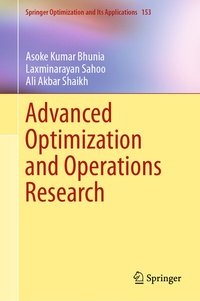
Advanced Optimization and Operations Research
Description

This textbook provides students with fundamentals and advanced concepts in optimization and operations research. It gives an overview of the historical perspective of operations research and explains its principal characteristics, tools, and applications. The wide range of topics covered includes convex and concave functions, simplex methods, post optimality analysis of linear programming problems, constrained and unconstrained optimization, game theory, queueing theory, and related topics. The text also elaborates on project management, including the importance of critical path analysis, PERT and CPM techniques. This textbook is ideal for any discipline with one or more courses in optimization and operations research; it may also provide a solid reference for researchers and practitioners in operations research.
More details
Other editions
Additional editions
Persons
ASOKE KUMAR BHUNIA is Professor at the Department of Mathematics, The University of Burdwan, West Bengal, India. He obtained his Ph.D. degree in Mathematics and M.Sc. in Applied Mathematics from Vidyasagar University, India. His research interests include computational optimization, soft computing, interval mathematics, and interval ranking. He has published over 125 research papers in various national and international journals of repute. He is a reviewer of several SCI journals. He has guided 13 Ph.D. and two M.Phil. students. An author of four research monographs and six book chapters, he is an INSA visiting fellow and former Associate Editor of the Springer's journal, OPSEARCH .
LAXMINARAYAN SAHOO is Assistant Professor at the Department of Mathematics, Raniganj Girls' College, West Bengal, India. He obtained his Ph.D. in Mathematics from The University of Burdwan and M.Sc. in Applied Mathematics from Vidyasagar University, India. His research interests include reliability optimization, computational optimization, artificial intelligence, soft computing, interval mathematics, interval ranking, and fuzzy mathematics. He has published several research papers in various national and international journals of repute. He has received MHRD fellowship from the Government of India and the Prof. M.N. Gopalan Award for the Best Ph.D. Thesis in Operations Research from the Operational Research Society of India.ALI AKBAR SHAIKH is Assistant Professor of Mathematics at The University of Burdwan, West Bengal, India. Earlier, he was a postdoctoral fellow at the School of Engineering and Sciences of Tecnológico de Monterrey, México. He has obtained the award SNI of level 1 (out of 0-3) presented by the National System of Researchers of México from the Government of México in the year 2017. He earned his Ph.D. and M.Phil. degrees in Mathematics from The University of Burdwan, and M.Sc. in Applied Mathematics from the University of Kalyani, India. Dr. Shaikh has published over 37 research papers in different international journals of repute. His research interests include inventory control, interval optimization, and particle swarm optimization.
